
For years, our relationship with AI was relatively simple: we asked questions, received answers, and then went somewhere else to act on the information. AI could explain a market move, summarize an asset, compare trading strategies, or help us understand a complex financial concept. But the actual decisions and actions still depended entirely on us.
That relationship is beginning to change. We are moving from AI that responds to instructions to AI agents that can work through tasks, connect to external tools, and take actions within the permissions they have been given. And in finance, that shift could be much bigger than simply making trading more convenient.
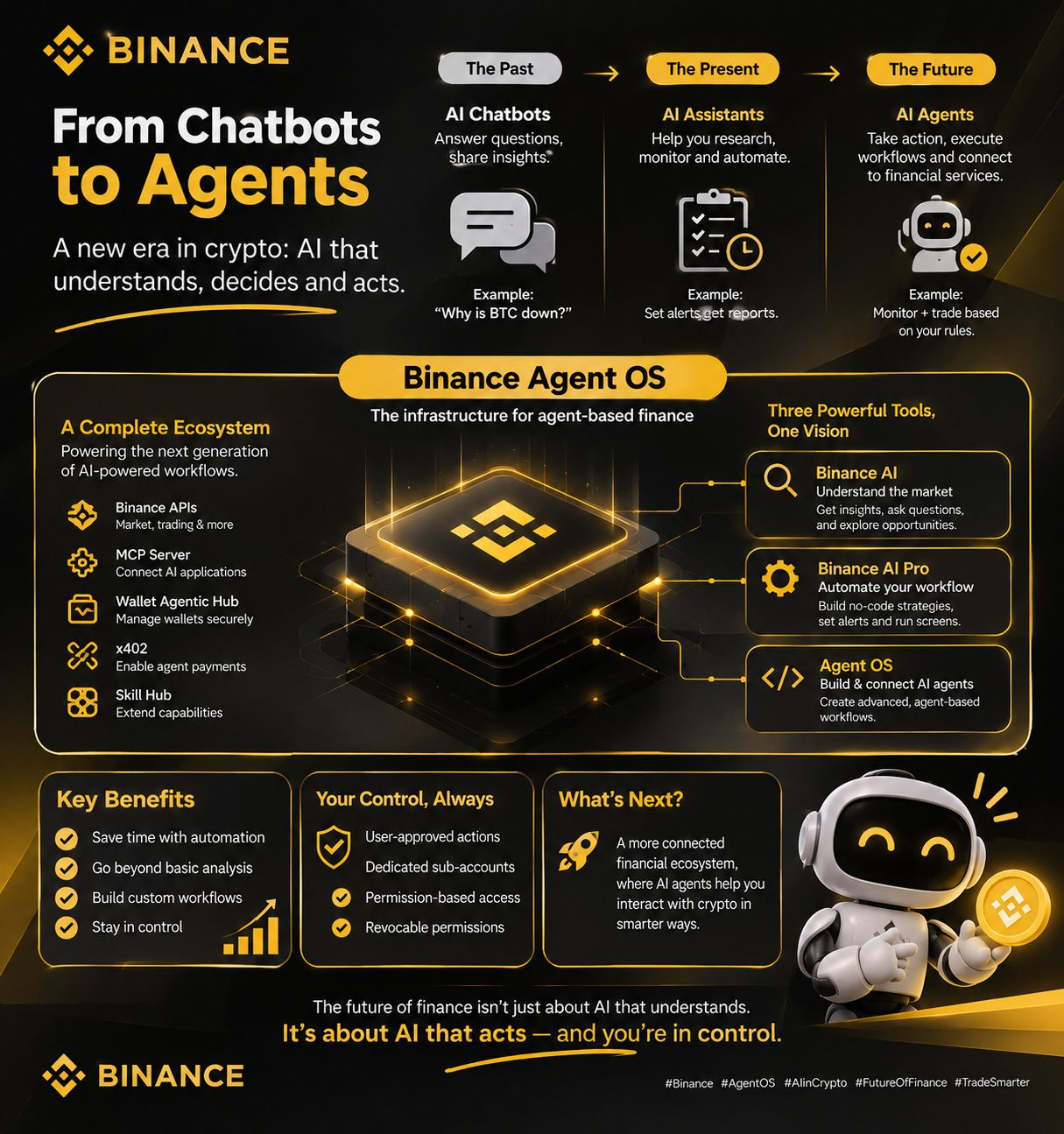
The difference between an AI chatbot and an AI agent
Think about a simple example. You ask an AI chatbot to check the price of Bitcoin, analyze its recent movement, and explain whether market conditions are changing. It can gather information, interpret it, and give you a response. But you still need to open your exchange, check your account, and decide what to do next.
An AI agent takes this further. With the right tools and authorization, it can retrieve market data, evaluate conditions, interact with connected financial services, and carry out supported actions as part of a larger workflow.
The important difference is not that one is necessarily smarter than the other. It is that an agent can connect reasoning with execution.
Instead of asking AI to tell you what happened, you can give it a task with a defined objective, the tools it is allowed to use, and the boundaries it must respect. It can then work through multiple steps rather than stopping after generating a response.
Of course, this does not mean that every AI agent is reliable, that every action should be automated, or that users should hand over control of their financial decisions. The infrastructure connecting an agent to financial services becomes just as important as the intelligence behind it.
Why crypto is a natural environment for agent-based workflows
Crypto markets operate around the clock. Prices move continuously, liquidity changes, funding rates fluctuate, and opportunities can appear across different markets at any hour.
For a human trader, monitoring everything manually can become exhausting. For developers and businesses, connecting different tools, APIs, wallets, and payment systems can also create unnecessary complexity.
This is where agent-based workflows become interesting. Imagine an agent that monitors selected trading pairs, checks market conditions against criteria you define, summarizes relevant changes, and notifies you when something requires attention. With appropriate permissions, a more advanced workflow could go further and place a supported order after evaluating the conditions and respecting the limits you established.
The same concept extends beyond trading. Agents could help businesses coordinate payment workflows, interact with wallets, retrieve on-chain information, or connect financial services to other applications.
The bigger opportunity is not simply automated trading. It is making financial infrastructure accessible to software that can coordinate tasks across different services.
Where Binance Agent OS fits into this evolution
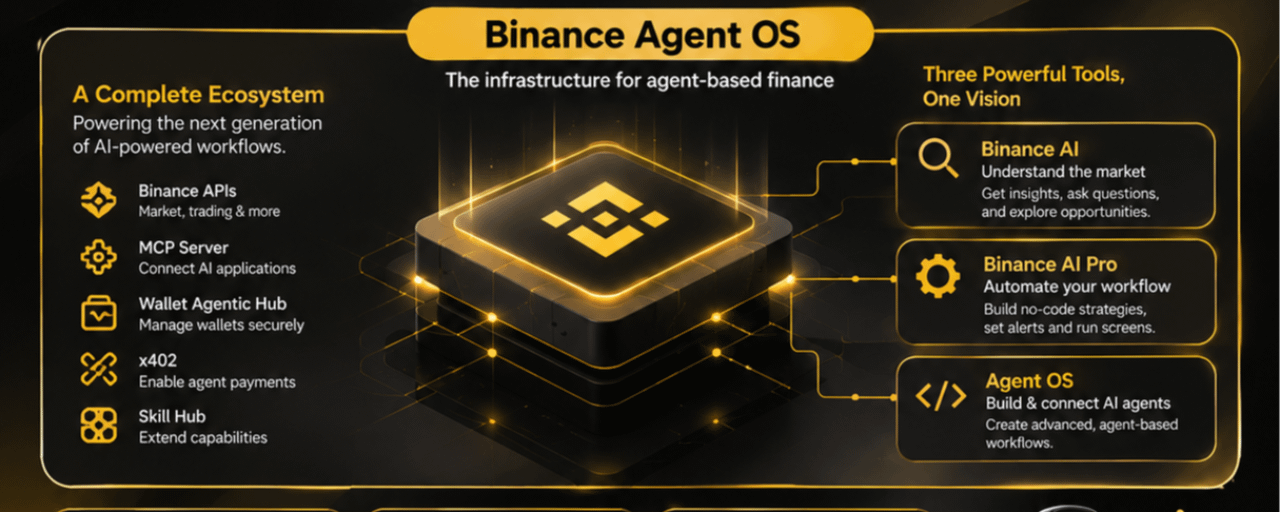
This is the direction behind <strong>Binance Agent OS</strong>, a developer platform built as part of Binance Intelligence.
Rather than being another chatbot, Agent OS provides a platform and toolkit that connects compatible AI applications and agents to supported Binance capabilities. It brings together several components, including Binance APIs, the Binance Wallet Agentic Hub, Binance x402, Binance Skill Hub, and support for the Model Context Protocol (MCP).
Each component addresses a different part of the ecosystem.
Binance APIs: Provide programmatic access to supported trading, market, wallet, and on-chain functions.
Binance MCP Server: Offers a standardized connection layer that allows compatible AI applications to discover and use supported Binance tools.
Binance Wallet Agentic Hub: Provides wallet capabilities designed for agent-driven interactions.
Binance x402: Provides payment and settlement infrastructure designed to support agent-driven payment flows.
Binance Skill Hub: Gives developers access to modular capabilities they can use when building agent workflows.
One distinction matters here: Agent OS is the broader platform and toolkit, while MCP is one of its connection layers. The integrated MCP server currently supports trading and market-data access. Other payment and on-chain capabilities can be integrated through additional Agent OS tools, APIs, and skills.
This matters because developers do not have to treat every connection as an isolated project. They have a more organized foundation for building applications that interact with financial services.
The real challenge: Giving agents the ability to act without giving up control
If an AI agent can interact with financial infrastructure, the next question is obvious: how do we make sure it only does what we actually authorize?
In finance, convenience cannot come at the expense of security. An agent that can access account information or place orders needs clear boundaries, limited permissions, and a way for the user to intervene.
Binance Agent OS approaches this through user-controlled permissions and a dedicated Agentic sub-account.
Users authorize the capabilities an agent can access, rather than giving it unrestricted control over their main account. Depending on the permissions granted, an agent can access market data, view authorized account information, or use supported trading functions. Access can also be revoked.
There are important safeguards worth understanding:
Dedicated account separation: Agent activity is handled through an Agentic sub-account isolated from the main account.
Permission-based access: Users decide which supported capabilities an agent can access.
No external withdrawal scope through MCP: The Binance MCP Server does not authorize agents to withdraw funds to external addresses.
Action review: Supported order-placement and transfer actions require users to carefully review the details before confirming submission.
Revocable access: Users can disconnect agents and revoke their permissions.
These controls are important, but they do not eliminate risk. An agent can misunderstand an instruction, make a poor decision, or execute an action that produces an unexpected result within the permissions it has been given. Users still need to understand what they are authorizing, limit the funds available to an agent, and monitor its activity.
Agent-based finance should not mean blind trust. It should mean controlled delegation.
From individual tools to connected financial workflows
What makes this development particularly interesting is the possibility of combining different capabilities into one workflow.
Consider a small business that needs to monitor incoming payments, reconcile transactions, and keep track of its financial activity. Today, those tasks may involve several separate applications and manual steps. An agent-based system could eventually coordinate more of that process through connected payment, wallet, and financial tools.
Or consider a developer building a portfolio-monitoring application. Instead of creating every exchange connection and data integration independently, the developer could use standardized tools to connect an AI agent to supported Binance capabilities.
These are examples of what the infrastructure makes possible, not a claim that every workflow is already available through one integration. The actual capabilities depend on the tools connected, the permissions granted, and the functionality supported at the time.
That distinction is important because the future of agentic finance will not be determined by how impressive an AI demonstration looks. It will depend on whether the infrastructure is reliable, secure, interoperable, and useful in real-world situations.
My experience: The moment AI moved from analysis to execution
I have been exploring Binance's AI ecosystem progressively, and Agent OS was the point where the difference became tangible.
After using Binance AI for research and Binance AI Pro for building and testing trading ideas, I wanted to see what would happen when an AI agent could actually interact with Binance.
I tested it by asking an agent to analyze the BNB/USDC 15-minute chart and open a 15x leveraged Futures position using 10 USDC. The agent executed the position. That was a very different experience from receiving a market analysis or a suggested strategy. I was seeing an AI agent interact with an exchange and carry out an action.
But the test also exposed something equally important. I encountered an issue with stop-loss and take-profit handling. It reminded me that successful execution involves more than connecting an AI model to an exchange. The instructions, permissions, execution logic, and reliability of the connection all matter.
I do not see this as a reason to dismiss the technology. I see it as a reminder of what needs to improve as these systems evolve. An agent needs more than the ability to act; it needs clear rules, dependable infrastructure, and meaningful safeguards.
What comes next for agent-based finance?
The longer-term opportunity goes beyond traders asking an AI to place orders.
As agent infrastructure develops, we could see applications where different agents specialize in different tasks: one monitors markets, another manages data, another coordinates payments, and another handles a defined operational workflow. These agents could interact with financial services and with one another, subject to the permissions and systems governing them.
For developers, this opens the door to building financial applications without having to create every integration from scratch. For businesses, it could reduce repetitive operational work. For individual users, it could make complex financial tools easier to access through natural-language instructions and delegated workflows.
But the foundation has to come first: standardized connections, secure authorization, reliable execution, transparency, and user control.
That is why I think Binance Agent OS is worth looking at as infrastructure rather than just another AI feature. Its significance is not limited to what one agent can do today. It is about creating a foundation on which developers can build a broader range of agent-powered financial experiences.
We spent the first phase of AI learning how to ask better questions. The next phase will be about deciding which tasks we can safely delegate, which permissions we are willing to grant, and how we remain in control while AI does more of the work.
The future of finance may not be AI replacing the user. It may be AI becoming the layer that helps the user interact with financial systems in entirely new ways.
#Binance #BinanceAgentOS #artificialintelligence #crypto #AgenticAI