
Updated October 28, 2026 | Binance Futures Referral Guide for 2027
Looking for a Binance Futures referral code in 2027 that can help reduce trading commissions?
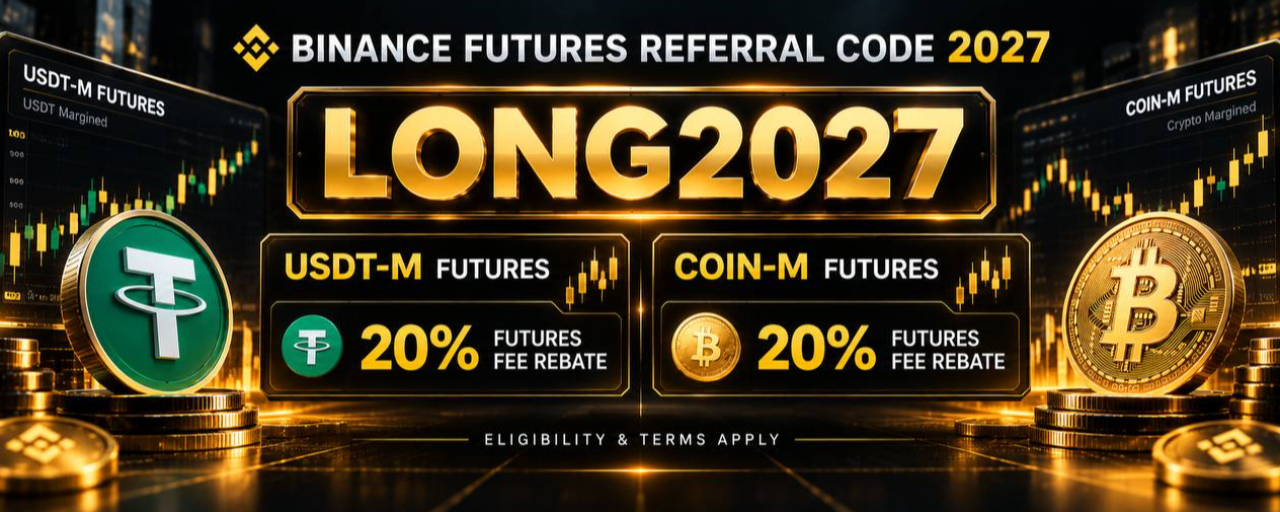
LONG2027 is a Binance referral code promoted as offering eligible new users a 20% trading fee rebate on Spot and a 20% rebate on Futures.
But before choosing a Futures referral code, there is an important distinction to understand.
Binance operates different types of cryptocurrency Futures contracts, including USDⓈ-M Futures and COIN-M Futures.
These products can have different margin currencies, settlement mechanisms, contract specifications, and fee calculations.
Does the LONG2027 referral code work with both types of Futures? How are rebates calculated? And how can traders verify whether a 20% commission benefit applies to their particular contracts?
This guide explains the differences between USDT-M and COIN-M Futures, how the Binance referral program works, and what traders should verify before opening a Futures account.
Quick Answer: What Is the Binance Futures Referral Code for 2027?
LONG2027 is promoted as a Binance referral code offering eligible users a 20% Futures trading fee rebate alongside a 20% Spot trading fee rebate.
Referral Code: LONG2027
Spot Trading Fee Rebate: 20%
Futures Trading Fee Rebate: 20%
Registration Link: https://www.binance.com/join?ref=LONG2027
Binance’s referral documentation supports commission-sharing arrangements involving both USDⓈ-M and COIN-M Futures.
However, not every referral offer necessarily provides identical benefits across every contract.
The exact rebate rate, eligible products, referral validity period, and regional restrictions must be confirmed through the user’s Binance account.
1. How Does a Binance Futures Referral Code Work?
A Binance Futures referral code connects an eligible user to a referral relationship when registering with Binance.
Under qualifying commission-sharing arrangements, the inviter may receive part of the trading commissions generated by the invited user.
The inviter can also share a portion of the eligible referral commission with the invited user as a fee rebate.
This mechanism differs from an ordinary promotional voucher.
A one-time trading fee voucher may cover qualifying fees until its value or validity expires.
A referral rebate, by contrast, is associated with qualifying trading activity and the applicable commission-sharing terms.
For LONG2027, the promoted benefit is a 20% rebate on eligible Futures trading fees.
The rebate percentage refers to qualifying commissions, not a 20% discount on the entire position value.
It also does not reduce trading losses, funding payments, or liquidation exposure by 20%.
1. What Are USDⓈ-M Futures on Binance?
USDⓈ-M Futures are contracts that use supported stablecoin-denominated margin and settlement arrangements.
Common examples include USDT-margined Futures and USDC-margined Futures.
For a typical BTCUSDT perpetual contract, trading commissions and profit or loss are calculated using the applicable USDT-denominated contract rules.
For a supported ETHUSDC contract, the corresponding stablecoin is USDC.
USDⓈ-M Futures are often useful to understand because their trading fees can be expressed directly in stablecoin terms.
Consider an illustrative BTCUSDT Futures position.
Executed position value: $10,000
Illustrative taker commission rate: 0.05%
Original trading commission: $5
Potential 20% referral rebate: $1
Effective commission after rebate: $4
This is a simplified example based on an assumed qualifying transaction.
Actual commission rates depend on the user’s fee tier, order execution, selected contract, and applicable promotions.
The example does not establish that every LONG2027 user will receive the rebate or that the same rate applies to all Futures products.
1. What Are COIN-M Futures on Binance?
COIN-M Futures are cryptocurrency-margined contracts.
Unlike typical USDT-margined Futures, COIN-M contracts can use the underlying cryptocurrency for margin, settlement, and the calculation of relevant account balances.
Examples include Bitcoin-margined and Ethereum-margined Futures contracts.
A BTCUSD COIN-M contract may use Bitcoin as its settlement asset.
An ETHUSD COIN-M contract may use Ethereum.
This creates an important difference in how trading costs are displayed.
Instead of paying a trading commission in USDT, an eligible COIN-M transaction may generate a fee denominated in the underlying cryptocurrency.
For example, a Bitcoin-margined Futures transaction could generate a commission expressed in BTC.
The USD-equivalent value of that commission changes with the market price of Bitcoin.
Understanding this distinction helps traders evaluate the actual economic value of any referral rebate.
1. Does the Binance Referral Program Include COIN-M Futures?
Yes, Binance has historically included COIN-M Futures in its Futures referral program.
Binance announced the addition of COIN-M Futures referral commissions in July 2020, including supported perpetual and quarterly contracts.
This established referral commission coverage beyond USDT-margined perpetual Futures.
However, historical inclusion in a referral program should not be confused with confirmation that every modern referral offer provides the same rebate percentage across all contract types.
For LONG2027, the promoted Futures rebate is 20% on qualifying commissions.
Eligible users should review the displayed referral conditions and verify whether their particular COIN-M contracts participate.
The appropriate distinction is between the platform’s general referral capabilities and the specific benefits attached to an individual referral relationship.
A promotional claim should always be checked against the actual account conditions.
1. USDT-M vs COIN-M Futures: What Changes for Trading Fees?
Both types of Futures can generate maker and taker commissions.
However, the contract structure affects how the fees are calculated and denominated.
With a typical USDT-margined Futures contract, the commission is associated with the executed notional value and the applicable fee rate.
For a COIN-M contract, the contract size, execution price, and coin-denominated notional value influence the commission calculation.
The underlying rebate concept is similar.
If a transaction generates a qualifying commission and the account has an applicable 20% referral rebate, the mathematical rebate is 20% of the eligible fee base.
The original commission and the effective commission after rebate are not necessarily displayed in the same location.
Referral distributions may be credited separately from execution fees.
It is therefore important to examine transaction records and rebate history rather than looking only at the initial commission field.
1. Example: Calculating a 20% Rebate on COIN-M Futures
Consider a hypothetical Bitcoin-margined Futures trade.
Assume an eligible transaction generates a trading commission of 0.00010000 BTC.
Original Futures commission: 0.00010000 BTC
Potential referral rebate at 20%: 0.00002000 BTC equivalent
Effective commission value after rebate: 0.00008000 BTC equivalent
The rebate calculation is straightforward when the qualifying fee is already known.
However, the settlement currency of an actual referral distribution may differ from the currency used to pay the original trading fee.
For example, Binance’s Referral Pro documentation describes USDC-based distribution arrangements for referral commissions and shared rebates.
Therefore, a BTC-denominated execution commission does not necessarily mean that the referral rebate will be distributed directly in BTC.
Conversion rules, settlement timing, and account conditions can affect how the rebate appears.
This distinction is particularly important for COIN-M traders who track portfolio balances in cryptocurrency units.
1. Maker and Taker Fees: Why Order Execution Matters
Binance Futures generally follows a maker-taker trading fee model.
A maker order adds liquidity to the order book.
A taker order removes available liquidity.
Market orders are normally classified as taker executions because they match against existing orders.
Limit orders can be maker or taker orders depending on whether they rest on the order book or execute immediately.
Maker and taker commission rates can differ.
For example, suppose a Futures account has an illustrative maker rate of 0.02% and a taker rate of 0.05%.
On a $20,000 transaction, the maker commission would be $4.
The taker commission would be $10.
A qualifying 20% referral rebate would represent $0.80 on the maker commission or $2 on the taker commission.
The rebate reduces the qualifying commission according to the applicable rules.
It does not change whether the order was executed as maker or taker.
A larger rebate amount on a more expensive transaction should not be mistaken for a better trading outcome.
Execution quality and total transaction cost matter more than the nominal cashback amount.
1. Can LONG2027 Be Combined With the BNB Futures Fee Discount?
Binance offers a BNB fee-payment discount for qualifying USDⓈ-M Futures transactions.
The published guidance describes a 10% discount on applicable standard USDⓈ-M trading commissions when the required BNB payment conditions are met.
This should not automatically be assumed to apply identically to COIN-M Futures.
It is also important to distinguish the BNB fee-payment discount from a referral rebate.
The BNB arrangement may affect the fee charged when the transaction is executed.
A referral rebate is determined by the applicable commission-sharing program.
A 10% BNB fee discount combined with a 20% referral rebate does not necessarily produce a simple 30% reduction in the original fee.
Depending on the rules and calculation sequence, the effective reduction may be different.
Check the final fee records and referral distributions instead of adding promotional percentages together.
1. How Does Leverage Affect Binance Futures Trading Fees?
Leverage is one of the most important considerations in Futures trading.
A trader may control a position whose notional value is much larger than the margin initially committed.
For example, a trader using $1,000 as margin might open a $10,000 position with 10x leverage, subject to applicable product limits.
Trading fees are generally calculated using the executed position value, not simply the initial margin.
Suppose the $10,000 transaction generates a commission of $5.
A qualifying 20% referral rebate would represent $1.
However, the trader’s market exposure remains $10,000.
The rebate does not reduce that exposure.
If the market moves against the position, losses can accumulate quickly relative to the margin committed.
Futures positions may be liquidated when margin requirements are no longer satisfied.
A referral rebate is a commission benefit, not a risk-management mechanism.
Using higher leverage solely to increase trading volume or referral rebates is not a rational fee-saving strategy.
1. Does LONG2027 Reduce Futures Funding Payments?
No trading commission rebate should automatically be interpreted as a reduction in perpetual Futures funding payments.
Funding mechanisms are used to help align perpetual Futures contract prices with their underlying reference markets.
Depending on the funding rate and position direction, traders may pay or receive funding at specified intervals.
These payments are separate from ordinary maker and taker execution commissions.
For example, a trader might save $2 through an eligible referral rebate but pay a larger amount in funding while maintaining a position.
The total economic cost of the trade could therefore exceed the commission savings.
COIN-M and USDⓈ-M perpetual contracts can both have funding arrangements, subject to the specific contract rules.
Quarterly delivery contracts operate differently from perpetual contracts and have their own settlement characteristics.
Always consider the entire cost structure before opening a position.
1. Does a 20% Futures Referral Rebate Last Forever?
Not necessarily.
This is an important distinction for anyone searching for a Binance Futures referral code in 2027.
Binance introduced changes to its Futures referral commission program in 2025.
Under the updated rules, certain referral relationships have a one-year Futures commission validity period.
Binance also provides a mechanism through which eligible inviters who achieve the required higher commission tier can have that time limitation waived.
The rebate shared with an invited user can depend on the inviter’s commission validity.
Therefore, a 20% Futures rebate should not automatically be described as lifetime cashback without confirming the specific referral relationship and its current terms.
The percentage and the duration are separate conditions.
A user may have an eligible 20% rate but still be subject to a time limitation.
LONG2027 users should verify both the displayed Futures rebate rate and any applicable expiration conditions.
1. Why Might Your Futures Referral Rebate Be Missing?
Several factors can explain why a trader does not see an expected Futures referral rebate.
First, the account may not have an eligible Referral Pro relationship.
Second, the selected contract or transaction may not qualify for the expected rebate.
Third, the underlying transaction may have generated no eligible trading commission.
Fourth, the account may have become subject to a restriction associated with VIP status, regional eligibility, or another program condition.
Fifth, the relevant Futures referral validity period may have expired.
Finally, rebate distributions may appear separately from the original transaction fee.
Binance updated its referral commission calculations in 2026 to use net fees after applicable market-maker rebates.
This means the eligible commission base may not always equal the original headline fee that a trader expects.
If your actual rebate appears different from the advertised percentage, examine the relevant transaction details and distribution history.
For a complete account-level verification guide, read:
Binance Referral Code 2027: How to Verify Your 20% Spot & Futures Rebate With LONG2027
https://www.binance.com/en/square/post/381417441423510
1. Can You Use LONG2027 for BTCUSDT and ETHUSDT Perpetual Futures?
LONG2027 is promoted as offering eligible users a 20% Futures trading fee rebate.
BTCUSDT and ETHUSDT perpetual contracts are examples of commonly recognized USDⓈ-M Futures products.
If a user’s account has an active qualifying Futures rebate arrangement and the relevant transaction generates an eligible commission, the rebate may reduce the effective trading fee.
However, eligibility is determined by actual program conditions.
The referral code alone does not guarantee that every BTCUSDT or ETHUSDT execution generates a rebate.
Special fee promotions, account tier restrictions, and other exclusions may affect the result.
Traders should verify the specific contract and commission arrangement before relying on the advertised benefit.
For a detailed comparison of Bitcoin and Ethereum transaction costs across Spot and Futures, see:
Binance Referral Code 2027 for Bitcoin & Ethereum: How LONG2027 Reduces BTC and ETH Trading Fees
https://www.binance.com/en/square/post/381841721228543
1. How to Register With Binance Futures Referral Code LONG2027
Eligible new users who want to evaluate LONG2027 can follow a straightforward registration process.
Step 1: Open the official Binance registration link.
https://www.binance.com/join?ref=LONG2027
Step 2: Confirm that the referral ID displays LONG2027.
Step 3: Review the advertised 20% Spot and 20% Futures rebate conditions.
Step 4: Check whether Binance Futures products are available in your country or region.
Step 5: Complete account registration and any required identity verification.
Step 6: Before opening a Futures account, review the referral relationship and applicable commission validity period.
Step 7: Compare the actual USDⓈ-M and COIN-M fee schedules for the contracts you intend to trade.
Step 8: After an eligible transaction, review the trading commission and any available rebate distribution records.
If the expected benefit is not displayed, do not assume that it has been applied.
Use Binance’s official account information or Support channels to clarify the available terms.
1. Can Existing Binance Users Add LONG2027?
Some existing Binance accounts without an established referral relationship may qualify for specific post-registration binding programs.
However, this is not equivalent to freely changing a referral code on an established account.
Binance has introduced separate options for eligible recently registered users and certain existing users.
These programs have different requirements involving account age, referral status, trading activity, and other conditions.
An account that already has an established referrer generally cannot simply replace that relationship.
For a full explanation of existing-user options, including post-registration binding, Affiliate Recall, and Affiliate Rebind, read:
Binance Referral Code After Sign-Up (2027): Can You Add LONG2027 Later?
https://www.binance.com/en/square/post/381737980857470
1. How Much Can Active Futures Traders Save?
The value of a referral rebate depends on the total qualifying trading commissions generated.
Consider a hypothetical trader who uses both USDⓈ-M and COIN-M Futures.
Monthly qualifying USDⓈ-M commissions: $120
Monthly qualifying COIN-M commissions, expressed in USD equivalent: $80
Total qualifying commissions: $200
Potential 20% referral rebate: $40
Effective commission cost after rebate: $160
This calculation assumes that the same 20% rate applies to both categories and all included commissions qualify.
It is an illustration, not a guarantee.
Actual rebates may vary because of contract eligibility, commission calculations, account restrictions, and the referral program’s validity period.
In addition, a trader’s total profitability depends on market results, spreads, slippage, and funding payments.
Trading more frequently simply to earn a larger rebate can increase both costs and risk.
1. Frequently Asked Questions About Binance Futures Referral Codes in 2027
What is the Binance Futures referral code for 2027?
LONG2027 is promoted as offering eligible new users a 20% rebate on qualifying Futures trading fees and a separate 20% Spot fee rebate. Actual benefits must be verified through Binance.
Does LONG2027 work for USDT-M Futures?
The code is intended to provide eligible Futures fee benefits. Users should confirm the rebate on their accounts and check whether their selected USDT-margined contracts qualify.
Does LONG2027 work for COIN-M Futures?
Binance has included COIN-M trading in its Futures referral program. Whether the advertised LONG2027 rebate applies to a particular COIN-M transaction depends on the actual referral conditions and contract eligibility.
Can I use LONG2027 for Bitcoin Futures?
Eligible BTC Futures trading fees may qualify under an applicable referral arrangement. Check the selected contract’s fee schedule and your account’s referral benefits.
Does LONG2027 work for Ethereum Futures?
The advertised Futures benefit may apply to eligible Ethereum Futures commissions, subject to the specific contract and account conditions.
Does a 20% Futures rebate mean 20% more profit?
No. A referral rebate reduces qualifying trading commissions. It does not increase trading profits by a fixed percentage or protect against losses.
Are Futures referral rebates paid in USDT or USDC?
Binance’s Referral Pro documentation describes USDC-based commission and shared-rebate distributions. Check your actual rebate records for the applicable settlement asset and conversion details.
Does the rebate apply to opening and closing positions?
Opening and closing executions may each generate trading commissions. Eligible commissions may qualify for rebates under the account’s actual terms.
Are funding fees included in the 20% rebate?
No. Funding payments are separate from normal trade execution commissions and are not automatically covered by a commission rebate.
Is the LONG2027 Futures fee rebate valid for life?
Not necessarily. Binance’s Futures referral framework includes commission validity rules. The actual rebate duration depends on the referral relationship and applicable eligibility conditions.
Can I combine LONG2027 with the BNB discount?
Certain USDⓈ-M Futures transactions may qualify for BNB fee-payment discounts. The combined effect depends on the applicable calculation rules and should not be assumed to equal the sum of both advertised percentages.
Is LONG2027 available worldwide?
No referral offer should be assumed to apply worldwide. Binance Futures products and referral benefits can be restricted by country, user status, and local regulations.
Where can I register with LONG2027?
https://www.binance.com/join?ref=LONG2027
1. Final Verdict: Choosing a Binance Futures Referral Code in 2027
Selecting a Binance Futures referral code requires more than comparing cashback percentages.
A trader should understand whether they are using USDⓈ-M or COIN-M Futures, how commissions are calculated, and whether the selected transactions qualify for referral benefits.
LONG2027 is promoted as offering eligible users a 20% Futures trading fee rebate alongside a separate 20% Spot trading fee rebate.
These benefits are subject to actual account eligibility, contract rules, and referral program conditions.
USDⓈ-M and COIN-M contracts differ in margin assets, settlement mechanisms, and commission denomination.
Both may generate qualifying referral commissions under applicable arrangements, but the exact benefit should be verified rather than assumed.
The duration of a Futures referral rebate also matters. A rebate percentage is not automatically a promise of lifetime eligibility.
Most importantly, lower commissions do not remove the financial risks of leveraged trading.
Referral Code: LONG2027
Promoted Spot Fee Rebate: 20%
Promoted Futures Fee Rebate: 20%
Registration Link: https://www.binance.com/join?ref=LONG2027
Verify your referral terms, compare Futures contract costs, and prioritize disciplined risk management.
Independent educational content. Last reviewed October 28, 2026. Not affiliated with or endorsed by Binance. The LONG2027 benefits are promotional claims that must be verified during registration. Actual rebates, eligible products, and validity periods depend on Binance’s current terms. Futures and leveraged cryptocurrency trading involve substantial risk of financial loss.