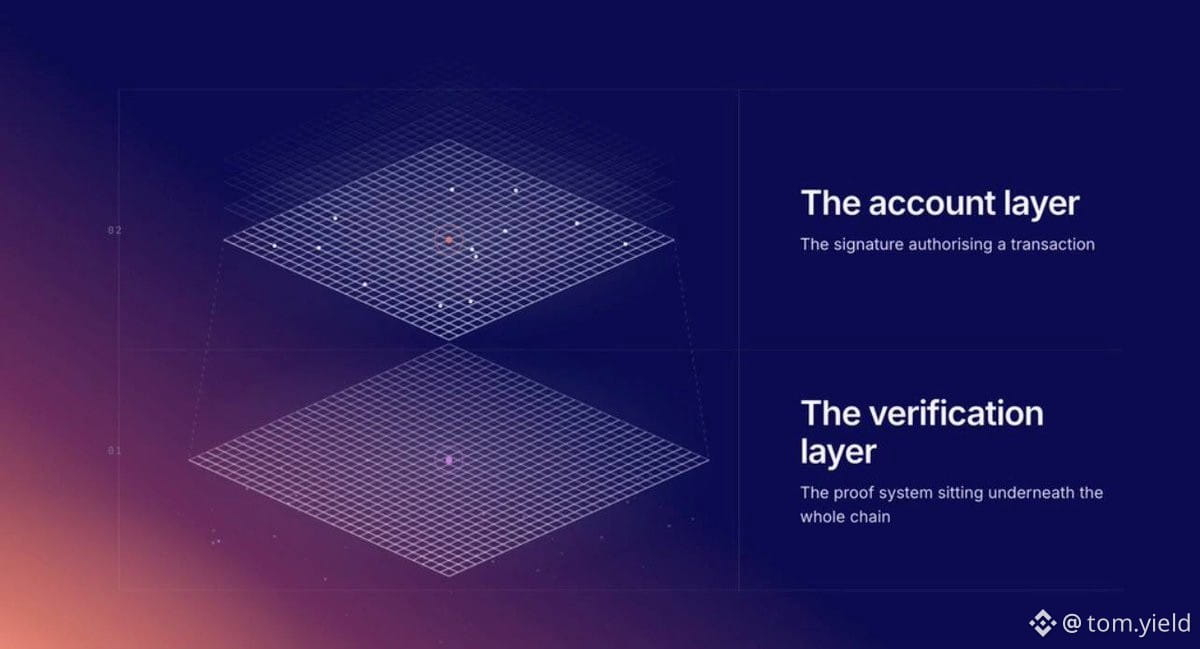
Most crypto debates obsess over which cryptography protects your bag. Almost nobody asks: what happens when that crypto needs to change?
Quantum computing + AI-accelerated math could break today's security. Not guessing when. Asking if networks can adapt when it matters.
$STRK caught my attention because of one thing: STARKs.
STARK proofs verify computation correctness using hash-based cryptography, not elliptic curves vulnerable to Shor's algorithm. That's a real quantum-resistant foundation.
But here's the unlock most miss:
Your signature = your lock. If that lock breaks, you want to swap it without tearing down the whole house.
Starknet's native account abstraction lets every account be a programmable smart contract. You can change signature methods at the account level. No network fork needed.
Not theory. Live progress as of Oct 2026:
✅ BLAKE2s-256 replaced Pedersen hashing in Starknet v0.14.3. Live on mainnet.
✅ Falcon-512 post-quantum signature sent 0.01 $STRK on mainnet. Experimental, unaudited, but functional.
Two different milestones. One's deployed core infrastructure. The other proves the account model works for quantum-safe signatures.
Starknet's still an Ethereum L2, so some dependencies (KZG commitments for blobs, bridging) lean on Ethereum's migration timeline. That's why they're exploring an independent L1: full control over security upgrades.
I'm not here to hype quantum FUD or claim problems are solved. But being able to change the lock without rebuilding the building?
That's architectural alpha most networks ignore.
StarkWare's Quantum Hub has receipts. Check the evidence yourself.