What if AI didn’t need a data center to make a decision?
Most AI conversations focus on larger models, more GPUs, and bigger infrastructure. But Acurast is exploring a different question: how much useful AI work can run on phones people already own?
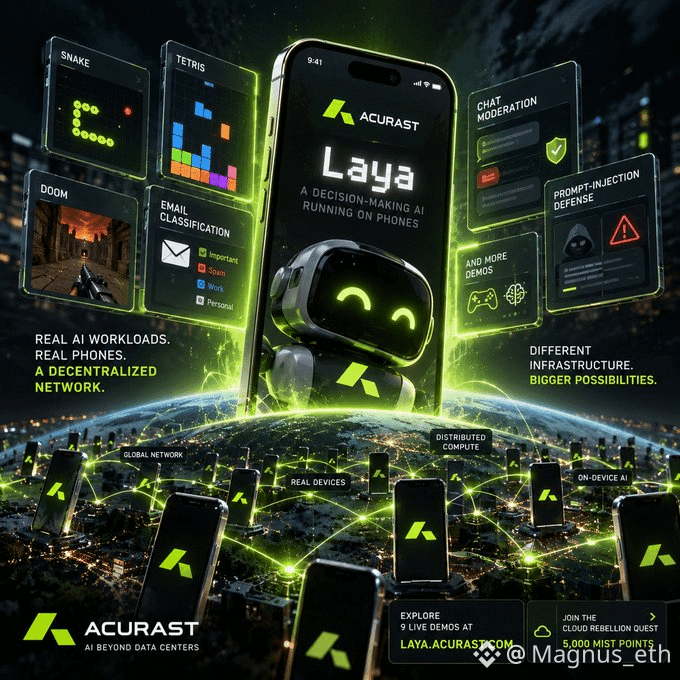
Meet Laya, a decision-making model running on Acurast’s decentralized smartphone network.
Its nine live demos go beyond gaming. Snake, Tetris, and Doom show how AI can choose actions, while email classification, chat moderation, and prompt-injection screening point toward practical software applications.
That distinction matters. Not every AI task needs a massive model generating paragraphs. Some tasks need fast, structured decisions and those may be suitable for smaller models running on everyday hardware.
Acurast’s approach connects these workloads to a distributed compute network rather than relying exclusively on centralized infrastructure. Of course, real-world adoption will still depend on accuracy, latency, reliability, and cost.
I think the interesting question isn’t whether a phone can run AI. It’s which useful AI workloads can a network of phones handle consistently at scale?
There’s also a Cloud Rebellion quest offering 5,000 MIST points for sharing your experience on X and submitting the post URL. MIST are campaign points, not the ACU token.
$ACU