


Silver’s latest decline has brought the metal to a level that could decide whether the selloff extends or buyers finally regain control. The silver price today has slipped below an important floor, and the pressures behind the fall stretch beyond the precious metals market.
October 23 has brought another difficult session for XAG after heavy losses during the previous trading day. The immediate concern is whether this breakdown holds, especially as energy prices and uncertainty over interest rates complicate the recovery picture.
Silver Falls Back Toward Critical Support
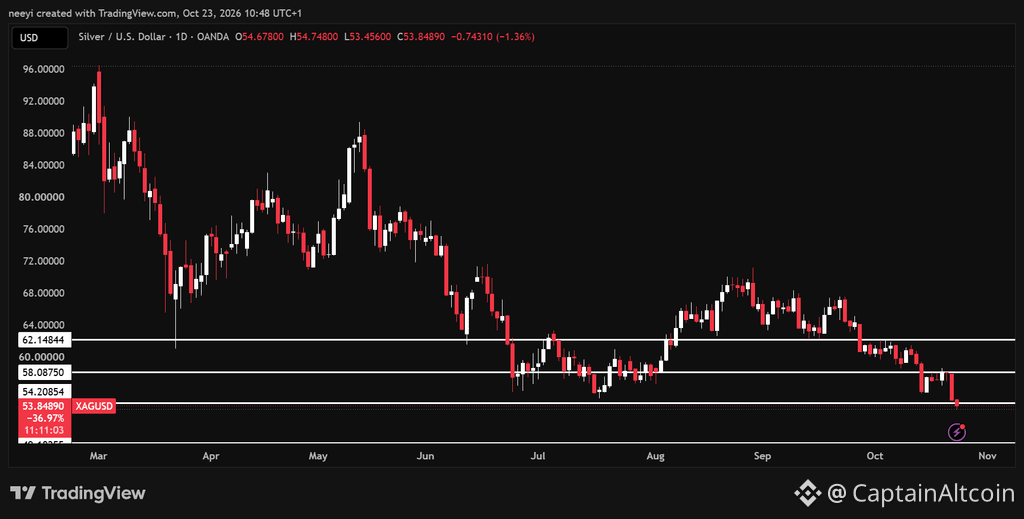
Silver traded below $54 on October 23 after a steep decline during the previous session. Historical XAG/USD data shows a fall of approximately 5.9% on October 22, followed by another move lower the next day. That puts the former $54 support area at the centre of the silver price outlook.
The technical setup supplied for this analysis describes lower highs and lower lows since August. Each unsuccessful rebound has left sellers in control, and the latest break extends that bearish structure.
A look at the silver chart setup shows why $54 matters. This area previously offered a floor, but a sustained move below it could turn the same level into resistance.
The distinction matters because a brief dip below support can reverse. Continued trading beneath it, followed by failed attempts to recover, would provide stronger evidence that the decline has further to run.
 XAGUSD Price Chart / TradingView.com What’s Driving The Silver Crash
Higher energy costs are an important part of the explanation. Brent crude climbed above $110 per barrel as attacks in Saudi Arabia increased concerns about energy supplies. More expensive oil creates fresh inflation risks because fuel costs feed into transport, production, and consumer prices.
Silver can benefit from demand for protection against inflation, but that relationship does not work automatically. Persistent inflation can also keep interest rates elevated, which makes an asset without interest payments less competitive.
The main pressures fall into 3 connected areas:
Energy And Inflation: Expensive oil could make inflation harder to control and delay relief from restrictive monetary policy.
Financial Market Stress: Heavy equity losses can create demand for cash and encourage investors to reduce other positions.
Industrial Demand Risks: Higher operating costs and expensive borrowing could weaken demand from manufacturers that use silver.
Technology shares have also suffered heavy losses. Reuters reported that the Nasdaq fell 2.6% on October 22 as concerns about AI spending weighed on major companies. Silver’s decline alongside equities makes broader portfolio reductions a plausible contributor, although simultaneous losses do not prove that investors sold metals to meet margin calls.
Silver’s industrial role creates another vulnerability. Electronics, manufacturing, and solar production provide sources of demand, but concerns about economic activity can weaken expectations for future consumption. This helps explain why silver may struggle even during periods of geopolitical uncertainty.
Why High Yields And The Dollar Are Hurting XAG
Interest rates matter because silver pays no interest. Investors can earn income from Treasury securities, so elevated bond yields increase the opportunity cost of holding the metal.
However, the latest market action requires a distinction. Treasury yields actually fell during the equity selloff as investors bought government bonds. Reuters reported that the benchmark 10 year yield dropped below 5% after its largest daily decline since March 2023.
The pressure therefore comes from yields that remain elevated, rather than an uninterrupted rise during today’s silver decline. Falling yields would normally provide some relief, but silver’s continued weakness indicates that this support has not overcome the broader selling pressure.
The dollar also affects XAG because silver is priced in the US currency. A firmer dollar makes the metal more expensive for buyers who use other currencies.
Currency moves have been mixed across different trading periods, so dollar strength should not carry the entire explanation. The stronger analytical case combines expensive energy, restrictive financing conditions, industrial concerns, and weakness across financial markets.
Can Buyers Defend The Recent Lows?
The first task for buyers is to prevent the break below $54 from developing into another sustained decline. A recovery above that level would reduce the immediate pressure, but a brief move higher would offer limited confirmation.
Silver needs to reclaim $54 and hold it as support during a subsequent pullback. That would show that buyers can defend a recovered level instead of simply producing a temporary rebound.
Failure to do so would leave the recent pattern intact. Sellers would retain control if recovery attempts repeatedly stop below the former floor.
The distinction between a bounce and a trend reversal is important here. Silver can recover for several sessions without ending the broader decline, particularly if it continues to form lower highs.
Silver Price Prediction For The Next Move
The supplied technical outlook favours further weakness unless silver repairs the breakdown. Continued trading below $54 would keep $50 to $49 in view over the coming days or weeks, although those levels remain conditional targets.
The main scenarios are:
Further Decline: Persistent weakness below $54 leaves $50 to $49 as the next downside area.
Deeper Breakdown: A sustained break below $49 could expose the $46 target.
Recovery Attempt: A successful reclaim of $54 could allow silver to challenge $58, followed by $62 if that resistance breaks.
Read Also: Here’s Why Gold and Silver Prices Are Getting Wrecked Right Now
The bearish case currently has the clearer technical foundation because the supplied structure still contains lower highs and lower lows. A stronger recovery would require both a reclaimed support level and a break above a previous rebound high.
Silver price today therefore faces a straightforward test around $54. Buyers need to recover that level before the discussion can move toward $58 and $62.
FAQs
Can silver hit $200?
Yes, silver can hit $200 per ounce, though it would require severe economic distress, major currency devaluations, or a systemic market shock.
How high will silver go in 2026?
Silver is trading around $57 to $64 per troy ounce as of late October 2026, with major financial institutions and analysts offering mixed forecasts for the remainder of the year:
Subscribe to our YouTube channel for daily crypto updates, market insights, and expert analysis.
The post Silver Price Today: Here’s Why Silver Is Crashing appeared first on CaptainAltcoin.