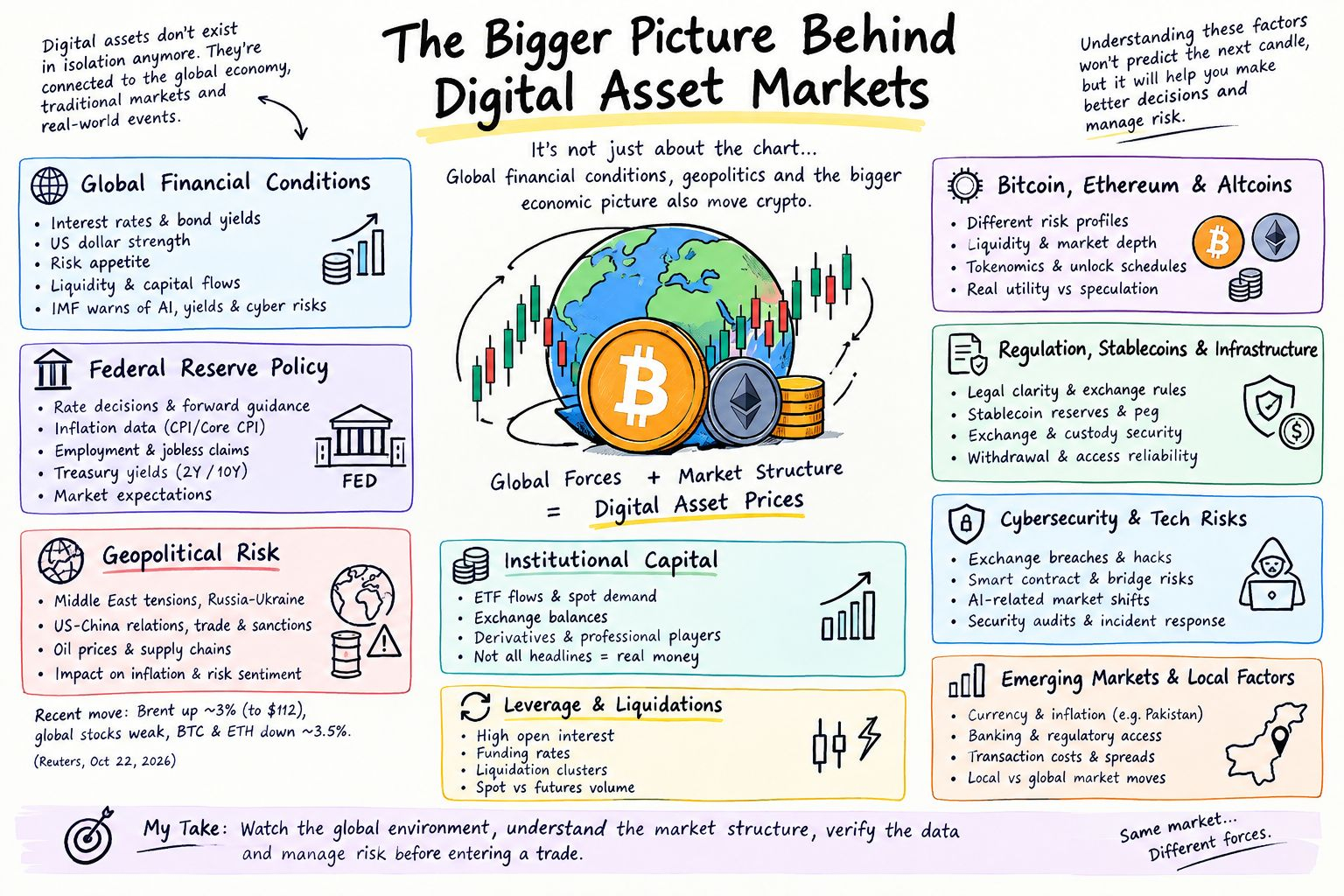

I have learned one thing from watching crypto markets: sometimes the chart tells you where the price is moving, but the global economy helps explain why.
When Bitcoin drops, people immediately start looking for support levels. When an altcoin pumps, everyone searches for the next target. But I think we sometimes miss the bigger picture by focusing too much on candles and not enough on the financial environment surrounding the market.
Digital assets don't exist in isolation anymore. Institutional investors, exchange-traded products, derivatives, stablecoins, global liquidity and macroeconomic expectations have created stronger connections between crypto and traditional financial markets.
That means a decision made by a central bank, an escalation in the Middle East, a sudden change in oil prices or a shift in government bond yields can influence the same market where traders are watching BTC, ETH and hundreds of altcoins.
While researching the current environment, I found several important factors worth examining.
1. Global Financial Conditions: The Foundation Behind Risk Appetite
Before trying to understand Bitcoin's next move, I would look at the broader financial environment.
Are borrowing costs rising? Is the US dollar strengthening? Are investors willing to take risks, or are they moving toward safer assets? Is capital becoming easier or more expensive to access?
These questions matter because financial conditions influence how much risk investors are prepared to accept.
When interest rates and bond yields rise, investors can earn more from relatively conventional financial instruments. That can make speculative assets less attractive, particularly when investors are uncertain about future returns.
When financial conditions ease, the opposite can happen. Investors may become more willing to allocate capital to equities, emerging markets and digital assets.
But there is an important distinction here: easier financial conditions do not automatically guarantee a crypto rally, and tighter conditions do not mean Bitcoin must fall every day.
Markets respond to expectations, positioning and new information, not just the headline interest rate.
The IMF's October 2026 Global Financial Stability Report highlights elevated financial stability risks despite resilience across many markets. It specifically identifies potential shocks involving AI-related valuations, sovereign bond yields and cyber threats. These risks could become more damaging if existing financial vulnerabilities amplify them.
That is an important reminder that a market can appear strong on the surface while remaining vulnerable underneath.
Source: IMF, October 2026 Global Financial Stability Report.
2. Federal Reserve Policy: Watch Expectations, Not Just Decisions
The Federal Reserve remains one of the most important institutions for global risk markets because US monetary policy influences borrowing costs, bond yields, the dollar and financial conditions internationally.
However, I would not build a trading thesis around a simple assumption such as rate cuts are bullish and rate hikes are bearish.
The reason behind a policy decision matters.
Imagine the Fed cuts interest rates because inflation is falling gradually while economic growth remains healthy. Investors might interpret that as a supportive environment for risk assets.
Now imagine the Fed cuts rates because the economy is deteriorating rapidly and unemployment is rising. The same rate cut could initially trigger fear rather than optimism.
The same principle applies to interest-rate increases.
A hike that investors have already anticipated may produce a limited reaction. An unexpected shift toward tighter policy, however, can force markets to reprice quickly.
For crypto traders, I would monitor:
Federal Reserve policy decisions and forward guidance.
US inflation data, particularly CPI and core CPI.
Employment figures and weekly jobless claims.
US Treasury yields, especially the two-year and ten-year maturities.
The US dollar's direction.
Market expectations for future interest rates.
The relationship between these indicators matters more than any single data release.
If inflation surprises to the upside while economic growth remains strong, the market may price in tighter monetary policy. That can pressure speculative assets.
If inflation cools without a serious deterioration in employment, the environment could become more supportive.
The key is to understand what the market expected before the announcement and how the actual result changes those expectations.
3. Geopolitical Risk: Why Conflicts Can Reach the Crypto Chart
Geopolitical developments are often treated as background news until they begin affecting oil prices, trade flows, inflation expectations and investor confidence.
That is when they become directly relevant to traders.
The Middle East is particularly important because disruptions to energy production or shipping routes can push oil prices higher. More expensive energy can increase transportation and production costs, potentially adding to inflationary pressure.
If inflation becomes more persistent, central banks may have less room to ease monetary policy.
That creates a chain reaction:
Geopolitical escalation can push energy prices higher. Higher energy prices can complicate the inflation outlook. Inflation concerns can influence bond yields and central-bank expectations. Those changes can affect risk appetite and digital asset prices.
Recent October market developments illustrate this connection.
On October 22, Reuters reported that Brent crude had risen nearly 3% to around $112 per barrel amid increased Middle East conflict risks. The same report described weakness across global equities and a decline of approximately 3.5% in both Bitcoin and Ether.
This does not establish that geopolitical tensions alone caused the crypto decline. It does show how geopolitical developments and movements across traditional markets can coincide with pressure on digital assets.
I would also monitor developments involving Russia and Ukraine, US-China relations, trade restrictions, sanctions and disruptions to critical shipping routes.
However, traders should avoid assuming that every geopolitical headline is automatically bearish for Bitcoin.
Sometimes markets sell off before an event because investors are reducing exposure. If the outcome is less severe than expected, prices may recover.
At other times, an apparently contained event can trigger a much larger reaction if it disrupts energy supplies or changes monetary-policy expectations.
The important question is not simply whether geopolitical risk is increasing. It is how that risk changes capital flows, liquidity and expectations.
4. Oil Prices, Inflation and the Cost of Capital
Oil deserves separate attention because it can connect geopolitical developments directly to monetary policy.
When energy prices rise sharply, the impact extends beyond petrol and transportation.
Businesses may face higher operating costs. Consumers may have less disposable income. Inflation expectations may increase, and central banks may become more cautious about easing policy.
For digital assets, the transmission mechanism is indirect but important.
Suppose oil prices remain elevated for an extended period.
Investors begin expecting inflation to stay higher. Bond yields rise, and markets reduce their expectations for interest-rate cuts. Capital becomes more selective, and leveraged investors may reduce exposure to volatile assets.
Under those conditions, altcoins with weak liquidity and speculative valuations may experience more severe declines than Bitcoin.
The opposite scenario is also possible.
If geopolitical tensions ease and energy prices fall, inflation concerns may moderate. That could improve the outlook for financial conditions.
But even then, crypto would still need sufficient demand to sustain a recovery.
I would therefore monitor oil alongside inflation expectations, Treasury yields, the dollar and spot demand rather than treating it as a standalone trading signal.
5. The US Dollar and Treasury Yields: Two Signals Worth Watching
The US dollar and government bond yields can provide useful context for crypto trading.
A stronger dollar can create tighter financial conditions for international borrowers and investors. It may also coincide with a broader preference for dollar-denominated assets.
Rising Treasury yields can increase the relative attractiveness of conventional fixed-income investments and raise the discount rates used to value financial assets.
However, these relationships are not mechanical.
Bitcoin can rise while the dollar strengthens, and yields can rise alongside equities when investors are responding to strong economic growth.
The reason behind the move matters.
For example, rising yields caused by healthy growth may produce a different market reaction from rising yields caused by inflation fears or concerns about government borrowing.
The IMF's October 2026 report identifies a sharp rise in sovereign bond yields as a potential catalyst for broader market turmoil.
That matters because a sudden repricing of government debt can affect multiple asset classes simultaneously.
My approach would be to examine the dollar, Treasury yields and Bitcoin together.
If the dollar strengthens, yields rise and BTC repeatedly fails to recover important resistance levels, I would become more cautious about assuming that a short-term bounce represents a sustainable reversal.
If yields stabilize, the dollar weakens and spot buying improves, the recovery case may become more convincing.
These are conditions to evaluate, not guaranteed trading signals.
6. Institutional Capital: Why ETF Flows and Spot Demand Matter
Another important development is the changing structure of the crypto market.
Bitcoin is no longer traded exclusively by retail participants using crypto-native exchanges. Institutional investors can gain exposure through regulated investment products, while professional firms can use derivatives, custody services and sophisticated trading strategies.
This creates additional sources of demand, but it also connects Bitcoin more closely to conventional portfolio decisions.
When institutions increase their exposure, the market can benefit from additional capital.
When they reduce risk across portfolios, digital assets can face selling pressure even when the underlying blockchain continues to operate normally.
That is why I would distinguish between three things:
Institutional interest: Whether investors are interested in gaining exposure.
Actual capital flows: Whether money is entering or leaving investment products and exchanges.
Sustainable spot demand: Whether buyers are absorbing available supply at prevailing prices.
These are not interchangeable.
.
Positive headlines about institutional adoption do not necessarily mean new capital is entering the market today.
Likewise, an increase in trading volume does not automatically mean buyers are accumulating.
For Bitcoin, I would examine spot-market volume, exchange-traded product flows, exchange balances and the relationship between spot demand and derivatives activity.
For altcoins, I would be even more careful because institutional demand for Bitcoin does not automatically translate into equivalent demand for smaller tokens.
A market can have a compelling long-term adoption story and still experience significant short-term selling pressure.
7. Leverage and Liquidations: When a Small Move Becomes a Large One
This is where crypto's internal market structure becomes especially important.
A price decline caused by macroeconomic uncertainty can become more severe when too many traders are positioned in the same direction.
Consider a market where open interest is elevated, leveraged longs are crowded and traders are paying positive funding rates.
If Bitcoin begins falling, some positions may be liquidated automatically.
Those liquidations can add selling pressure, pushing prices lower and triggering further liquidations.
The result is a feedback loop.
The same mechanism can operate in the opposite direction when crowded short positions are forced to close during a rally.
This is why I never consider a large liquidation figure sufficient evidence that the market has reached a bottom or a top.
Liquidations tell us something about positioning and forced exits. They do not independently establish what price will do next.
Before taking a trade, I would examine:
Open interest relative to recent price movements.
Funding rates across major exchanges.
Spot volume compared with perpetual futures volume.
Long and short liquidation concentrations.
Liquidity clusters around important price levels.
Whether a breakout is supported by actual spot buying.
A rising price accompanied by increasing spot demand can tell a different story from a rising price driven mainly by leveraged positions.
Similarly, falling open interest during a price decline may indicate that leverage is being removed from the market, but it does not prove that selling pressure has ended.
For me, the key question is whether the market is building a sustainable position or simply creating the conditions for another liquidation event.
8. Bitcoin, Ethereum and Altcoins Do Not Carry the Same Risk
One mistake I see in market discussions is treating every digital asset as if it responds to global developments in the same way.
Bitcoin has a larger market presence, deeper liquidity than most altcoins and substantial institutional participation.
Ethereum has its own demand drivers, including network activity, staking, decentralized finance and its role in blockchain infrastructure.
Smaller altcoins may depend much more heavily on speculative demand, exchange liquidity, token unlock schedules and the activity of a relatively small group of holders.
During periods of uncertainty, investors may reduce exposure to smaller tokens first because they can be harder to exit without moving the price.
This can lead to a situation in which Bitcoin declines moderately while some altcoins lose a much larger percentage of their value.
The reverse can happen during strong risk-on periods, when capital rotates into higher-risk assets.
But I would not assume that every altcoin will eventually catch up with Bitcoin.
Some projects have weak demand, excessive token emissions, concentrated ownership or limited utility. Others may face declining activity regardless of what the wider market does.
A falling token price is not automatically a buying opportunity.
Before considering an altcoin, I would assess its market structure, circulating supply, upcoming unlocks, liquidity, development activity and the actual demand for its product.
A strong narrative cannot compensate indefinitely for a weak economic model.
9. Token Unlocks and Supply Pressure: The Risk Hidden Behind a Good Story
Tokenomics deserves particular attention because a project's market price can struggle even when its technology and ecosystem are developing.
Suppose a token has a relatively small circulating supply but a much larger maximum supply.
If substantial allocations are scheduled to unlock, the market needs to absorb the additional tokens entering circulation.
An unlock does not mean that every token will immediately be sold. Some tokens may remain locked in staking, be retained by recipients or serve operational purposes.
However, the possibility of additional selling pressure matters, especially when liquidity is limited.
I would investigate:
The next scheduled unlock date.
The percentage of circulating supply being unlocked.
The recipients of the unlocked allocation.
The difference between circulating supply and fully diluted valuation.
Daily spot volume and available market depth.
Whether the project has meaningful organic demand.
The relationship between new supply and available demand is more important than the unlock headline alone.
A large unlock can be absorbed if demand is strong. A smaller unlock can still affect price if liquidity is thin and holders are already looking to exit.
This is also why I would avoid buying a token solely because it is trading near its all-time low.
A low price does not tell us whether a token is undervalued. Supply dynamics, demand, liquidity and the project's long-term prospects still matter.
10. Regulation, Stablecoins and the Reliability of Market Infrastructure
Digital assets also depend on legal and operational infrastructure.
Regulatory decisions can influence which products exchanges list, how institutions access crypto markets, how stablecoins operate and whether tokenized assets can be used in conventional financial transactions.
Clear rules can encourage participation by institutions that require legal certainty and established compliance procedures.
Uncertainty, enforcement actions or restrictions can have the opposite effect.
Stablecoins deserve special attention because they play a central role in crypto trading and decentralized finance.
Traders use them to move between positions, provide liquidity and settle transactions. Their reliability therefore affects more than the individual stablecoin holder.
Important questions include whether reserves are adequate, whether redemptions remain available under stress, how concentrated the issuer's banking relationships are and whether the token maintains its intended peg during periods of volatility.
A stablecoin trading slightly below its intended value does not automatically indicate a systemic crisis. However, persistent depegging, redemption problems or uncertainty about reserves can undermine confidence and disrupt liquidity.
The same principle applies to exchanges and custodians.
An exchange may report substantial trading volume, but traders should still consider custody arrangements, withdrawal reliability, operational resilience and counterparty exposure.
The ability to enter a position is only one part of trading. The ability to exit and access funds when needed is equally important.
11. Cybersecurity and Technology Risks: Adoption Creates New Dependencies
As financial services become more digital, cyber risk becomes increasingly relevant.
Crypto markets face exchange breaches, compromised private keys, smart-contract vulnerabilities, bridge exploits, oracle failures and phishing attacks.
These risks can affect individual projects, but interconnected systems can also transmit problems across protocols and liquidity pools.
For example, a vulnerability in a widely used protocol may affect other applications that depend on it.
A bridge exploit may disrupt access to assets represented across different networks.
A compromised exchange can create uncertainty about customer funds and trigger withdrawals elsewhere.
The IMF's October 2026 financial stability assessment identifies increasingly sophisticated cyber threats as a growing risk to the financial system.
This is particularly relevant as tokenization and decentralized finance create new connections between technology infrastructure and conventional finance.
The long term potential of blockchain technology does not eliminate operational risk.
Before investing in a project, I would examine its security history, audits, upgrade permissions, validator concentration, dependence on external infrastructure and incident-response procedures.
An audit is useful evidence, but it is not a guarantee that a protocol is secure.
12. Artificial Intelligence and the Broader Technology Trade
Another factor worth monitoring is the relationship between digital assets and the wider technology sector.
AI related investment has become an important theme in global markets. If investor expectations about AI profitability change sharply, technology stocks and related financial assets could face a repricing.
The IMF has identified a potential AI-driven market correction as one of the risks facing global financial stability.
How would that affect crypto?
The impact would depend on the source and scale of the correction.
If investors simply rotate between technology sectors, crypto may experience a limited reaction.
If a broader repricing triggers reduced risk-taking, tighter financial conditions or forced selling across leveraged portfolios, digital assets could come under additional pressure.
At the same time, blockchain projects connected to AI agents, decentralized computing and digital payments may have their own adoption drivers.
I would separate those long-term technological developments from short-term token-price speculation.
A project can benefit from a growing industry without its token necessarily capturing that value.
The important questions are whether the product is being used, whether demand is measurable and whether the token has a credible economic role in the ecosystem.
13. Liquidity Is More Than Trading Volume
One of the most overlooked aspects of crypto trading is the difference between reported volume and genuine market depth.
A token may show impressive daily volume while still experiencing substantial slippage when a large order enters the market.
Market depth determines how much buying or selling pressure the order book can absorb before prices move significantly.
During periods of uncertainty, liquidity providers may reduce their exposure or widen spreads.
This can make price movements more violent, particularly in smaller tokens and derivatives markets.
I would examine order book depth, bid-ask spreads, execution quality and the distribution of liquidity across exchanges.
I would also distinguish between spot liquidity and derivatives liquidity.
A market with heavy futures activity but relatively weak spot demand can be vulnerable to sharp reversals when leveraged positioning changes.
For traders, this has a practical consequence: the entry price shown on a chart may not be the price at which a large position can be executed.
The same applies when exiting during a fast market.
Risk management must account for slippage, not just the distance between entry and stop loss levels.
14. What About Emerging Markets and Pakistan?
For traders in emerging economies, global crypto developments can interact with local financial conditions.
Currency movements, inflation, access to foreign exchange, banking restrictions and domestic regulation can influence how people access digital assets.
However, local currency weakness does not automatically mean a cryptocurrency will outperform in local currency terms.
A token can decline substantially in dollar terms while the local currency also depreciates.
The final result depends on both movements, as well as transaction costs, spreads and the conversion rate available to the trader.
For anyone trading from Pakistan, I would distinguish between global crypto-market risk and local access or regulatory risk.
Before using an exchange or moving funds, it is important to verify the current legal and regulatory position through relevant official sources. Platform availability does not, by itself, establish that every activity is legally permitted or protected.
I would also consider counterparty risk, withdrawal options, payment channels and the potential impact of sudden changes in access to financial services.
These are practical issues, not just macroeconomic theory.
A profitable position on a screen is not the same as a successfully realized and accessible profit.
15. How I Would Read the Current Market Environment
Putting these factors together, I would avoid building a market outlook around a single headline.
Instead, I would monitor three broad scenarios.
Scenario A: Financial conditions improve
Inflation moderates, bond yields stabilize, the dollar weakens and geopolitical tensions ease.
If spot demand strengthens alongside these developments, Bitcoin may have a more supportive environment. Altcoins could also benefit, although the degree of participation would depend on their individual fundamentals and liquidity.
Confirmation would still be necessary. Better macroeconomic conditions alone do not guarantee an immediate rally.
Scenario B: Uncertainty remains elevated
Oil prices stay high, central-bank expectations fluctuate and investors remain selective.
Under these conditions, Bitcoin could trade within a volatile range while individual tokens move sharply in response to their own news, unlocks and liquidity conditions.
This would be an environment where patience and position sizing matter more than predicting every short-term move.
Scenario C: Risk aversion intensifies
Geopolitical tensions escalate, inflation expectations rise, bond yields jump or a significant financial or cybersecurity shock occurs.
Investors may reduce exposure to speculative assets. Leveraged positions could unwind, and thinly traded altcoins could experience disproportionate losses.
In this scenario, I would pay close attention to liquidity, leverage and whether Bitcoin can maintain important market-structure levels.
I would not assume that a sharp decline automatically creates a bottom.
The market would need to demonstrate that selling pressure is easing and buyers are returning.
These scenarios are analytical frameworks, not price forecasts. The available evidence does not establish which one must occur next.
16. My Final Take: Understand the Environment Before Predicting the Price
The more I examine digital asset markets, the more I think that successful trading requires two separate skills.
The first is understanding the asset itself: its fundamentals, tokenomics, liquidity, technical structure and demand.
The second is understanding the environment in which that asset is trading.
A technically bullish chart can fail when a major macroeconomic shock changes market sentiment.
A fundamentally strong project can experience a prolonged decline when supply exceeds demand.
A positive geopolitical development can produce only a short-lived rally if investors are still concerned about interest rates or liquidity.
And a market that looks extremely bearish can recover quickly when positioning becomes crowded and new information changes expectations.
None of these possibilities can be evaluated properly by looking at a single indicator.
I would rather combine macroeconomic data, geopolitical developments, spot demand, derivatives positioning and project-specific fundamentals than rely on a confident prediction from one analyst.
My approach is simple: watch the global environment, understand the market structure, verify the data and manage risk before entering a trade.
Because the biggest mistake in crypto is not always buying the wrong token.
Sometimes it is buying the right asset at the wrong time, with too much leverage, while ignoring the forces that are moving the entire market.
#TeslaSlides5%PreMarket #ChinaSeeksToSeize61800BTC #BitcoinETFsPullIn$1.08BInThreeDays #BTC走势分析 #Binance