

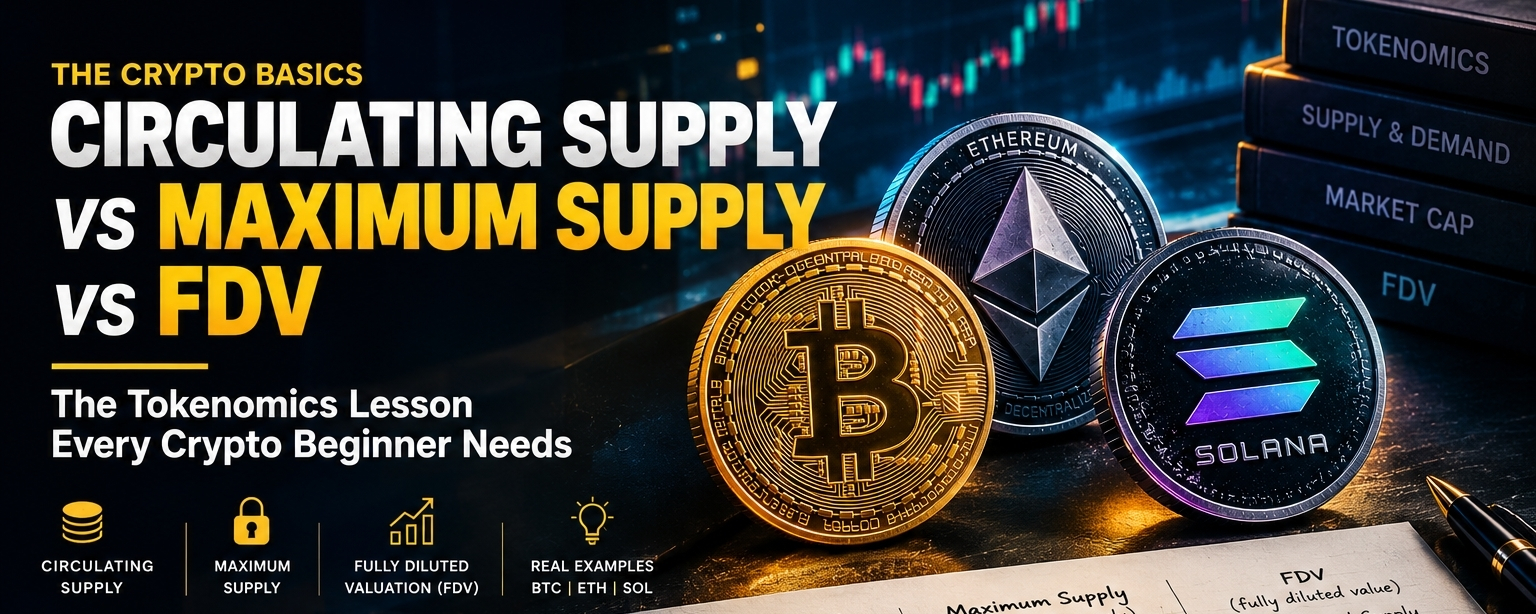

A coin’s price tells you what one token costs. It doesn’t tell you how the entire project is valued.
Imagine two cryptocurrencies:
- Coin A: $10 per token, with 10 million tokens circulating.
- Coin B: $1 per token, with 500 million tokens circulating.
At first glance, Coin B looks cheaper. But is it really the smaller or more undervalued project?
Let’s break down the numbers.
🔹 1. Circulating Supply: How Many Tokens Are Out There?
Circulating supply refers to the coins or tokens currently considered available in the market.
The formula for market capitalization is:
Market Cap = Token Price × Circulating Supply
For example:

- Bitcoin ($BTC BTC): Has a maximum supply of 21 million BTC, with new coins gradually entering circulation through mining.
- Ethereum (ETH): Has no fixed maximum supply; its supply changes through issuance and the burning of ETH.
- Solana (SOL): Has a supply model that includes ongoing issuance, rather than Bitcoin’s fixed 21-million-coin cap.
These differences matter because the number of tokens in circulation affects how a project’s market capitalization is calculated.
🔹 2. Maximum Supply: Is There a Limit?
Maximum supply is the largest number of tokens that can ever exist under a cryptocurrency’s current protocol rules, where a fixed cap applies.
Bitcoin is the classic example: its maximum supply is 21 million BTC.
Ethereum, on the other hand, has no fixed maximum supply. Its issuance and ETH-burning mechanisms influence whether its overall supply increases or decreases over time.
Here is the important distinction: a capped supply does not automatically make a cryptocurrency valuable, and an uncapped supply does not automatically make it worthless. Demand, utility, distribution, and the economic design of the network also matter.
🔹 3. Fully Diluted Valuation (FDV): What If More Tokens Entered Circulation?
Fully diluted valuation estimates a token’s valuation using its price and the applicable maximum supply—or another defined fully diluted supply figure when no maximum exists.
A simplified formula is:
FDV = Token Price × Assumed Fully Diluted Supply
Consider a hypothetical cryptocurrency:
- Current price: $2
- Circulating supply: 100 million tokens
- Assumed fully diluted supply: 1 billion tokens
Its market capitalization would be $200 million, while its simplified FDV would be $2 billion.
That gap tells us something important: the circulating supply represents only a fraction of the supply used in the FDV calculation.
It does not mean the project is definitely overvalued. It means you need to investigate token unlocks, issuance schedules, distribution, demand, and how the fully diluted figure is defined.
🔹 4. Real Crypto Examples: BTC, ETH and SOL
Bitcoin (BTC)
Bitcoin’s 21-million maximum supply makes its supply ceiling relatively straightforward to understand. However, scarcity alone does not guarantee rising prices; demand and market conditions still matter.

Ethereum has no fixed maximum supply. New ETH issuance and ETH burned through network activity work in opposite directions, so net supply changes over time.
Solana (SOL)
Solana’s supply model includes ongoing issuance. When studying SOL tokenomics, it is useful to examine circulating supply, issuance, staking-related factors, and how the supply available to the market may change.
These three assets demonstrate why a single supply metric cannot explain an entire cryptocurrency’s economics.
🔹 5. The Hidden Risk: Supply Dilution
Suppose a project has 100 million tokens circulating today, but additional tokens are scheduled to become available later.
Those new tokens may increase the circulating supply. If demand does not keep pace, the additional supply can create downward pressure on price.
However, token unlocks do not automatically cause a price decline. The effect depends on factors such as market expectations, who receives the tokens, whether they sell, and the level of demand.
This is why token unlock schedules and distribution deserve attention alongside price charts.
🔹 6. A Simple Tokenomics Checklist
Before forming an opinion about any cryptocurrency, ask:
✅ What is its circulating supply?
✅ Does it have a maximum supply?
✅ How is new supply created, and can tokens be burned?
✅ Is a significant amount of supply still locked or scheduled to unlock?
✅ How does its market capitalization compare with its FDV?
✅ Does the project have meaningful utility and demand to support its valuation?
Remember: these metrics help you understand a project; they do not predict its future price with certainty.
🧠 The Rational Takeaway
A low token price does not automatically mean a cryptocurrency is cheap. A high market capitalization does not automatically mean it is overpriced. And a large gap between market cap and FDV is a reason to investigate—not an automatic buy or sell signal.
The better question is not “How much does one coin cost?” but “What am I actually valuing, and how might its supply change?”
💬 Discussion question: If you had to choose just one metric to investigate first—market cap, circulating supply, or FDV—which would it be, and why?
Share your reasoning in the comments. Let’s learn to analyze before we assume.
---
Disclaimer: This article is for educational purposes only and is not financial advice or a recommendation to buy or sell any cryptocurrency. Crypto assets are volatile, token supply figures and methodologies can change, and no metric guarantees future performance.
#TheRationalCryptoMind #CryptoEducation #Tokenomics #Bitcoin #Ethereum #Solana #CryptoBasics #LearnAnalyzeGrow