

An on-chain look at whale positioning, spot demand, exchange supply, and what could determine Bitcoin's next major move.
Bitcoin has started showing signs of recovery, but there's something in the on-chain data that makes me cautious about calling this a proper trend reversal.
It's not that buyers have disappeared. They haven't.
The issue is that the buying isn't coming from enough different parts of the market.
I've been looking at Bitcoin's 60-day accumulation data, and one thing stands out: some large holders are still increasing their exposure, while others are reducing theirs.
That difference matters more to me than a few strong daily candles.
A market can recover temporarily with limited buying participation. Sustaining that recovery is a different challenge.
The whale activity isn't as bullish as it first appears
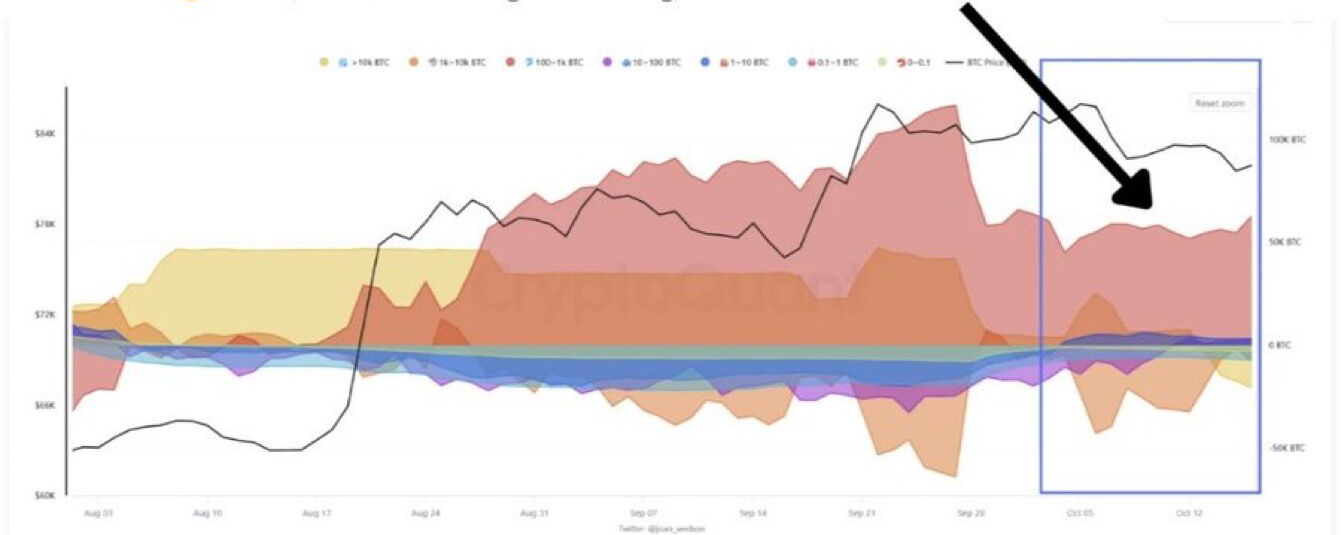
The most interesting part of the accumulation chart is the difference between wallet sizes.
Addresses holding 100–1,000 BTC remain net accumulators, although their accumulation has slowed compared with late September.
The 1,000–10,000 BTC group is moving closer to neutral after reducing holdings.
But wallets holding more than 10,000 BTC are still showing net declines.
This tells me Bitcoin has meaningful buyers, but accumulation hasn't become broad-based.
And there's an important distinction here.
If medium-sized holders keep buying while the largest holders distribute, the market can still move higher. But those buyers must absorb enough available supply to prevent selling pressure from overwhelming the recovery.
What concerns me isn't simply that some whales are reducing exposure.
It's that the strongest accumulation hasn't spread across the larger holder groups yet.
I would become more constructive if the 1,000–10,000 BTC cohort returned to net accumulation while the 100–1,000 BTC group continued adding.
That would suggest demand is strengthening across more than one segment of the market.
One limitation worth remembering: wallet balance changes don't always represent outright buying or selling. Custody movements and transfers between addresses can influence these readings.
So I use cohort data to understand positioning, not as a standalone trading decision.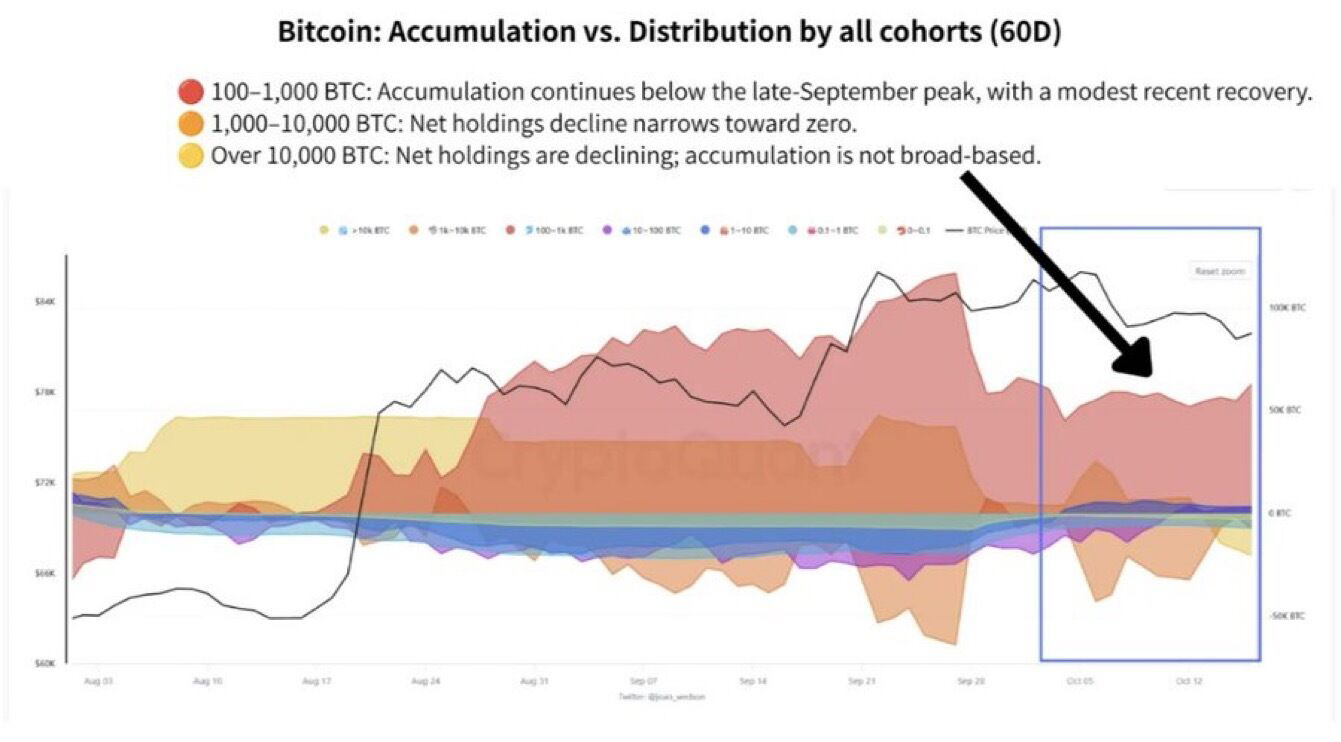
Bitcoin's exchange supply deserves more attention
Another detail I've been watching is the change in Bitcoin held on centralized exchanges.
Recent on-chain estimates suggest exchange reserves edged higher during October, from roughly 2.67 million BTC to 2.68 million BTC.
That isn't an enormous increase relative to total exchange holdings.
But the timing matters.
When spot demand is already uncertain, even a modest increase in available exchange supply becomes worth monitoring.
I don't automatically interpret exchange deposits as selling. Coins can move for custody, collateral, or internal operational reasons.
What matters is what happens afterward.
If more Bitcoin reaches exchanges and price holds firm, that can indicate buyers are absorbing the additional supply.
If exchange balances increase while spot demand weakens and price struggles to maintain support, the interpretation becomes less encouraging.
This is why I prefer watching exchange supply alongside actual demand instead of treating one metric as a complete answer.
The market doesn't necessarily need exchange balances to fall every day.
It needs enough buyers to absorb the supply that becomes available.
The spot market is where I see the biggest unanswered question
This is probably the most important part of my current Bitcoin outlook.
Recent CryptoQuant analysis indicates that its 30-day spot demand measure briefly improved toward neutral territory before weakening again.
At the same time, demand in perpetual futures remained comparatively stronger.
That difference can explain why Bitcoin sometimes produces impressive recoveries without a convincing improvement in the underlying market.
Leverage can accelerate price movement.
When traders increase long exposure, futures activity can push prices higher, especially if short positions are forced to close.
But those moves don't necessarily tell us whether investors are buying and holding Bitcoin in the spot market.
And that is the distinction I'm watching.
A futures-driven recovery can be powerful, but it also carries additional risks.
Funding costs can increase. Positioning can become crowded. A relatively small price reversal can trigger liquidations that accelerate the move in the opposite direction.
Spot buying doesn't eliminate volatility, but sustained demand from buyers acquiring the underlying asset can provide a stronger foundation.
For me, a convincing recovery would involve more than rising prices and increasing futures activity.
I want to see spot demand turn positive and remain there.
Until that happens, I'm careful about interpreting every breakout as the beginning of a larger bullish move.
Institutional participation adds another layer
There is a reason I wouldn't describe Bitcoin's current structure as completely bearish.
Institutional demand has shown signs of improvement at different points during the recent market cycle.
Coinbase Institutional reported approximately $2.6 billion in U.S. spot Bitcoin ETF inflows during September, alongside improving order-book bid depth.
Separately, CryptoQuant's entity-adjusted whale data showed that holdings among certain large entities reached approximately 3.03 million BTC in October.
These observations suggest that meaningful accumulation is taking place in parts of the market.
But they also raise a question.
If some institutional and large-holder measures are improving, why does the 60-day cohort chart still show distribution among the largest wallets?
The answer may be in how the data is measured.
Different datasets classify wallets differently. Some exclude exchanges and mining pools. Others group addresses by their balances and calculate rolling changes.
An institution can also hold Bitcoin through multiple addresses or custodians, making it difficult to interpret ownership from wallet size alone.
I don't see these figures as necessarily contradictory.
They show why relying on a single whale metric can produce an incomplete market view.
What I care about is whether institutional participation translates into consistent spot buying, particularly during pullbacks.
One strong month of inflows is encouraging.
Several weeks of demand absorbing available supply would tell me much more.
Macro conditions can lift Bitcoin, but they can't do all the work
Bitcoin doesn't trade independently of the broader financial system.
Interest-rate expectations, Treasury yields, dollar liquidity, and investors' appetite for risk can all influence demand.
When financial conditions appear likely to become less restrictive, Bitcoin can benefit from renewed interest in risk assets.
But I separate that kind of recovery from one supported by stronger on-chain accumulation.
Improving macro sentiment can bring buyers back quickly.
The problem is that sentiment can change just as quickly.
If Bitcoin rallies because investors expect easier monetary conditions, but spot demand remains weak, the market may become vulnerable when those expectations shift.
A healthier situation would be one where improving macro conditions encourage sustained capital inflows, while large holders increasingly absorb supply.
That's when external support begins translating into stronger internal market structure.
Three developments that would change my outlook
I see three realistic paths from the current setup.
The first is a stronger recovery supported by broader accumulation.
In this scenario, the 100–1,000 BTC group continues adding, the 1,000–10,000 BTC cohort returns to positive accumulation, and distribution among the largest holders slows.
At the same time, spot demand strengthens and exchange inflows are absorbed without significant price deterioration.
That would make me more confident that the recovery has genuine support.
The second is an extended consolidation.
Bitcoin could remain range-bound while different holder groups continue moving in opposite directions.
Mid-sized holders may keep accumulating, but their buying could be offset by distribution elsewhere.
Spot demand might fluctuate around neutral, preventing the market from developing a decisive trend.
I wouldn't necessarily consider that unhealthy.
Consolidation can give the market time to absorb supply and reduce excessive leverage.
But I would want to see the underlying demand improve before expecting a sustained breakout.
The third is a recovery that fails to attract enough spot buyers.
This is the risk I take most seriously.
If exchange supply continues increasing, the largest holders remain net distributors, and spot demand stays negative, the market could struggle to defend higher prices.
A recovery supported mainly by leveraged positions would become particularly vulnerable if those positions started unwinding.
That doesn't guarantee a sharp correction.
It means the market's ability to absorb selling pressure would be weaker than the price chart initially suggested.
What I'm watching instead of trying to predict the next candle
I don't think the best approach here is to predict an exact Bitcoin top or bottom from one on-chain chart.
I'd rather monitor whether the evidence supporting a recovery is getting stronger or weaker.
My attention is on the relationship between spot demand and available exchange supply.
I'm also watching whether whale accumulation expands beyond the 100–1,000 BTC cohort, whether ETF inflows remain consistent, and whether derivatives activity becomes too dominant relative to spot buying.
These developments can help distinguish a recovery driven by real demand from one driven primarily by positioning and short-term sentiment.
There's also no requirement for every indicator to turn bullish simultaneously.
Markets rarely offer that kind of clarity.
But when several independent indicators begin moving in the same direction, the underlying trend becomes more convincing.
My final perspective
I still see reasons to remain interested in Bitcoin's recovery.
Some large holders are accumulating. Institutional participation hasn't disappeared. And the market has shown an ability to recover despite periods of selling pressure.
But I'm not ignoring what the data is showing on the other side.
The largest wallet cohort remains in net distribution on the 60-day chart. Spot demand has struggled to maintain positive momentum, and exchange supply has recently edged higher.
Those aren't details I'd overlook simply because price has started moving upward.
I think Bitcoin can continue recovering from here, but I would distinguish that possibility from having confirmation of a sustainable bullish trend.
The real test isn't whether Bitcoin can attract buyers during a rally. It's whether those buyers remain active when additional supply enters the market.
That's what I'm watching now.
Because a higher price tells me what the market has done.
The behaviour of buyers and sellers helps me judge whether that move has enough support to continue.
#bitcoin #BTC #BitcoinSurpasses$83,000 #Write2Earn #Binance