

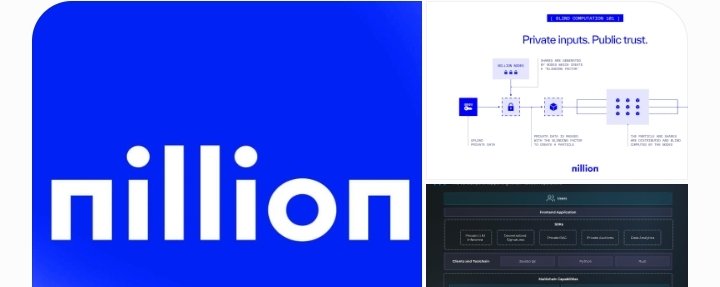



Nillion is a decentralized privacy infrastructure network designed to let applications store, use, and compute on sensitive data without unnecessarily exposing that data. Its central idea is called Blind Computation, and its broader vision is known as the Blind Computer.
This guide covers Nillion's technology, architecture, AI agents, blockchain integrations, $NIL token, use cases, benefits, risks, and future potential, based on official documentation and project publications.
### 1\. What is Nillion?
Traditional blockchains are excellent at maintaining transparent, verifiable records, but they are not ideal for processing every kind of sensitive information. Publishing private information directly on-chain can create serious confidentiality problems.
For example:
* An AI agent may need access to private user information.
* A trader may want to protect a trading strategy.
* A company may want to analyze confidential business data.
* A decentralized application may need to store sensitive credentials.
Nillion aims to make this information usable without requiring the entire system to trust a single database provider or computing operator.
Private storage
Store sensitive information across distributed nodes using secret sharing and encryption.
Private computation
Run supported computations or AI workloads while limiting exposure of the underlying data.
Decentralized verification
Use cryptographic mechanisms and the Blacklight verification network to strengthen trust in execution.
Official resources: Nillion · [Website](https://nillion.com/?utm_source=chatgpt.com) · [Official documentation](https://docs.nillion.com/?utm_source=chatgpt.com).
### 2\. What is Blind Computation?
Blind Computation is the process of performing supported operations on sensitive data while keeping the data protected from parties that should not see it.
In conventional computing, the usual process is:
* Receive private data.
* Decrypt it.
* Process it.
* Return or store the result.
The sensitive information may be exposed to the application, server, or infrastructure during processing.
Nillion's approach uses privacy-enhancing technologies to reduce that exposure.
User or application
Sensitive input
Protect the data
Encryption and/or secret sharing
Nillion infrastructure
Distributed storage and/or confidential computation
Authorized result
Return useful output without unnecessarily exposing private input
This is a simplified conceptual diagram, not a claim that every Nillion workload uses exactly the same sequence. Storage and computation can use different mechanisms. For example, Nillion's nilDB distributes secret shares, while nilCC uses trusted execution environments for confidential workloads.
### Why does blind computation matter?
The goal is to separate using information from revealing information.
Imagine an AI assistant that needs to evaluate a user's private financial records. Instead of making those records openly accessible to every infrastructure operator, an application could use privacy-preserving storage and computation to limit unnecessary exposure.
That can create new opportunities for AI, decentralized finance, digital identity, and confidential data services.
### 3\. Nillion's main technology components
Nillion's Blind Computer is built around several components that work together. The current architecture described in its documentation includes the following.

1\. nilDB — Private storage
nilDB stores data through distributed clusters. Data can be encrypted or split into secret shares, so an individual storage node does not necessarily possess enough information to reveal the original data. Applications can also query and manage structured data through supported SDKs.
Best suited for: private user records, application data, credentials and sensitive datasets.
[nilDB documentation](https://docs.nillion.com/build/nildb?utm_source=chatgpt.com)

2\. nilCC — Confidential computation
nilCC runs developer-defined workloads inside Trusted Execution Environments (TEEs). These secure enclaves are designed to isolate data and computation from the underlying host and produce cryptographic attestation evidence.
Best suited for: confidential business logic, data analysis and general-purpose private workloads.
[Blind Computer overview](https://docs.nillion.com/blind-computer/learn/overview?utm_source=chatgpt.com)

3\. nilAI — Private AI
nilAI provides AI inference through Nillion's confidential computing infrastructure. Developers can send prompts and data to supported models while reducing the exposure of sensitive inputs to infrastructure operators.
Best suited for: AI agents, private chatbots, confidential AI workflows and inference over sensitive information.
[Developer portal](https://developer.nillion.com/?utm_source=chatgpt.com)

4\. Blacklight — Verification and conditional secrets
Blacklight's role has expanded with the network's architecture. Its verification infrastructure is designed to check that confidential workloads execute as expected. The newer Blacklight L1 system also supports conditional secrets, where encrypted payloads remain sealed until specified on-chain conditions are satisfied.
Best suited for: execution verification, decentralized participation and condition-based release of secrets.
[Original Blacklight announcement](https://nillion.com/news/nillion-blacklight-is-now-live/?utm_source=chatgpt.com) · [Blacklight L1 update](https://nillion.com/news/blacklight-node-migration-the-move-to-ethereum-l1?utm_source=chatgpt.com)
### 4\. How does Nillion protect data?
Nillion combines different privacy-enhancing technologies rather than relying on one universal method.
| Technology | What it does |
| ------------------------------------- | ------------------------------------------------------------------------------------------------------------- |
| Multi-Party Computation (MPC) | Allows parties or nodes to participate in computations without each party needing the others' private inputs. |
| Secret sharing | Splits a secret into separate shares that can be distributed across nodes. |
| Homomorphic encryption | Supports certain computations directly on encrypted values. |
| Trusted Execution Environments (TEEs) | Isolates computation inside protected hardware-backed environments. |
| Remote attestation | Provides cryptographic evidence about the software and environment running inside a TEE. |
These technologies have different security assumptions and performance trade-offs. A TEE is not the same as MPC, and not every workload uses fully homomorphic encryption. The actual privacy guarantee depends on the specific implementation and configuration.
### A simple example
Imagine three organizations want to calculate a combined statistic from their private datasets.
* Organization A does not want to expose its records.
* Organization B has the same concern.
* Organization C also needs confidentiality.
With an appropriate privacy-preserving protocol, they may be able to contribute information and obtain an aggregate result without disclosing all underlying records to one another.
This illustrates the broader idea behind blind computation. The exact mechanism and guarantees depend on how the application is implemented.
### 5\. Why is Nillion relevant to AI agents?
AI agents increasingly work with long-term memory, private user preferences, financial information, credentials and business systems. If these inputs are sent to ordinary services without appropriate protections, sensitive data may be exposed through logs, databases, application servers or model-processing infrastructure.
Nillion aims to make privacy-preserving AI workflows more practical.
Private agent memory
Store useful user context without putting the entire memory into a conventional centralized database.
Credential protection
Design workflows that limit exposure of sensitive credentials and access information.
Private decision-making
Let agents use confidential inputs for selected analysis and inference tasks.
Personalized AI
Help developers build applications that use personal context with less unnecessary disclosure.
These are potential application patterns, not a guarantee that every agent or model automatically becomes private by using Nillion. Developers must still manage permissions, model behavior, outputs, application logs and external integrations.
### 6\. Use cases across industries

AI and machine learning
Confidential inference, private agent memory and AI applications that handle sensitive business or personal data.

DeFi and trading
Confidential strategy execution, private financial analytics and selected workflows that need to protect trading information.

Healthcare and research
Privacy-preserving analysis of medical datasets and collaboration across organizations, subject to regulatory and implementation requirements.

Digital identity and reputation
Applications that manage private credentials, personal attributes or reputation information with controlled disclosure.

Enterprise data
Organizations can explore data analysis and collaborative workflows without granting every participant unrestricted access to raw information.
The common objective is to make sensitive information useful while limiting unnecessary exposure. These categories describe possible uses, not a guarantee that all listed applications are already deployed at scale.
### 7\. Nillion's blockchain architecture
Nillion is not simply another blockchain competing to process transactions. Its core purpose is private data storage and computation, coordinated by blockchain-based infrastructure.
The project's July 2026 white paper describes three important parts of the architecture.
Token infrastructure, coordination and on-chain verification
Blacklight
Verification infrastructure and, in the L1 design, condition-based secret release
### Petnet — Privacy infrastructure
nilDB
Storage
nilCC
Confidential compute
nilAI
Private AI built on confidential compute
Important network update: Nillion's older Cosmos-based nilChain was permanently halted in March 2026. The project moved its token and coordination architecture toward Ethereum and an Ethereum Layer 2. Blacklight has also been transitioning from its L2 verification design toward Blacklight L1. These are distinct developments, so older guides may describe an outdated setup.
### 8\. What is the $NIL token?

$NIL — Nillion's native utility token
$NIL is designed to connect access to network resources with the economic incentives for operating and verifying the network.
Official references: [NIL white paper](https://nillion.com/legal/mica/july-15-2026-white-paper.html?utm_source=chatgpt.com) · [Migration guide](https://nillion.com/news/nil-token-migration-guide/?utm_source=chatgpt.com)
### Main functions of $NIL
| Function | Explanation |
| -------------------- | ------------------------------------------------------------------------ |
| Network access | Used in the network's resource-access and service-payment model. |
| Compute and storage | Developers can use NIL to purchase credits for nilDB and nilCC services. |
| Staking | Used in eligible network participation and verification mechanisms. |
| Verification rewards | Eligible Blacklight operators can receive rewards for verification work. |
| Governance | Supports protocol governance according to the applicable rules. |
The April 2026 developer-portal update describes a credit-based model: developers purchase credits using NIL for nilDB and nilCC, while nilAI also supports Stripe payments for easier access.
### Token migration: a critical detail
The official migration guide identifies the Ethereum ERC-20 NIL contract as:
`0x7Cf9a80db3B29eE8efE3710AadB7b95270572d47`
Verify the address directly against the official [Nillion migration guide](https://nillion.com/news/nil-token-migration-guide/?utm_source=chatgpt.com) and [Ethereum token explorer](https://etherscan.io/token/0x7cf9a80db3b29ee8efE3710AadB7b95270572d47?utm_source=chatgpt.com) before making any transaction.
The old Cosmos nilChain bridge is no longer operational following the March 2026 shutdown. Eligible holders who did not migrate before the snapshot may need to use the official claim mechanism. Never send funds to an unofficial migration website.
### 9\. Blacklight nodes and earning rewards
Blacklight is important because privacy alone is not enough: users also need ways to establish that confidential workloads are executing as intended.
The earlier Blacklight L2 model uses staked NIL to allocate verification work. The newer Blacklight L1 design introduces a different role involving condition-based release of encrypted payloads.
According to the September 2026 migration announcement:
* Blacklight node migration began on September 26, 2026.
* The project announced an October 5, 2026 L1 mainnet target.
* The stated minimum stake for L1 operators is 70,000 NIL.
* L1 operators need ETH to pay Ethereum gas fees.
* Rewards depend on the applicable mechanism, successful participation and network rules.
The announcement also describes a migration period during which staked tokens may not earn rewards. Verify current network status before setting up a node or staking funds.
Official links:
* [Blacklight L1 migration instructions](https://nillion.com/news/blacklight-node-migration-the-move-to-ethereum-l1?utm_source=chatgpt.com)
* [Current Nillion documentation](https://docs.nillion.com/?utm_source=chatgpt.com)
Risk reminder: A stated reward rate is not guaranteed investment income. Token prices can fall, requirements can change, and operating infrastructure introduces technical and financial costs.
### 10\. Nillion's advantages and limitations
| Potential advantages | Important limitations |
| -------------------------------------------------------------------- | ------------------------------------------------------------------------------------------------- |
| Privacy-focused infrastructure for AI and decentralized applications | Different privacy technologies provide different guarantees. |
| Distributed storage reduces reliance on a single storage node | Secure implementation and key management remain essential. |
| Confidential AI inference and computation | TEE hardware, implementation and attestation assumptions matter. |
| A token-based network resource model | Token demand does not automatically translate into token price appreciation. |
| Developer APIs and SDKs | Adoption, developer experience and real usage must continue to grow. |
| Permissionless node participation | Actual decentralization and security depend on the live network's participants and configuration. |
Nillion's central technical proposition is compelling: private data can become more useful when systems can work with it