


# Bitcoin Under Pressure: What Crypto Investors Should Learn When the Market Turns Red
The cryptocurrency market has a way of testing both your knowledge and your patience.
One day, people are discussing the next rally. The next day, red candles dominate the charts, investors become nervous, and everyone starts asking the same question: *Is this the beginning of a bigger crash, or just another market correction?*
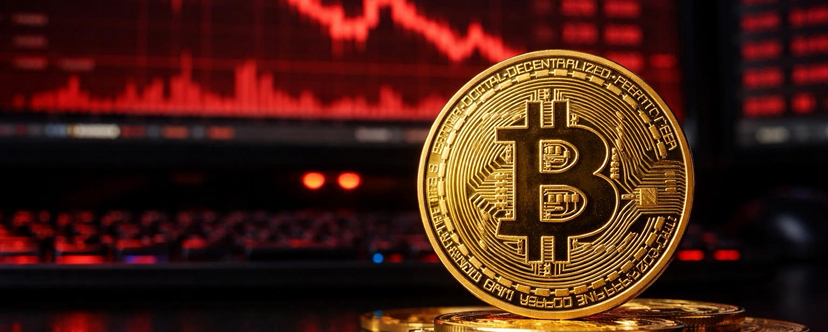
As of October 15, Bitcoin has been trading around the $81,000 region after testing prices close to $80,000. Recent US inflation data has also raised concerns about the possibility of tighter monetary policy, putting pressure on risk-sensitive assets, including cryptocurrencies.
But beyond the price movement, I believe there are some important lessons worth discussing.
## 1. Crypto Does Not Operate in Isolation
One misconception among beginners is that cryptocurrency prices depend only on what happens inside the crypto industry.
In reality, global economic developments can have a significant influence on market sentiment.
When inflation comes in higher than expected, investors may reconsider their expectations for interest rates. If interest rates remain high or rise, some investors may become less willing to take risks.
This can affect technology stocks, cryptocurrencies, and other risk-sensitive investments.
The lesson? If you want to understand Bitcoin, pay attention to more than Bitcoin. Global economic news matters, too.
## 2. A Falling Price Does Not Automatically Mean a Buying Opportunity
We often hear the phrase “buy the dip” whenever the market turns red.
The idea sounds simple: buy an asset at a lower price and benefit if it recovers.
However, a lower price alone does not tell us whether an asset is undervalued or whether the decline will continue.
A market can recover after a sharp drop, but it can also fall further. The challenge is distinguishing a temporary pullback from a more sustained downturn.
Rather than buying simply because prices are falling, investors should consider market conditions, their investment goals, the risks involved, and whether they can afford potential losses.
Sometimes patience is a strategy in itself.
## 3. Market Sentiment Can Change Quickly
Crypto markets are heavily influenced by expectations, uncertainty, and investor behaviour.
Positive news can create excitement, while disappointing economic data or unexpected developments can trigger selling pressure.
This is why chasing a rally or reacting emotionally to a sudden decline can be dangerous.
When everyone seems convinced that prices will go higher, it is worth asking what could go wrong. When panic spreads, it is equally important to avoid assuming that every negative headline signals the end of the market.
Neither optimism nor pessimism should replace independent thinking.
## 4. What Should Traders Watch Next?
Instead of trying to predict every Bitcoin move, here are three things I would pay attention to:
**Bitcoin's price behaviour:** Does the market stabilise around recent lows, or does selling pressure continue? A single bounce is not enough to confirm a trend reversal.
**Economic developments:** Future inflation figures and central bank decisions could influence expectations about interest rates and investor appetite for risk.
**Trading volume and market sentiment:** Price movements accompanied by stronger buying or selling activity may offer additional context, although no single indicator guarantees what happens next.
These are observations to help structure market analysis, not signals to buy or sell.
## 5. The Real Lesson: Protect Your Decision-Making
In my view, one of the most underrated skills in crypto is the ability to remain disciplined when the market becomes unpredictable.
You do not have to trade every movement. You do not have to follow every trending coin. And you certainly do not have to risk money simply because other people appear to be making profits.
Learn the fundamentals. Understand your risk exposure. Be cautious about leverage. Never treat online predictions as guarantees.
The goal should not be to predict every market move correctly. It should be to make more informed decisions while recognising that uncertainty is part of investing.
## Final Thoughts
Bitcoin's current weakness is a reminder that cryptocurrency markets are influenced by both industry developments and the wider financial environment.
Whether the market recovers or experiences further declines, the important thing is to approach the situation with a clear mind rather than fear or unrealistic expectations.
**You cannot control the market, but you can control how much risk you take and how you respond to uncertainty.**
### Let's discuss 👇
With Bitcoin trading near the $81,000 region, what would you prioritise right now?
**A.** Watching for a potential recovery
**B.** Waiting for stronger confirmation before acting
**C.** Learning more about macroeconomic factors
**D.** Staying out until market conditions become clearer
Share your reasoning in the comments. Let's exchange ideas and learn from different perspectives.
*This article is for educational purposes only and does not constitute financial advice.*
#Bitcoin #CryptoMarket #BinanceSquare #CryptoEducation #TradingPsychology