


♟️ The Institutional Liquidity & CVD Divergence Engine: How Pros Trade Bitcoin
Most retail traders enter Bitcoin trades when a breakout looks "obvious" — right into the jaws of an institutional distribution block.
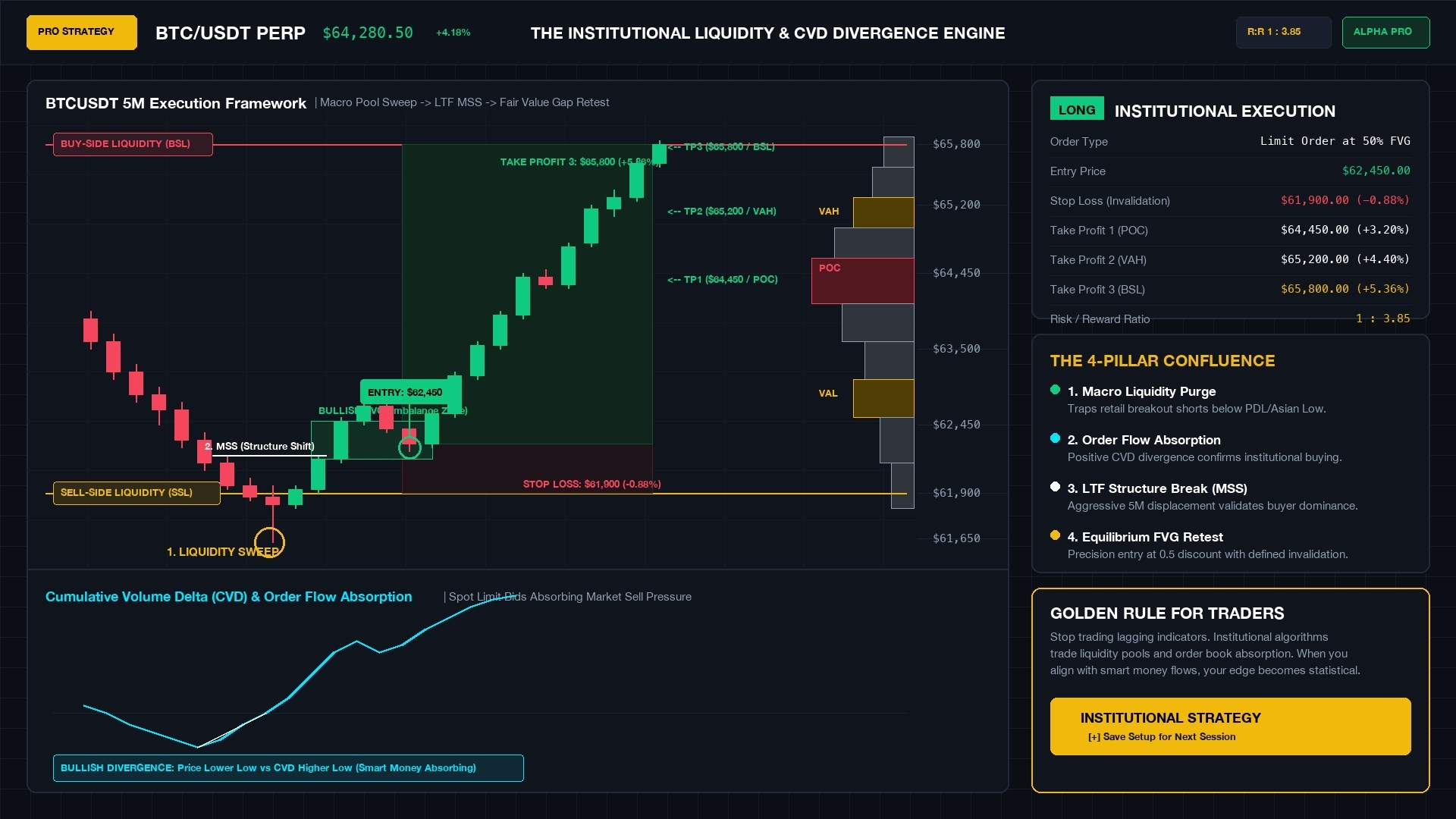
If you want to stop being exit liquidity, you need to think like a liquidity provider. Here is the 4-Pillar Confluence Framework used by proprietary desks and smart-money operators to trade $BTC with asymmetric Risk-to-Reward (minimum 1:3.5).
🏛️ Why Typical Retail Strategies Fail
Retail relies on lagging oscillator crossovers (RSI, MACD) on single timeframes. In contrast, institutional algorithms run on Liquidity Pools, Volume Imbalances, and Order Flow Absorption.
When price aggressive sweeps a key level and reverses, it is almost never random — it’s a stop-run engineered to fill massive institutional limit orders.
🎯 The 4-Pillar Execution Blueprint
1. Macro Liquidity Mapping (4H / 1D)
Mark out Buy-Side Liquidity (BSL) and Sell-Side Liquidity (SSL):
Equal Highs (EQH) / Equal Lows (EQL)
Previous Day High (PDH) & Previous Day Low (PDL)
Asian Session High/Low (00:00 – 08:00 UTC)
Rule: We never initiate breakout trades at these levels. We wait for the sweep (fakeout).
2. Volume Profile & Value Areas (1H)
Overlay a Fixed Range Volume Profile (FRVP) across the current range:
POC (Point of Control): Highest traded volume node.
VAH / VAL: Value Area High (70th percentile) and Value Area Low.
If price sweeps outside VAH/VAL and closes back inside the Value Area, an 80% statistical probability exists for price to rotate to the opposite boundary.
3. Order Flow & CVD Absorption (15M / 5M)
Watch Cumulative Volume Delta (CVD) and Open Interest (OI) at the sweep level:
Bullish Reversal Signal: Price prints a lower low (sweeping SSL), but Spot CVD prints a higher low (Passive buyers absorbing aggressive market selling). Open Interest suddenly flushes (liquidation cascade exhausted).
Bearish Reversal Signal: Price prints a higher high (sweeping BSL), but CVD prints a lower high (Aggressive buyers trapped into limit sell walls).
4. The Trigger: Market Structure Shift (MSS) + FVG
Do not enter blindly on the wick.
Wait for a Market Structure Shift (MSS) on the 5-minute timeframe: an aggressive displacement candle that creates an imbalance (Fair Value Gap / FVG).
Entry: Limit order at the 50% equilibrium of the FVG.
Stop Loss: 1 tick beyond the swing sweep extreme.
Take Profit Targets:
TP1 (40% off): Range POC (move stop to breakeven).
TP2 (40% off): Opposite Value Area boundary.
TP3 (20% runner): Opposite major liquidity pool (BSL/SSL).
🛡️ The Golden Risk Protocol
Max Risk Per Trade: 1.0% – 1.5% of total portfolio equity.
Fixed Invalidation: If the 15M candle closes beyond the sweep wick, the thesis is invalidated immediately — zero emotional holding.
Positive Expectancy: Never take a setup offering less than a 1:3 Risk-to-Reward. Winning only 40% of trades with this ratio yields strong positive expectancy.
⚡ Quick Pre-Flight Checklist
Has a high-timeframe liquidity pool been tapped/swept?
Is there an Order Flow / CVD divergence confirming absorption?
Did a clean Market Structure Shift with an FVG print on the lower timeframe?
Is Risk-to-Reward ≥ 1:3 with a defined invalidation level?
💬 Drop a "🔥" in the comments if you want a step-by-step chart breakdown of this setup in action!
📌 Save this post so you don't chase FOMO candles on your next session.
#Buy NCH Native on omnichain at swap.cheeseblockchain.com or NCH-BSC bridge token.
Disclaimer: Educational content only. Cryptocurrency trading involves substantial risk of loss. Always manage your own risk.
#BTC #CryptoTrading #TechnicalAnalysis #OrderFlow
Visit https://bscscan.com/token/0xa481714D92437A006f0Eee5770EE9E4380f25396#code and help NCH-BSC Token grow.