

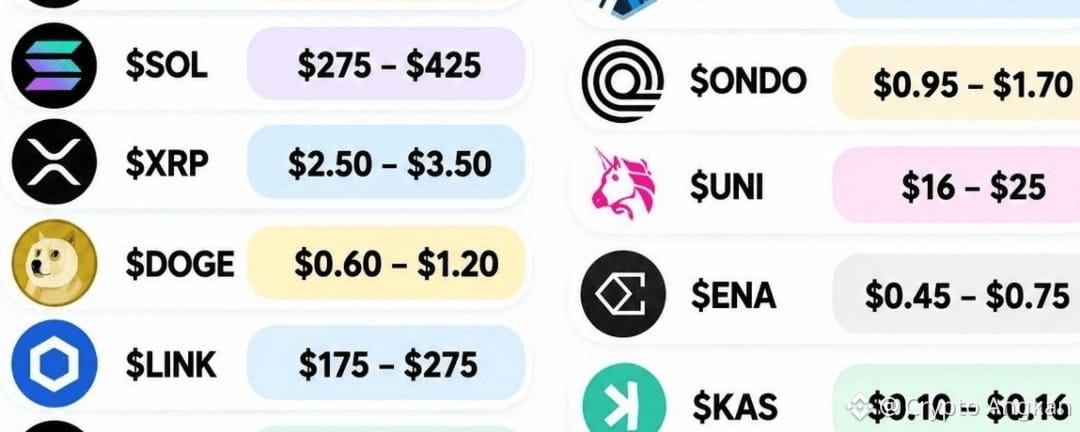

The crypto market is full of opportunities, but it is also full of risks. As we move toward the end of 2026, one important question deserves attention:
Which crypto projects have the technology, adoption, and long-term potential to remain relevant in the next market cycle?
Many people focus only on price. They see a coin pumping and rush to buy it. Others sell in panic when the market turns red. But successful research starts with a different mindset: understanding what you own, why it might have value, and what could go wrong.
In this article, we will explore 12 crypto assets from the image above, examine their potential narratives, and discuss what investors should research before making any decision.
🔶 1. Bitcoin ($BTC ) — The Foundation of the Crypto Market
Bitcoin remains one of the most recognized digital assets in the world.
Its limited maximum supply of 21 million BTC is a major part of its investment narrative. Some investors view Bitcoin as a long-term alternative asset, while others trade it according to market trends and liquidity.
Why watch BTC?
- Its established position in the crypto market.
- Growing institutional interest in Bitcoin-related investment products.
- Its influence on sentiment across the broader crypto market.
- Its role in discussions about digital scarcity and monetary alternatives.
What could go wrong?
Bitcoin is still volatile. Economic uncertainty, interest rates, changing investor demand, and regulatory developments can all influence its price.
My takeaway: BTC deserves attention because of its established market position, but its past performance does not guarantee future returns.
🔷 2. Ethereum ($ETH ) — The Smart Contract Giant
Ethereum is a major blockchain platform for decentralized applications, tokenized assets, and decentralized finance.
Its long-term story is connected to the number of people and businesses using its ecosystem, the security of its network, and the demand for ETH.
Why watch ETH?
- A broad ecosystem of decentralized applications.
- Smart contract infrastructure used by developers.
- Potential demand connected to network activity and staking.
- Continued development of scaling technologies.
What should investors research?
Network fees, competing blockchains, developer activity, ETH supply dynamics, and whether ecosystem growth creates sustainable demand for ETH.
My takeaway: Ethereum has a significant role in blockchain infrastructure, but competition and changing network economics matter.
🟡 3. $BNB — The Exchange and Ecosystem Token
BNB is associated with the BNB Chain ecosystem and has multiple uses within that environment.
Its prospects are connected to ecosystem adoption, network activity, token economics, and the broader position of the platforms and applications that support its utility.
Why watch BNB?
- Use cases within the BNB Chain ecosystem.
- Participation in network transactions and applications.
- Potential benefits from ecosystem expansion.
What are the risks?
Changes in regulation, ecosystem demand, competition, or platform-related conditions can affect its outlook.
My takeaway: Research actual utility and adoption rather than assuming that a large ecosystem automatically means a rising token price.
🟣 4. Solana (SOL) — Speed, Applications, and Network Activity
Solana has attracted attention for its high-throughput blockchain design and its ecosystem of decentralized applications.
Its future performance may depend on whether developers, users, and businesses continue to find value in its infrastructure.
Why watch SOL?
- A growing range of blockchain applications.
- Activity in decentralized finance and consumer-focused applications.
- Ongoing network development.
- Competition for users and developers in the smart contract market.
What are the risks?
Network reliability, congestion, competition, speculative trading, and changing user activity could affect its long-term outlook.
My takeaway: SOL is worth researching as a blockchain ecosystem, but popularity alone is not proof of future price appreciation.
🔵 5. XRP — Payments and Financial Infrastructure
XRP is associated with a digital asset ecosystem focused in part on payments and financial transfers.
Its investment narrative often includes cross-border payments, institutional use cases, liquidity, and regulatory developments.
Why watch XRP?
- Its established recognition in the crypto market.
- Its connection to payment-related blockchain use cases.
- Potential developments in financial infrastructure and adoption.
What should be considered?
Real-world usage, competition, token supply dynamics, liquidity, and the evolving regulatory environment are all important.
My takeaway: Payment-related use cases may matter over the long term, but adoption must be evaluated using evidence rather than headlines.
🐕 6. Dogecoin (DOGE) — Community and Speculation
Dogecoin demonstrates how community attention and internet culture can influence cryptocurrency markets.
Its popularity is an important part of its identity, but its market price can also be highly sensitive to social media sentiment and speculative demand.
Why watch DOGE?
- A well-known cryptocurrency brand.
- A large and recognizable community.
- Potential changes in sentiment during broader market rallies.
What are the risks?
DOGE's price can move sharply without a corresponding improvement in fundamental utility. It also has an inflationary supply model, which investors should understand.
My takeaway: Community strength can influence demand, but a popular meme coin is not automatically a sound long-term investment.
🔗 7. Chainlink (LINK) — Connecting Blockchains With Real-World Data
Smart contracts often need reliable information from outside their own blockchain. Chainlink provides oracle infrastructure designed to help blockchain applications access external data and services.
Its long-term narrative includes decentralized finance, cross-chain infrastructure, and tokenization.
Why watch LINK?
- Oracle infrastructure for smart contracts.
- Potential use in tokenized financial applications.
- Cross-chain connectivity.
- Continued demand for reliable blockchain data services.
What should investors examine?
Actual protocol usage, adoption by applications, token economics, competition, and how network demand translates into demand for LINK.
My takeaway: Infrastructure projects can be important to blockchain adoption, but the usefulness of a service does not automatically guarantee token appreciation.
⚫ 8. Hedera (HBAR) — Enterprise-Focused Blockchain Infrastructure
Hedera offers a distributed ledger network designed for applications that require predictable fees, performance, and governance.
Its investment case is connected to enterprise adoption and the practical use of its network.
Why watch HBAR?
- A focus on business and organizational use cases.
- Distributed ledger infrastructure.
- Potential applications involving data, digital assets, and business processes.
What are the risks?
Enterprise announcements do not always translate into significant token demand. Competition, real transaction activity, and token supply dynamics remain important.
My takeaway: Look for measurable usage and sustainable adoption rather than relying solely on partnerships or promotional announcements.
🟪 9. Quant (QNT) — Interoperability and Institutional Connections
Quant is associated with Overledger, technology designed to facilitate interoperability between different networks and systems.
Interoperability could become increasingly relevant if financial institutions and businesses use multiple blockchain networks.
Why watch QNT?
- A focus on connecting different systems.
- Potential relevance to enterprise blockchain applications.
- A narrative connected to interoperability and tokenized assets.
What are the risks?
Competition, limited adoption, project execution, and the relationship between product usage and token demand must be investigated carefully.
My takeaway: Interoperability is an interesting area to study, but investors should verify whether real customers are using the technology at meaningful scale.
🔵 10. Arbitrum (ARB) — Ethereum Scaling
Arbitrum is part of the Ethereum layer-2 ecosystem, which aims to improve transaction efficiency and expand the capacity of Ethereum-based applications.
The broader scaling narrative is connected to making blockchain applications more accessible and practical.
Why watch ARB?
- Activity across Ethereum scaling solutions.
- Adoption of decentralized applications.
- Potential growth in layer-2 infrastructure.
- Continued development of the Ethereum ecosystem.
What are the risks?
ARB is a governance token, and network growth does not necessarily translate directly into token price appreciation. Token unlocks, competition, and value capture deserve particular attention.
My takeaway: Research both the success of the network and the specific economic role of its token.
🟡 11. Ondo (ONDO) — The Tokenization Narrative
Tokenization involves representing certain assets or rights digitally using blockchain technology. Ondo is associated with tokenized financial products, including products linked to traditional financial assets.
This area has attracted attention because it explores how blockchain technology might connect with conventional financial markets.
Why watch ONDO?
- The broader real-world asset tokenization trend.
- Potential demand for blockchain-based financial infrastructure.
- Continued development of tokenized financial products.
What are the risks?
Regulation, product eligibility, access restrictions, liquidity, and the actual rights attached to a token are essential considerations.
My takeaway: Tokenization is worth monitoring, but growth in tokenized assets does not guarantee that every related token will increase in value.
🦄 12. Uniswap (UNI) — Decentralized Trading Infrastructure
Uniswap is a prominent decentralized exchange protocol that enables users to swap digital assets through blockchain-based liquidity pools.
Its relevance is linked to decentralized finance and the ongoing development of on-chain trading.
Why watch UNI?
- An established decentralized trading ecosystem.
- Potential demand for decentralized financial services.
- Continued innovation in on-chain markets.
What should investors research?
Trading volume, liquidity, protocol competition, governance, and the relationship between protocol activity and UNI's token economics.
My takeaway: A successful decentralized application and an attractive investment token are not necessarily the same thing. Both need independent analysis.
---
📊 What About the Other Coins in the Image?
The image also includes assets such as SONDO, SUNI, ENA, and KAS. Before treating any of their projected prices as credible, verify the exact token name, ticker, official website, contract address, circulating supply, and current market capitalization.
Ticker symbols can be confusing, and similar names can refer to entirely different projects. Do not assume that a price target is reliable simply because it appears in a polished graphic.
🔥 Why the End of 2026 Matters
The final months of a calendar year can attract attention because investors review their portfolios, markets react to economic developments, and traders speculate about the next cycle.
However, December 31 is not a guaranteed deadline for a crypto rally.
Several factors could influence the market through the end of 2026:
1. Macroeconomic conditions
Interest rates, inflation, liquidity, and global economic uncertainty can affect demand for speculative assets.
2. Institutional participation
Institutional products and investment flows may influence some crypto markets, but flows can change direction quickly.
3. Real-world adoption
Projects that attract active users and solve practical problems may have a more substantial foundation than projects relying entirely on hype.
4. Regulation
Regulatory developments can create opportunities while also introducing new restrictions and compliance costs.
5. Token supply
Unlock schedules, circulating supply, staking, and emissions can affect the balance between buying demand and available tokens.
Coinbase Institutional's 2026 market outlook discusses several of these themes, including regulation, institutional integration, tokenization, and technological development. It also recognizes uncertainty around the market's direction.
⚠️ The Biggest Mistake: Buying Every Coin Because of a Price Target
Let's take the price ranges in the image as an example.
A graphic might suggest that BTC could reach $105,000–$120,000, ETH could reach $4,500–$6,000, or SOL could reach $275–$425.
These figures should be treated as hypothetical scenarios, not confirmed future prices.
A target is only meaningful when you understand the assumptions behind it. What market capitalization would the target imply? How much new demand would be required? What could invalidate the forecast? Is the prediction supported by transparent analysis?
Without answers to these questions, a price target is simply a number.
Another important point: a lower-priced token is not necessarily cheaper in investment terms. Market capitalization, circulating supply, token distribution, liquidity, and future emissions all matter.
A $0.10 token is not automatically a better opportunity than a $100 token.
🧠 A Smarter Research Framework for the Rest of 2026
Instead of asking, "Which coin will make me rich?", ask five better questions:
1. What problem does the project solve?
Understand the product and its real purpose before evaluating the token.
2. Is there measurable adoption?
Look for verifiable network activity, users, transactions, and genuine demand rather than relying only on social media claims.
3. Does the token have a clear economic role?
A useful platform does not automatically make its token valuable. Understand the connection between usage and token demand.
4. What is the supply situation?
Review circulating supply, upcoming unlocks, emissions, and concentration of token ownership.
5. What would make the investment thesis wrong?
Every investment idea needs a downside scenario. If you cannot explain what could go wrong, you probably have not researched it sufficiently.
🛡️ Protect Your Capital Before Chasing Returns
Crypto markets can experience rapid price increases and equally rapid declines. The SEC's investor education resources warn that crypto-related investments can be highly speculative and that investors may lose their entire investment.
Keep these principles in mind:
- Never invest money needed for essential expenses.
- Do not borrow money to speculate on crypto.
- Avoid leverage if you do not fully understand the risks.
- Be skeptical of guaranteed returns and urgent buy signals.
- Verify token contracts and official project information.
- Understand custody and exchange risks.
- Follow the laws and age restrictions applicable where you live.
Risk management may sound less exciting than a prediction of a 10x return, but protecting yourself from avoidable mistakes is an essential part of financial education.
🎯 Final Thoughts: Research First, Hype Second
Bitcoin, Ethereum, BNB, Solana, XRP, Dogecoin, Chainlink, Hedera, Quant, Arbitrum, Ondo, and Uniswap represent different areas of the crypto ecosystem.
Some focus on payments. Others support smart contracts, decentralized trading, scaling, data infrastructure, or tokenized financial products.
That diversity makes them interesting to research, but it does not mean they will all perform well before the end of 2026.
The strongest approach is not to buy every coin on a list. It is to understand each project's purpose, evaluate its token economics, examine its risks, and remain open to changing your opinion when new evidence appears.
The biggest opportunity may not be finding the next coin that pumps. It may be learning how to distinguish a project with a credible long-term case from one driven mainly by hype.
The end of 2026 could bring opportunities, challenges, or both. No forecast can remove that uncertainty.
Do your own research. Protect your capital. Never confuse a possibility with a promise.
💬 Let's Discuss
Which of these projects do you think has the strongest long-term fundamentals: BTC, ETH, SOL, LINK, HBAR, or another project?
#Crypto #Bitcoin #Ethereum #Solana #CryptoResearch #Blockchain #BinanceSquare #dyor