

Arbitrum stopped being just a rollup a while ago.
BUSINESS
Arbitrum is the Ethereum scaling network built by Offchain Labs, centered on Arbitrum One, an optimistic rollup that processes transactions off-chain and settles them on Ethereum mainnet.
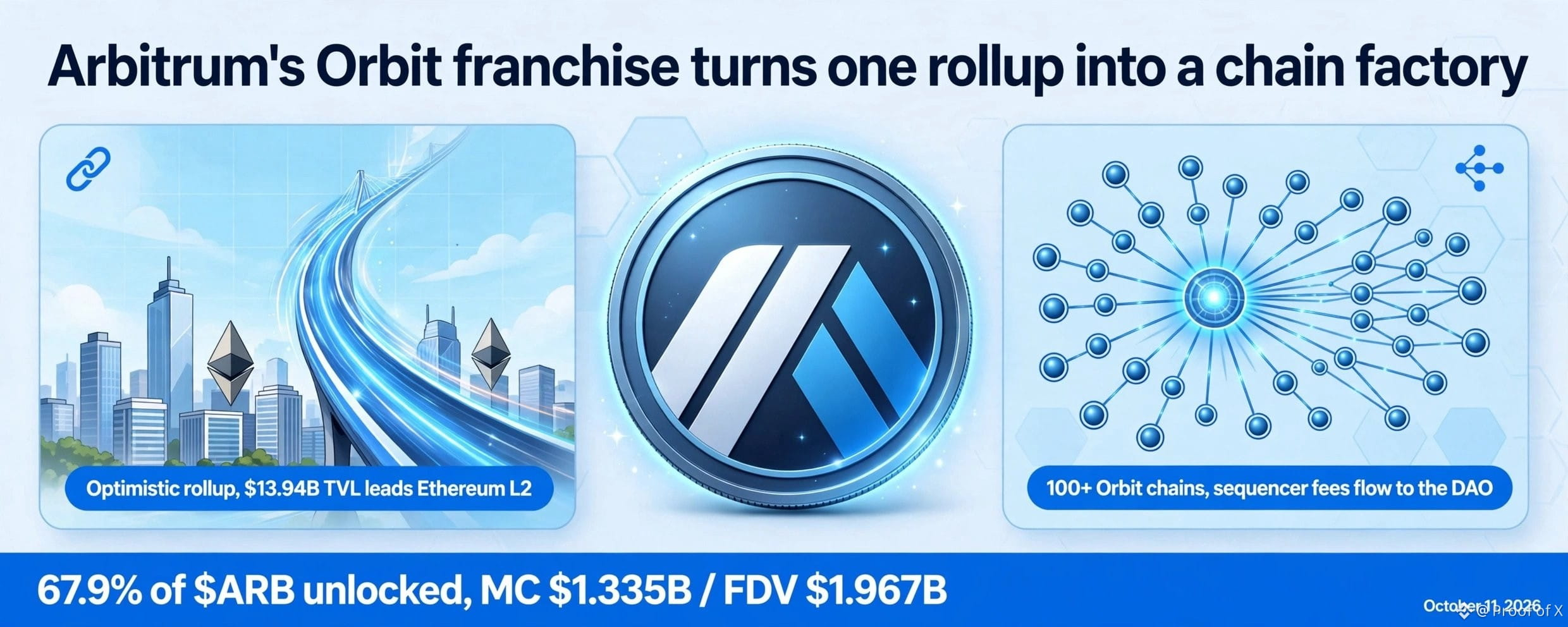
Its business model runs on the sequencer: activity across Arbitrum One and the Orbit chain family generates fees that flow to the Arbitrum DAO, which $ARB holders govern.
The ecosystem hosts more than 1,000 projects and carries about $8 billion in stablecoin supply, the deepest liquidity pool on any Ethereum L2.
Orbit, Arbitrum's chain-building toolkit, lets any team launch a dedicated chain that inherits Arbitrum's security model, which is why the network now spans 100-plus application-specific chains.
TECHNOLOGY
The Nitro stack, upgraded through ArbOS releases and EIP-4844 blob support, brings block times down to about 250 milliseconds and typical transfers to roughly $0.003.
As of January 2026 the network passed Stage 1 decentralization on L2Beat's walkaway test, meaning users can exit even if operators misbehave.
Stylus extends the chain beyond the EVM, letting contracts written in Rust, C, and C++ run alongside Solidity code and widening the developer pool beyond Ethereum natives.
Arbitrum Nova runs in parallel for gaming and social use cases, using AnyTrust data availability for higher throughput at lower cost.
SECTOR
Ethereum L2 total locked value has rebounded to about $36.1 billion this week, with Arbitrum One at $13.94 billion, the largest single L2 by TVL.
Optimistic rollups still dominate the sector, and Arbitrum holds its lead while Base and OP Mainnet compete on growth.
The sector's center of gravity is moving from launch-hype metrics toward sustained fee revenue and user retention, and security governance is under the microscope: ecosystem reporting notes the Arbitrum Security Council recently paused new Stylus contract activations over AI-assisted attack risks.
COMPETITION
Optimism ($OP) answers with the OP Stack, now a standard for the Superchain alliance, plus a distinctive retroactive public-goods funding program.
Base, incubated by Coinbase, pulls in retail liquidity and distribution muscle but keeps its sequencer economics centralized.
Polygon ($POL) differentiates through AggLayer and the CDK toolkit for cross-chain aggregation, though real AggLayer adoption is still early.
ZK-rollups offer stronger cryptographic guarantees on paper, but their TVL remains a fraction of the optimistic-rollup leaders.
TOKENOMICS
$ARB has a circulating supply of 6.79 billion against a 10 billion maximum, so 67.9% is unlocked (CoinGecko, verified this run).
Market cap is about $1.335 billion with a fully diluted valuation of about $1.967 billion (CoinGecko, verified this run).
No unlock schedule could be verified from a cited source this run.
The token's fundamental question is not whether L2 demand exists, but how much of the Orbit franchise's value the DAO can keep.
Not financial advice. DYOR.
$ARB