

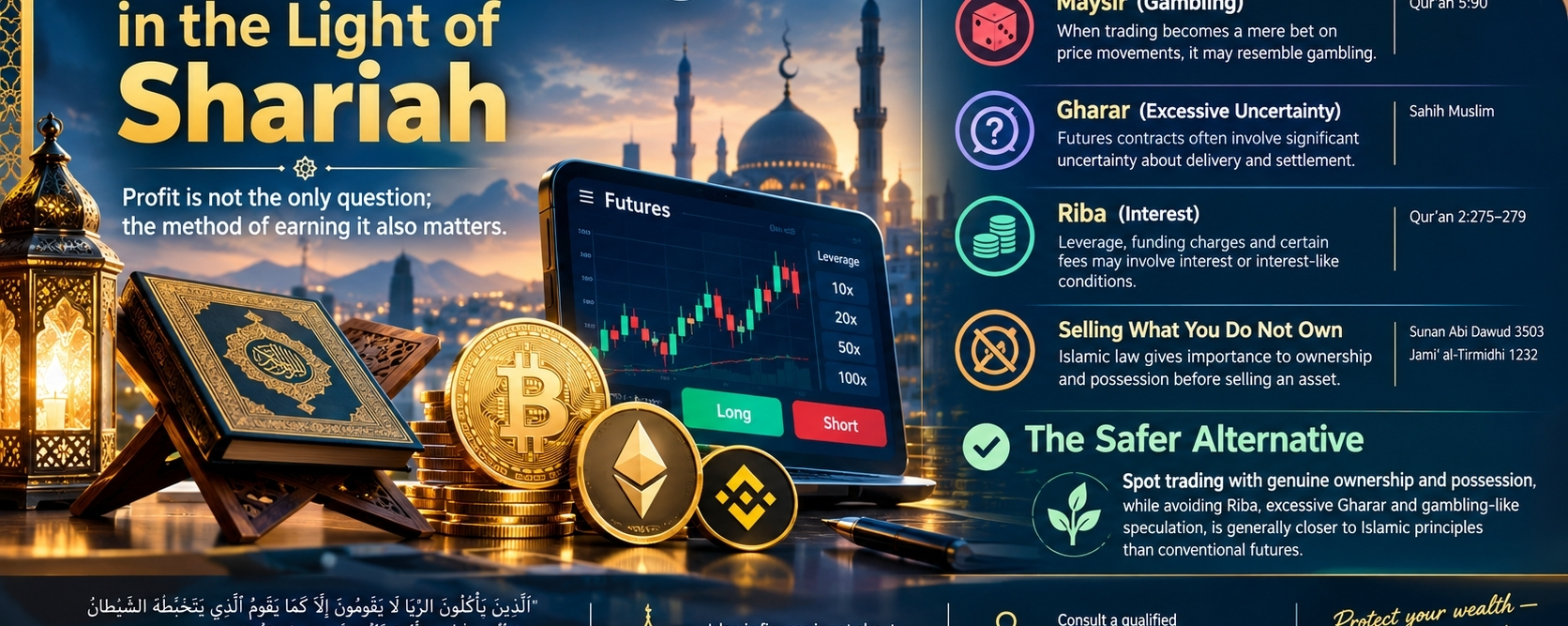

This is an important question in today's digital financial market. Islam does not prohibit business and profit, but it establishes clear principles for lawful transactions.
Allah Almighty says:
“Allah has permitted trade and forbidden Riba.”
(Qur'an 2:275)
At the same time, the Qur'an prohibits consuming wealth through false or invalid means:
“Do not consume one another's wealth unjustly, but only through trade by mutual consent.”
(Qur'an 4:29)
🔍 Where Do the Concerns Arise?
In conventional crypto futures trading, several elements may create serious Shariah concerns:
1️⃣ Gharar — Excessive Uncertainty
The Prophet ﷺ prohibited transactions involving excessive uncertainty (Gharar).
Sahih Muslim records the prohibition of Bay‘ al-Gharar.
Futures contracts can involve uncertainty concerning the actual delivery, ownership and settlement of the underlying asset.
2️⃣ Maysir — Gambling-Like Speculation
The Qur'an says:
“Indeed, intoxicants, gambling, idols and divining arrows are filth from the work of Satan, so avoid them.”
(Qur'an 5:90)
When trading becomes primarily a wager on whether a price will rise or fall, without genuine ownership or investment, the activity may raise the serious issue of Maysir/Qimar.
3️⃣ Riba — Interest
Some leveraged trading arrangements may involve interest or interest-like charges. Allah explicitly prohibits Riba (Qur'an 2:275–279).
Therefore, a Muslim must carefully examine leverage, funding mechanisms, borrowing charges and other fees rather than assuming that every trading product is Shariah-compliant.
4️⃣ Selling What One Does Not Own
The Prophet ﷺ said:
“Do not sell what you do not possess.”
(Sunan Abi Dawud, 3503; Jami‘ al-Tirmidhi, 1232)
This principle is particularly relevant when examining derivative contracts in which the trader may not actually own or possess the underlying cryptocurrency.
🕌 What Is the Safer Alternative?
For someone wishing to participate in crypto markets, spot transactions involving genuine ownership and possession, while avoiding Riba, excessive Gharar and gambling-like speculation, are generally closer to the classical principles of Islamic commerce than conventional leveraged futures.
However, cryptocurrency itself is a contemporary issue on which scholars have different views. Therefore, the ruling can depend on the asset, the contract structure, the platform and the exact terms of the transaction.
⚠️ Final Reminder
A Muslim should not ask only:
“How much can I earn?”
The more important question is:
“Is the way I earn it permissible?”
Before entering crypto futures or leveraged products, consult a qualified Shariah scholar or Islamic finance expert who understands the actual mechanics of modern derivatives.
Protect your wealth — but also protect your faith. 🤲
#BinanceSquare #FuturesTrading #Shariah #IslamicFinance #Crypto #HalalInvesting #Riba #Gharar #Maysir #MuslimTraders