

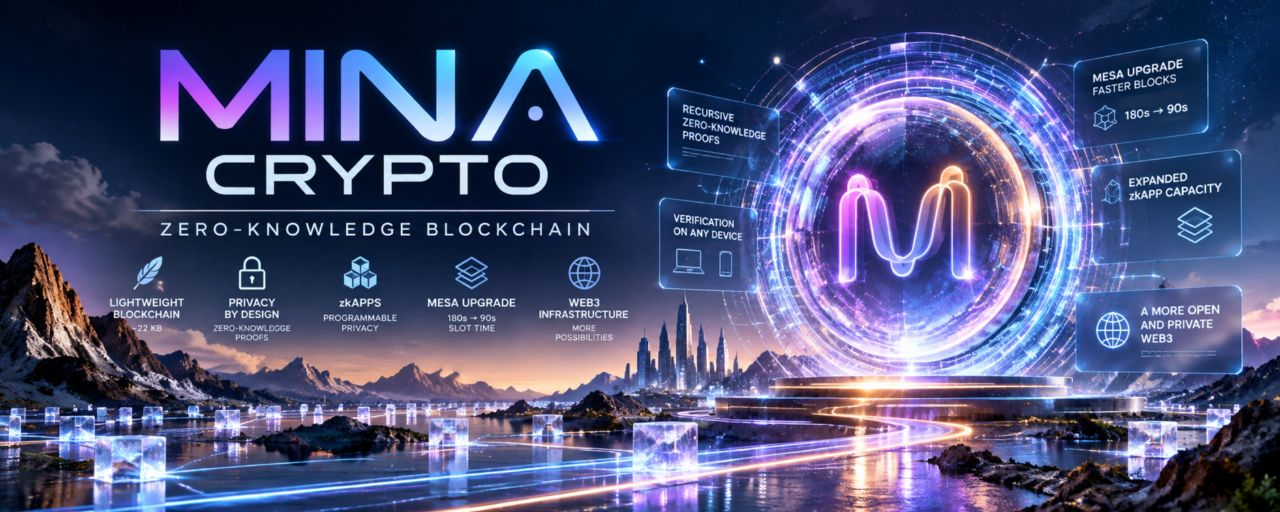

MINA: Small Blockchain, Big Ambition
The cryptocurrency market has never lacked ambitious projects.
Every market cycle produces new Layer-1 blockchains, new scaling solutions, new smart-contract platforms, new privacy protocols and new narratives designed to capture the attention of developers, investors and the broader Web3 community.
But occasionally, a project approaches the blockchain problem from a fundamentally different direction.
Mina Protocol is one of those projects.
Instead of trying to build the biggest blockchain, Mina has spent years pursuing a radically different objective:
Keep the blockchain extremely small while making verification extremely powerful.
That philosophy is at the heart of Mina's identity.
Mina uses recursive zero-knowledge proofs, specifically zk-SNARK technology, to maintain a blockchain that is designed to remain around 22 KB in size rather than continuously growing in proportion to historical blockchain data.
That creates a fundamentally different proposition.
Traditional blockchain systems generally become larger as more transactions and historical states accumulate.
Mina's architecture attempts to compress the proof of the blockchain's state into a succinct representation that participants can verify without downloading and processing the entire history.
This is not merely a technical curiosity.
It represents a different vision for decentralization.
If blockchain verification becomes sufficiently lightweight, the number of people capable of independently verifying the network can potentially increase.
And if verification can eventually happen on devices such as smartphones and browsers, the concept of a truly user-owned and user-verifiable blockchain becomes considerably more interesting.
This is where the MINA story begins.
And in 2026, that story has entered another important chapter.
The Mesa Upgrade Changes the Conversation
For years, Mina's lightweight architecture has been its defining characteristic.
But architecture alone is not enough.
A blockchain must also evolve.
Developers need better tools.
Applications need more capacity.
Users expect better responsiveness.
And the network needs mechanisms that allow future upgrades to happen efficiently.
That is why the Mesa upgrade is so important.
Mina's Mesa upgrade went live on mainnet in September 2026.
According to Mina's official announcement, Mesa reduced slot time from 180 seconds to 90 seconds, effectively making block production twice as fast. It also increased zkApp capacity and introduced improvements designed to make future protocol upgrades easier.
The upgrade is therefore much more than a simple speed improvement.
Mesa represents Mina moving from an innovative technological concept toward a more capable infrastructure platform.
The four major protocol improvements include:
Reduced slot time
Larger on-chain state limits
Increased events and actions capacity
Increased account-update limits
Mina also introduced an automated upgrade mechanism intended to reduce the manual coordination required for future hard forks.
This matters because the future of a blockchain is not determined by one upgrade.
It is determined by how easily that blockchain can continue improving.
Why Zero-Knowledge Technology Matters
To understand Mina, it is necessary to understand the larger technological movement behind it.
That movement is zero-knowledge cryptography.
Zero-knowledge proofs allow one party to prove that a statement is true without necessarily revealing all of the underlying information used to establish that truth.
In simple terms:
You can prove something without revealing everything.
That sounds simple.
The implications are enormous.
Imagine proving that you satisfy a particular requirement without revealing your complete identity.
Imagine proving that a transaction is valid without exposing unnecessary information.
Imagine verifying a computation without repeating the entire computation yourself.
Imagine proving that information obtained from an external system is authentic without exposing the underlying private information.
These are the types of problems where zero-knowledge technology can become extremely powerful.
The broader blockchain industry has increasingly recognized this potential.
But Mina's approach is particularly interesting because ZK technology is not simply an additional scaling layer sitting on top of its blockchain.
It is deeply integrated into Mina's architecture.
Mina's Core Idea
Mina's core proposition can be summarized in one sentence:
The blockchain should be easy to verify.
That sounds obvious.
But it is actually one of the most difficult problems in blockchain infrastructure.
A blockchain is valuable because participants do not have to blindly trust a central authority.
They can verify the network.
The challenge is that as blockchain networks grow, verification can become increasingly resource-intensive.
Large blockchain histories require substantial storage, bandwidth and computational resources.
This can create barriers for ordinary users.
Mina approaches this differently.
Rather than asking every participant to carry the entire historical burden of the blockchain, Mina uses recursive proofs to represent the validity of the chain in a very small proof.
This allows Mina to preserve its lightweight design.
The result is a blockchain that can theoretically remain accessible to a much broader set of participants.
And that has implications far beyond convenience.
It goes directly to the question of decentralization.
Decentralization Is More Than the Number of Validators
Crypto discussions often reduce decentralization to one metric:
How many validators does the network have?
But decentralization is more complicated.
Who can run a node?
Who can independently verify the network?
How much hardware is required?
How much bandwidth is necessary?
How much historical data needs to be stored?
How difficult is it for an ordinary individual to participate?
These questions matter.
A network can have thousands of validators and still have meaningful barriers to independent verification if running infrastructure requires increasingly expensive hardware.
Mina's lightweight blockchain architecture attacks this problem at the infrastructure level.
Its roadmap describes a long-term vision in which trustless verification can become possible on everyday devices, including phones and browsers.
That is a very ambitious objective.
If successful, it could help move blockchain verification away from specialized infrastructure and closer to ordinary users.
The 22 KB Idea
One of the most famous characteristics of Mina is its approximately 22 KB blockchain size.
For comparison, the history of many conventional blockchains becomes progressively larger as transactions accumulate.
Mina attempts to avoid this historical growth problem through recursive proofs.
The blockchain does not need to carry the entire burden of historical information in the same way.
Instead, the system maintains a succinct proof representing the validity of the chain.
This creates one of the most distinctive technical propositions in the Layer-1 market.
Mina is not trying to win by saying:
"We have the biggest blockchain."
It is saying:
"We can prove the blockchain without carrying an enormous blockchain history."
That distinction is important.
zkApps: Where Mina Becomes More Interesting
A blockchain without applications has limited value.
That is why Mina's zkApps are central to its long-term thesis.
zkApps are zero-knowledge-enabled applications designed to allow developers to build applications where privacy and verifiability can be incorporated directly into application logic.
Mina describes zkApps as applications that can provide enhanced privacy, off-chain computation and composable proofs.
This opens a different design space.
Traditional applications often follow a model where data is collected, stored and processed centrally.
Blockchain applications introduced another model where information and state can be decentralized.
Zero-knowledge applications introduce another possibility:
Prove the required information without exposing everything.
This could eventually become important for:
Digital identity
Credentials
Privacy-preserving applications
Financial applications
Web3 authentication
Reputation systems
Gaming
Governance
Enterprise verification
Cross-chain verification
Real-world data verification
The challenge is not whether these ideas are technically possible.
The challenge is whether developers will actually build products that people want to use.
That is where Mina's next chapter becomes critical.
The Real MINA Question
The biggest question facing MINA is not:
"Is the technology interesting?"
It clearly is.
The more important question is:
Can Mina turn its technology into meaningful adoption?
This distinction separates successful blockchain infrastructure from technically impressive but underused networks.
Crypto has many examples of excellent technology that struggled to attract developers, users and liquidity.
Technology creates possibility.
Adoption creates value.
For Mina, the next stage therefore depends on ecosystem growth.
More developers.
More zkApps.
More users.
More transactions.
More integrations.
More real-world applications.
More liquidity.
More reasons for people to hold and use MINA.
Mesa and the Developer Equation
This is one reason Mesa matters.
Mina's earlier architecture already had a compelling technological story.
But developers need practical infrastructure.
They need sufficient application capacity.
They need predictable transaction behavior.
They need flexible smart-contract environments.
They need better developer tooling.
They need a network that can evolve.
Mesa directly targets several of these areas.
The upgrade increased the amount of on-chain state available to zkApps and expanded event and action capacity. It also raised account-update limits, allowing more complex application logic to be handled within transactions.
These improvements may sound highly technical.
But technical improvements matter because developers ultimately decide which platforms receive attention.
A blockchain that makes developers' lives easier has a better chance of producing an ecosystem.
The Importance of the 90-Second Slot Time
Reducing slot time from 180 seconds to 90 seconds is one of the easiest Mesa improvements to understand.
Transactions can receive confirmations more quickly.
Applications can feel more responsive.
Developers can build around shorter block intervals.
The network becomes more efficient from a user-experience perspective.
Mina officially described Mesa as delivering faster block production and improved responsiveness.
But there is a deeper point.
The upgrade demonstrates that Mina is not choosing between its lightweight architecture and performance.
It is attempting to improve both.
That balance will be important.
Mina's Roadmap Is Bigger Than a Single Blockchain
Mina's long-term roadmap extends beyond simply improving its Layer-1.
The project describes multiple strategic tracks, including:
Trust Minimization
ZK Programmability
Settlement Layer Performance
Road to DAOification
These tracks demonstrate that Mina's ambitions extend beyond being another smart-contract network.
Its roadmap describes the possibility of Mina acting as a settlement, security and interoperability layer for zkRollups and zkAppChains.
That could dramatically change how the market views Mina.
Instead of asking:
"How many users does the Mina L1 have?"
The more important question could eventually become:
"How much ZK activity can Mina help verify?"
That is a much larger opportunity.
Mina as a ZK Verification Layer
Consider the broader blockchain ecosystem.
There are thousands of applications.
There are multiple Layer-1 networks.
There are Layer-2 networks.
There are rollups.
There are application-specific chains.
There are bridges.
There are decentralized identity systems.
There are off-chain computations.
Many of these systems need verification.
Zero-knowledge proofs can potentially provide that verification efficiently.
Mina's recursive-proof architecture could potentially allow the network to participate in this emerging verification economy.
This is one of the most interesting long-term possibilities.
Mina does not necessarily need to become the blockchain where every transaction happens.
It could become infrastructure that helps prove that transactions, computations or claims are valid.
That would represent a fundamentally different growth model.
The ZK Race Is Getting Competitive
However, Mina is not operating in isolation.
The zero-knowledge industry has become increasingly competitive.
Ethereum's ecosystem has adopted ZK rollups.
Multiple Layer-1 and Layer-2 networks use zero-knowledge technology.
Specialized ZK infrastructure companies are building proving systems.
New ZK-focused networks continue to emerge.
Therefore, Mina's competitive advantage cannot simply be:
"We use zero knowledge."
That is no longer enough.
The differentiation has to be deeper.
Mina's combination of:
Succinct blockchain architecture
Recursive proofs
zkApps
Lightweight verification
Privacy
Programmability
Interoperability ambitions
is what creates its unique proposition.
The question is whether the market recognizes that proposition.
The MINA Token
Technology and token economics are separate questions.
A good blockchain does not automatically mean its token will perform well.
The MINA token exists within the Mina ecosystem and is used as the network's native asset.
Its role includes network participation and staking-related functions.
But investors should separate three concepts:
Technology
Network adoption
Token value
They are related.
They are not identical.
A technically strong protocol can have weak token performance if demand for the token remains limited.
Conversely, strong market speculation can temporarily push token prices higher even when fundamental adoption is still developing.
This is why serious analysis should not focus exclusively on price charts.
MINA Should Be Viewed Through Utility
A healthier framework is to ask:
Why would people need MINA?
Why would developers choose Mina?
Why would users interact with Mina?
Why would applications settle or verify information through Mina?
Why would ecosystem participants stake or hold MINA?
The stronger the answers become, the stronger the fundamental network thesis becomes.
This is more useful than simply asking:
"Can MINA reach X price?"
Price targets without adoption analysis are speculation.
Utility gives the discussion substance.
The Supply Question
Token supply is another important part of MINA analysis.
Investors should monitor:
Circulating supply
Inflation
Staking participation
Token emissions
Validator economics
Network demand
Exchange liquidity
Treasury or ecosystem allocations
Long-term distribution
Supply dynamics matter because token demand must be evaluated relative to the amount of available and newly issued tokens.
A growing ecosystem can absorb additional supply if demand expands sufficiently.
But if supply grows faster than genuine demand, token economics can become a challenge.
Therefore, MINA's future cannot be evaluated only through market capitalization.
The relationship between:
Network activity + token demand + token supply
is much more important.
Staking and Network Security
Staking is another important component of Mina's ecosystem.
Proof-of-stake networks rely on economic participation to help secure the network.
Participants who stake or delegate contribute to the security model while receiving rewards according to the protocol's rules.
This creates an economic relationship between:
Security
Participation
Token ownership
and
Network incentives
For MINA, long-term staking participation can therefore be an important metric to monitor.
But again, staking alone is not proof of adoption.
A healthy ecosystem requires productive economic activity beyond simply locking tokens.
The Most Important Metrics to Watch
If you are researching MINA seriously, do not look at only one metric.
Build a dashboard.
1. zkApp activity
How many applications are actually being built?
How many are active?
How many users interact with them?
2. Transaction activity
Is network usage increasing?
Are transactions coming from real applications?
3. Developer activity
Are developers continuing to build?
Are new tools being released?
Are existing applications improving?
4. Ecosystem funding
Are teams receiving support?
Are new projects entering the ecosystem?
5. Liquidity
Can users efficiently enter and exit positions?
Is liquidity broad or concentrated?
6. Staking
How much network participation exists?
7. Validator distribution
Is participation decentralized?
8. Exchange support
Are major venues supporting the upgraded network?
9. Interoperability
Can Mina interact efficiently with other ecosystems?
10. Real-world use cases
Are applications solving real problems?
These metrics are much more informative than social-media hype.
The Enterprise Opportunity
One particularly interesting area for Mina could be enterprise applications.
Enterprises often have a difficult problem.
They need verification.
But they do not always want to expose sensitive information publicly.
Consider examples such as:
Employee credentials
Professional certifications
Compliance verification
Supply-chain records
Financial eligibility
Identity verification
Vendor qualification
Education credentials
Healthcare credentials
Access control
Corporate attestations
Zero-knowledge technology can potentially allow enterprises to verify specific claims without exposing unnecessary underlying information.
For example:
Instead of revealing an entire employee record, a system could potentially prove that a person possesses a valid qualification.
Instead of exposing complete financial information, an application could potentially prove that a specific requirement has been satisfied.
This is the type of use case where ZK technology becomes much more than a crypto-native feature.
Privacy Is Becoming More Important
The internet has historically operated under a simple tradeoff:
If you want digital services, you often provide information.
That information is then stored, processed and analyzed.
Blockchain introduced transparency as a core design principle.
But complete transparency creates its own problems.
Users do not necessarily want every aspect of their financial or digital activity permanently visible.
Businesses certainly do not want confidential information exposed.
This creates demand for selective disclosure.
And selective disclosure is one of the areas where zero-knowledge proofs become extremely powerful.
Mina's roadmap explicitly focuses on privacy and ZK programmability.
Identity Could Be a Major Use Case
Digital identity is one of the most obvious potential applications for zero-knowledge systems.
Imagine having a digital credential that proves:
"I am over the required age."
Without revealing:
"My exact date of birth."
Or:
"I am an accredited professional."
Without publishing:
"My entire employment history."
Or:
"I meet the required financial threshold."
Without exposing:
"My complete bank account information."
These are examples of selective verification.
If blockchain infrastructure can make this practical, the implications could extend beyond cryptocurrency.
It could become part of the broader digital identity ecosystem.
Mina's lightweight verification model could make this especially interesting for consumer devices.
Why Mobile Verification Matters
One of Mina's most ambitious ideas is making blockchain verification accessible on ordinary devices.
Imagine a future where users do not need to trust a centralized API to tell them whether a blockchain state is valid.
Instead, their device could verify a succinct proof.
This is powerful.
It changes the relationship between users and infrastructure.
Today, most people interact with blockchain systems through interfaces.
They do not independently verify everything happening underneath.
Mina's architecture attempts to make verification significantly more accessible.
The project's roadmap specifically describes a vision of verification through everyday devices such as phones and browsers.
If that vision becomes practical at scale, it could become one of Mina's strongest differentiators.
Mina and Web2
Another interesting part of Mina's thesis is its relationship with Web2.
Most people in the world are not crypto-native users.
They use:
Google
Apple
Microsoft
Banking applications
Social platforms
Enterprise software
E-commerce platforms
Government portals
Education systems
The future of Web3 will therefore depend partly on how easily blockchain infrastructure can interact with existing internet systems.
Mina's zero-knowledge capabilities could potentially allow applications to prove information originating from Web2 systems without requiring every underlying database to become a blockchain.
That is a major conceptual opportunity.
Instead of replacing Web2 entirely, blockchain could become a verification layer for Web2.
The Oracle Problem
Blockchains can verify information on-chain.
But where does the information come from?
This is the oracle problem.
If a blockchain needs to know something about the real world, it needs a mechanism for bringing that information into the blockchain environment.
That creates another trust issue.
Mina's roadmap includes zkOracles as part of its broader interoperability and real-world verification vision.
If zero-knowledge technology can help verify real-world information while protecting sensitive data, the applications could be substantial.
Cross-Chain Potential
The blockchain industry is fragmented.
There is no single universal blockchain.
There are multiple ecosystems.
Mina.
Various Layer-2 networks.
Application-specific chains.
Private networks.
Enterprise systems.
For this reason, interoperability is increasingly important.
Mina's roadmap describes ambitions around trustless bridges, interoperability and composability using recursive proofs.
This creates a potential role for Mina beyond its own ecosystem.
It could become part of the connective tissue between different blockchain systems.
Mina as Infrastructure Rather Than Destination
This is an important way to think about the project.
Many blockchain projects compete to become the destination where users execute transactions.
Mina could potentially become infrastructure that helps other systems prove things.
That is a different model.
Think about the internet.
Not every successful infrastructure company directly owns the end-user application.
Some companies provide the infrastructure that thousands of applications rely upon.
A ZK verification layer could follow a similar model.
If Mina becomes valuable infrastructure for multiple ecosystems, its addressable market could potentially be larger than the Mina L1 ecosystem alone.
That is the bull-case architectural thesis.
The Bull Case for MINA
Let's examine the strongest argument in favor of Mina.
Bull Case #1: ZK Adoption Accelerates
If zero-knowledge proofs become one of the dominant technologies in blockchain infrastructure, Mina is positioned directly within that trend.
Bull Case #2: zkApps Gain Traction
If developers begin building useful applications on Mina, network activity could increase significantly.
Bull Case #3: Mobile Verification Becomes Important
If users increasingly demand direct verification from smartphones and browsers, Mina's lightweight architecture becomes more relevant.
Bull Case #4: Privacy Becomes Mainstream
As governments, enterprises and users become more concerned about data exposure, privacy-preserving applications could become more valuable.
Bull Case #5: Mina Becomes a Verification Layer
If Mina successfully positions itself as infrastructure for ZK applications, rollups, cross-chain systems and real-world data verification, the opportunity expands significantly.
Bull Case #6: Ecosystem Development Accelerates
More developers lead to more applications.
More applications can lead to more users.
More users can lead to more transactions.
More transactions can create greater network utility.
This creates a potential network effect.
The Bear Case for MINA
A balanced analysis must also examine the downside.
Bear Case #1: Technology Does Not Guarantee Adoption
Mina could remain technologically impressive but fail to attract enough users.
Bear Case #2: Competition Is Intense
The ZK sector is rapidly developing.
Mina has to compete with extremely well-funded ecosystems.
Bear Case #3: Developer Mindshare Is Difficult
Developers have limited time.
They tend to focus on ecosystems where tooling, liquidity, users and funding are strongest.
Bear Case #4: Token Demand Could Lag Network Technology
A protocol can succeed technically while the token struggles to capture sufficient economic value.
Bear Case #5: Complexity
Zero-knowledge technology is technically sophisticated.
Developer education and tooling therefore remain important.
Bear Case #6: Crypto Market Cycles
Even excellent projects can experience extreme volatility during market downturns.
Fundamentals do not eliminate market risk.
Mesa Is a Beginning, Not the Finish Line
It is tempting to treat the Mesa upgrade as the final answer.
It is not.
Mesa should instead be viewed as infrastructure for the next phase.
The upgrade provides:
Faster slots
Greater zkApp capacity
More expressive application capabilities
Better protocol upgrade mechanisms
But these features only create opportunity.
Developers still need to build.
Users still need to arrive.
Applications still need to solve problems.
Liquidity still needs to grow.
The ecosystem still needs to compete.
That is why the post-Mesa period could be particularly important for Mina.
The question is no longer simply:
"Can Mina improve its technology?"
It has demonstrated that it can.
The next question is:
"What will developers build with that technology?"
The Ecosystem Is the Real Test
Every blockchain eventually reaches the same test.
Can the infrastructure become an ecosystem?
An ecosystem needs multiple layers.
Infrastructure
Nodes, wallets, developer tooling and network services.
Applications
Consumer and enterprise applications.
Liquidity
Exchanges, market makers and DeFi protocols.
Developers
People continuously building and improving applications.
Users
Real people interacting with those applications.
Community
People contributing beyond speculation.
Governance
A mechanism for making decisions about the protocol.
Mina has been developing across these areas, but the next stage requires measurable scale.
Developer Experience Matters
One of the most underrated factors in blockchain adoption is developer experience.
A developer does not choose a platform solely because its cryptography is impressive.
They ask:
How easy is it to build?
How good is the documentation?
How mature is the SDK?
How easy is debugging?
How much liquidity exists?
Can I find developers who understand the ecosystem?
Can I deploy reliably?
Can users access my application easily?
Mina's o1js developer environment is designed to provide TypeScript-based development for zkApps, helping developers access ZK functionality without having to build every cryptographic primitive from scratch.
This type of tooling can be critical.
The best technology is not necessarily the technology developers use.
The technology developers can actually build with often wins.
The Importance of Protokit
Another development worth watching is Mina's ecosystem tooling around privacy-enabled applications.
Mina introduced Protokit as a framework for building privacy-enabled applications on Mina.
The importance of frameworks like this should not be underestimated.
Developers need abstractions.
They need reusable components.
They need ways to build sophisticated applications without becoming cryptography researchers themselves.
If Mina can develop a mature application stack around ZK, its competitive position could strengthen.
Mina's Five-Year Journey
Mina mainnet launched in 2021.
By 2026, the protocol has already passed its five-year mainnet milestone.
That matters.
Crypto is a young industry.
Many projects disappear within a few years.
Survival alone does not guarantee success, but sustained development through multiple market cycles demonstrates resilience.
Mina has continued evolving its architecture, developer tools and ecosystem.
The next five years could therefore be even more important than the first five.
What Could MINA Become?
There are several possible futures.
Scenario One: Niche ZK Blockchain
Mina remains a respected but relatively small Layer-1 focused on privacy and lightweight verification.
That would still make it technically significant.
But its market impact would remain limited.
Scenario Two: Successful zkApp Ecosystem
Developers build compelling applications and Mina becomes a recognized destination for privacy-preserving Web3 applications.
This would significantly improve the network's utility.
Scenario Three: ZK Verification Infrastructure
Mina evolves beyond being primarily an application chain and becomes a broader verification and settlement layer for ZK systems.
This would be a much larger opportunity.
Scenario Four: Mobile Verification Standard
Mina's lightweight architecture becomes particularly useful for consumer devices.
This could give the protocol a unique role in decentralized verification.
Scenario Five: Combination of All Four
The most ambitious outcome is that Mina becomes simultaneously:
A lightweight L1
A ZK application platform
A verification layer
An interoperability layer
A privacy infrastructure network
That is the vision worth watching.
MINA vs Traditional Layer-1 Thinking
Traditional blockchain competition often focuses on:
TPS.
Transactions per second.
But TPS is not everything.
A blockchain can process enormous numbers of transactions and still struggle with decentralization, privacy or verification.
Mina asks a different question:
How efficiently can the network prove that its state is correct?
That is a much more cryptographic question.
And as ZK technology becomes increasingly important, this metric could become more relevant.
The Future May Be About Proofs
The first generation of blockchain infrastructure was primarily about transactions.
The next generation could increasingly be about proofs.
Proof that you own something.
Proof that a computation was performed correctly.
Proof that you satisfy a condition.
Proof that a credential is valid.
Proof that data came from a trusted source.
Proof that a transaction is valid.
Proof that another blockchain state is correct.
Proof without revealing unnecessary information.
This is the world Mina is trying to build toward.
Why MINA Could Be Undervalued Technologically
Market prices are not always good reflections of technological importance.
Some technologies become important years before their economic value is recognized.
Zero-knowledge technology is a good example.
For years, ZK systems were largely viewed as highly specialized cryptography.
Today, ZK has become one of the most important technological narratives in blockchain infrastructure.
Mina has been working in this area for years.
That gives the project a certain strategic positioning.
But being early is both an advantage and a risk.
Early projects have more time to develop.
But they also have to survive long enough for the market to mature.
The Biggest Opportunity: Bringing ZK to Normal Users
Crypto adoption has often been limited by complexity.
Wallets are complicated.
Private keys are complicated.
Bridges are complicated.
Networks are complicated.
Gas fees are complicated.
Zero-knowledge technology is even more complicated.
The irony is that the technology capable of improving privacy and verification could itself be difficult for ordinary users to understand.
The winning products will hide that complexity.
Users should not need to understand recursive SNARKs to use a privacy-preserving application.
They should simply experience:
It works.
Mina's developer ecosystem has the opportunity to make sophisticated ZK capabilities accessible through simple applications.
That is the real product challenge.
The Network Effect
Blockchain networks benefit from network effects.
More developers create more applications.
More applications attract users.
More users create demand.
Demand attracts liquidity.
Liquidity attracts developers.
Developers create more applications.
The cycle reinforces itself.
But the reverse is also possible.
Low users lead to low liquidity.
Low liquidity leads to fewer developers.
Fewer developers mean fewer applications.
Fewer applications lead to low user activity.
Therefore, ecosystem development is critical.
MINA needs to enter the positive side of this cycle.
Community Matters
Crypto networks are not only technical systems.
They are communities.
A strong community can:
Test software
Run nodes
Build applications
Create educational content
Support developers
Participate in governance
Identify bugs
Improve documentation
Promote adoption
Mina's Mesa testing process demonstrated community participation, including 39 participants from 19 countries during one phase of testing.
That does not guarantee future adoption.
But it demonstrates that the upgrade process has involved a broader ecosystem rather than being purely internal.
Governance and Decentralization
As a blockchain matures, governance becomes increasingly important.
Who decides which upgrades happen?
Who funds development?
Who determines priorities?
How are protocol changes approved?
Mina's roadmap includes a dedicated path toward further DAO-based governance.
This is important because decentralized infrastructure needs decentralized decision-making.
However, governance must balance efficiency with participation.
Too much centralization creates trust concerns.
Too much fragmentation can slow development.
The challenge is finding the right equilibrium.
What Investors Should NOT Do
A serious MINA analysis should also discuss what not to do.
Do not buy simply because:
"MINA is a ZK coin."
Do not assume:
"ZK is popular, therefore MINA must rise."
Do not assume:
"Market cap is low, therefore it must go 10x."
Do not assume:
"Mesa launched, therefore price must increase."
Do not assume:
"Technology is excellent, therefore token performance is guaranteed."
These are all incomplete arguments.
The crypto market is more complicated.
What Investors CAN Monitor
Instead, watch the evidence.
Is network activity increasing?
Are new developers joining?
Are existing developers still active?
Are zkApps gaining users?
Is transaction activity organic?
Is liquidity improving?
Is staking participation healthy?
Are integrations increasing?
Are enterprise use cases emerging?
Is Mina becoming relevant to broader ZK infrastructure?
These questions create a much stronger investment framework.
MINA and the Broader ZK Narrative
There is a larger macro trend here.
The blockchain industry is gradually moving toward a world where computation does not necessarily have to be repeated everywhere.
Instead, computation can be performed and then verified using cryptographic proofs.
That is a major architectural shift.
If this model becomes dominant, networks capable of efficiently verifying proofs could become increasingly important.
Mina is designed around precisely this idea.
Its long-term thesis is therefore connected to a much larger movement than one token.
It is connected to the evolution of computational verification.
From Blockchain to Verifiable Computing
This could ultimately be the biggest conceptual shift.
Traditional blockchain:
"Store and verify transactions."
Next-generation blockchain:
"Verify computations."
Future decentralized infrastructure:
"Verify claims about digital and real-world information."
That is a much bigger market.
Mina's roadmap explicitly describes ZK programmability, composability, settlement and interoperability as key parts of its future direction.
If those pieces come together, Mina could potentially become more than a blockchain.
It could become a verification platform.
The Importance of Interoperability
No blockchain exists in isolation.
The future will almost certainly be multi-chain.
Users will move between networks.
Applications will interact across ecosystems.
Assets will move between environments.
Proofs will need to be verified across systems.
This is why interoperability is so important.
Mina's recursive proofs could potentially make it useful as a bridge between different computational environments.
The more systems Mina can verify, the greater the potential utility.
Why Privacy Could Become a Global Theme
Privacy is not just a crypto narrative.
It is a global technology issue.
Consumers increasingly understand that personal information has value.
Companies face growing cybersecurity and compliance requirements.
Governments are developing digital identity systems.
Financial institutions require verification.
Healthcare organizations manage extremely sensitive data.
Education systems issue digital credentials.
Across all of these areas, the ability to prove information without exposing unnecessary information could become extremely valuable.
Zero-knowledge technology provides a cryptographic framework for that.
Mina is positioned directly within that opportunity.
The Long-Term MINA Thesis
The long-term thesis can therefore be summarized as follows:
Mina wants to make blockchain verification lightweight, programmable, private and accessible.
Its architecture is designed around recursive proofs.
Its application layer uses zkApps.
Its roadmap focuses on ZK programmability.
Its Mesa upgrade improves network performance and application capacity.
Its longer-term vision includes interoperability and settlement.
This creates a coherent technological narrative.
The remaining question is commercial execution.
Technology vs Adoption
This distinction deserves repeating.
Technology creates the opportunity.
Adoption determines whether the opportunity becomes economically meaningful.
Mina can have brilliant cryptography.
But if nobody builds applications, the network remains underutilized.
Mina can have excellent developer tooling.
But if users do not care about the resulting applications, activity remains low.
Mina can have an impressive roadmap.
But if execution is slow, competitors can catch up.
Therefore, the next phase of Mina's story must be judged through execution.
The Post-Mesa Era
The Mesa upgrade gives Mina a stronger technical foundation.
Now the market gets to see what developers do with it.
This creates several important questions:
Will zkApps become more sophisticated?
Will transaction activity increase?
Will new applications attract users?
Will developers take advantage of larger state limits?
Will privacy-preserving applications find product-market fit?
Will Mina become more interoperable?
Will ZK verification become a major use case?
These are the questions that could determine Mina's next stage.
A Simple MINA Checklist
For anyone researching the project, here is a simple checklist.
Technology
Is Mina's lightweight architecture still differentiated?
ZK
Is zero-knowledge adoption growing?
Developers
Are more developers building?
Applications
Are useful zkApps launching?
Users
Are people actually using them?
Transactions
Is network activity growing?
Liquidity
Is the token market healthy?
Staking
Is network security participation strong?
Governance
Is the ecosystem becoming more decentralized?
Interoperability
Is Mina connecting with other ecosystems?
Enterprise
Are businesses exploring privacy-preserving verification?
Mobile
Is lightweight verification becoming practical for everyday devices?
If the answers increasingly become "yes", the Mina thesis becomes more compelling.
MINA Is Not Just Another L1
This is probably the most important takeaway.
Mina should not be evaluated exactly like every other Layer-1.
Its primary differentiation is not simply:
"fast blockchain."
It is not simply:
"cheap blockchain."
It is not simply:
"smart-contract blockchain."
Its identity is much more specific:
A lightweight, zero-knowledge-focused blockchain designed around efficient verification and programmable privacy.
That makes its opportunity more specialized.
But specialization can become a strength if the market grows in that direction.
The Biggest Risk Is Not Technology
One of the most interesting conclusions from studying Mina is that its biggest challenge may not be cryptography.
It may be adoption.
The technology is already sophisticated.
The difficult part is converting technology into products.
That requires:
Developers
Funding
Marketing
Liquidity
User experience
Partnerships
Applications
Education
Community
Long-term execution
Crypto history is full of projects with great technology and weak distribution.
Mina needs both.
What Would Change the MINA Narrative?
Several events could materially change how the market views MINA.
Major zkApp adoption
A breakout application with substantial users could demonstrate that Mina's technology has practical value.
Enterprise integration
A recognizable enterprise using Mina's privacy technology could validate the real-world thesis.
Major interoperability integration
Connecting Mina meaningfully with major ecosystems could increase its addressable market.
ZK verification demand
If the broader industry increasingly uses Mina for verification, the protocol's role could expand.
Developer growth
A sustained increase in active developers would indicate ecosystem health.
User growth
Ultimately, users matter more than headlines.
What Would Damage the Thesis?
The opposite is also true.
If developer activity declines, that is a warning.
If zkApps fail to attract users, that is a warning.
If network activity remains stagnant for an extended period, that is a warning.
If competing ZK systems offer substantially better developer experiences, that is a warning.
If the token fails to capture meaningful network utility, that is a warning.
A good investor watches both sides.
MINA and the Future of Web3
Web3 has spent much of its early history trying to answer:
"How can we decentralize ownership?"
The next question may be:
"How can we decentralize verification?"
Ownership matters.
But verification matters just as much.
If users cannot independently verify information, they still depend on intermediaries.
Mina's architecture is fundamentally designed around reducing that dependence.
That makes the project intellectually interesting even beyond its token.
A World of Proofs
Imagine a future internet where you can prove:
Your identity.
Your credentials.
Your eligibility.
Your ownership.
Your transaction.
Your financial condition.
Your reputation.
Your location.
Your data.
Your computation.
Without revealing everything about yourself.
That is the potential world of zero-knowledge technology.
Mina wants to be part of that world.
The question is whether its technology becomes a foundational component or remains one of many competing ZK architectures.
Why I Am Watching MINA
My interest in MINA is not based purely on short-term price movement.
The more interesting question is whether Mina can become relevant to the next phase of blockchain infrastructure.
The combination of:
ZK proofs
lightweight verification
privacy
zkApps
interoperability
mobile-friendly verification
creates a distinctive proposition.
Mesa strengthens that foundation.
But the real test starts now.
The MINA Opportunity in One Sentence
If Mina can transform its technically impressive zero-knowledge architecture into a widely used application and verification ecosystem, the protocol could become significantly more important than its current market perception suggests.
That is the opportunity.
But it remains an opportunity—not a guarantee.
Final Perspective
The crypto industry is constantly searching for the next narrative.
AI.
DePIN.
RWA.
Layer-2.
Restaking.
Modular blockchains.
Gaming.
Privacy.
Zero knowledge.
Some narratives disappear.
Others become infrastructure.
Zero-knowledge technology increasingly looks like the latter.
The reason is simple.
The world generates more data every day.
More applications require verification.
More users demand privacy.
More businesses require compliance.
More systems need interoperability.
And more computation is happening across increasingly complex digital environments.
The ability to prove something without revealing everything could become one of the defining technologies of the next internet.
Mina has been building around that idea for years.
Its lightweight blockchain architecture remains one of the most distinctive propositions in the industry.
Its zkApps create a programmable environment for privacy-preserving applications.
Its roadmap extends toward broader ZK programmability, settlement, interoperability and verification.
And now, following the Mesa upgrade, Mina has a stronger technical foundation for the next phase of development.
But the market should not confuse potential with certainty.
MINA still needs adoption.
It needs developers.
It needs applications.
It needs users.
It needs liquidity.
It needs sustainable token utility.
It needs execution.
That is exactly why the project is worth watching.
The next chapter will not be decided by another slogan.
It will be decided by what people actually build.
And ultimately, what people actually use.
MINA is not simply a bet on another blockchain.
It is a bet on an idea:
That the future of Web3 could be built around proofs rather than trust, privacy rather than unnecessary disclosure, and verification rather than blind dependence on intermediaries.
Whether Mina becomes one of the major beneficiaries of that future remains an open question.
But after Mesa, that question has become considerably more interesting.
My MINA Watchlist
If I were tracking Mina over the coming months, these would be the areas I would watch most closely:
1. zkApp adoption
2. Active developers
3. Network transaction growth
4. Ecosystem applications
5. ZK partnerships
6. Interoperability
7. Privacy use cases
8. Enterprise adoption
9. Staking participation
10. Token utility
11. Liquidity
12. Mobile/browser verification
13. Developer tooling
14. Governance development
15. Mina's role in broader ZK infrastructure
The answers to these questions will tell us far more than any short-term chart movement.
One Final Question for the MINA Community
Mina has always had a different vision from many Layer-1 projects.
It is not trying to win simply by becoming bigger.
It is trying to become lighter, more verifiable, more private and more programmable.
Mesa has now strengthened that foundation.
So the question for the community is no longer simply:
"Can Mina technology work?"
The bigger question is:
Can Mina turn its ZK technology into an ecosystem that millions of people eventually find useful?
If the answer is yes, Mina could become one of the more interesting infrastructure stories of the ZK era.
If the answer is no, it may remain one of crypto's most technically fascinating projects that never reached its full potential.
That is the debate I think is worth having.
👇 What is your view on MINA?
Underrated ZK infrastructure—or a technically strong project still waiting for mass adoption?
Share your thesis below.
If you found this analysis useful, Follow • Like • Repost • Comment so we can continue the discussion around MINA, ZK technology and the future of Web3.