

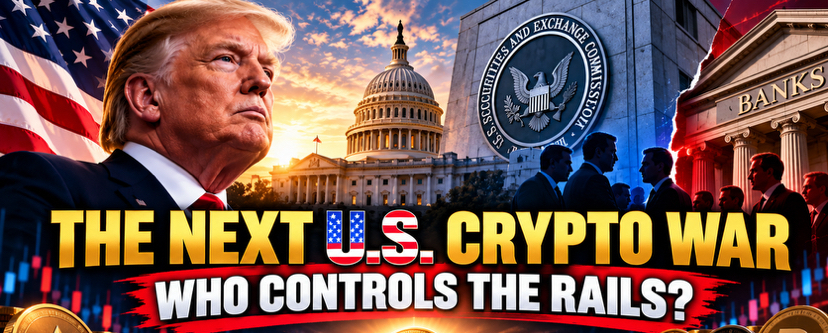

For years, the crypto battle in America looked pretty simple:
Crypto vs regulators.
But something different is happening now.
And I think traders focusing only on Bitcoin candles may be missing the bigger story.
On October 1, the U.S. SEC proposed a new framework addressing how registered investment advisers and regulated funds can custody crypto assets.
This isn’t a final rule yet. It still has to go through the regulatory process.
But the direction is interesting.
The conversation is increasingly moving away from:
“Should traditional finance touch crypto?”
toward:
“How should traditional finance hold and use crypto?”
That’s a very different conversation.
Then, one day later, the banks entered the picture.
On October 2, the Independent Community Bankers of America sued the Office of the Comptroller of the Currency over its approach to national trust-bank charters being used by crypto companies.
The banking group argues that the OCC has gone beyond its legal authority and that these firms shouldn’t receive access to the federal banking system without comparable regulatory requirements.
Those are allegations in an ongoing legal challenge—not a court finding.
But forget the legal argument for a second.
Look at what the fight itself tells us.
Crypto companies aren’t just building exchanges anymore.
They’re moving toward:
Custody.
Payments.
Stablecoins.
Settlement.
Institutional infrastructure.
In other words…
the rails.
And this is where the Trump story gets more interesting. 🇺🇸
The Trump administration has explicitly pushed toward making the United States a major global center for digital assets and integrating crypto more deeply into the existing financial system.
That sounds bullish when reduced to a headline.
But actually rebuilding financial infrastructure around digital assets is much more complicated.
Because once crypto companies start operating in areas traditionally occupied by banks and other regulated financial institutions, the question changes.
It’s no longer simply:
“Will America allow crypto?”
It becomes:
“Who gets to control the infrastructure?”
Banks?
Crypto-native companies?
Asset managers?
Fintechs?
Or some combination of all four?
And that could become one of the most important U.S. crypto stories to watch.
This isn’t necessarily a Bitcoin-pumps-tomorrow story.
That’s important.
A regulatory proposal doesn’t guarantee institutional money suddenly enters crypto.
A lawsuit doesn’t automatically hurt crypto.
And political support doesn’t remove regulatory, legal or market risk.
I’m looking at something longer term.
If digital assets genuinely become part of America’s mainstream financial system, enormous businesses could eventually compete over:
who holds the assets,
who issues the stablecoins,
who processes the payments,
who settles the transactions,
and who owns the relationship with the customer.
That’s much bigger than another green candle.
For years everyone asked:
“Will Wall Street enter crypto?”
Maybe we’re approaching a more interesting question:
What happens when crypto starts entering Wall Street’s territory? 👀
Because the next major U.S. crypto battle might not be about the price of Bitcoin.
It might be about something much more valuable:
Who controls the rails.
— Master CX
#CryptoNews
#CryptoRegulation #USCrypto