

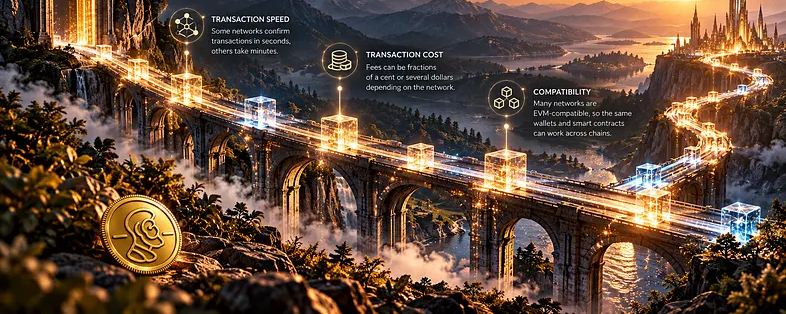

Transaction speed, fees, and compatibility all trace back to one technical choice most people never look at
Every crypto token runs on top of a blockchain network, and that choice shapes almost everything about how the token behaves — yet it’s rarely the first thing people check.
What a Blockchain Actually Does
A blockchain is a distributed ledger: a record of transactions maintained by thousands of independent computers (nodes) instead of one central server. They all keep a copy and agree on its contents through a consensus mechanism, which is simply a set of rules for how the network decides what’s true. This is why no single party can quietly rewrite history or freeze an account — doing so would require overpowering the majority of the network at once.
Different blockchains make different trade-offs in how they achieve this, and those trade-offs are what you actually experience as a user.
Three Things That Depend on the Network Choice
Transaction speed. Some networks confirm transactions in seconds; others take minutes. This comes down to how often new blocks are produced and how consensus is reached.
Transaction cost. Fees (often called “gas”) vary enormously between networks — from a fraction of a cent to several dollars — depending on how much demand competes for limited block space.
Compatibility. Many newer networks are EVM-compatible, meaning they can run smart contracts written in Solidity, the same language used on Ethereum. This lets the same wallets (like MetaMask) and the same contract code work across multiple chains with minimal changes.
The Trade-Off Nobody Advertises
Faster, cheaper networks usually achieve that by using a smaller, more curated set of validators compared to fully permissionless networks. This is a well-known and widely discussed trade-off in blockchain design — between decentralization, speed, and cost — not a flaw unique to any one network or project.