


Zcash Craters 21% From $1,698 Peak: ETF Outflows and a $387M North Korean-Linked Heist Just Stress-Tested the Privacy Trade
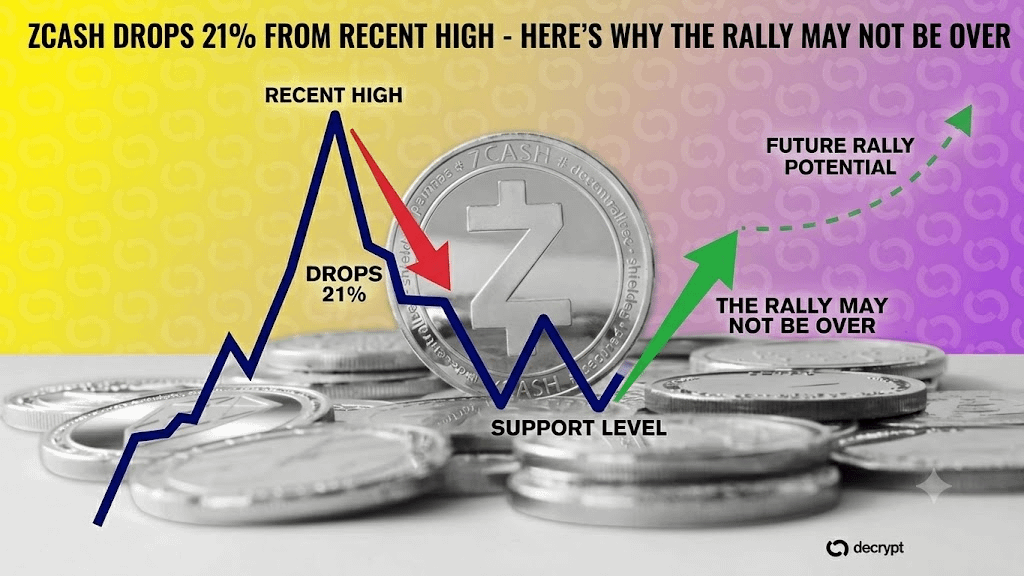
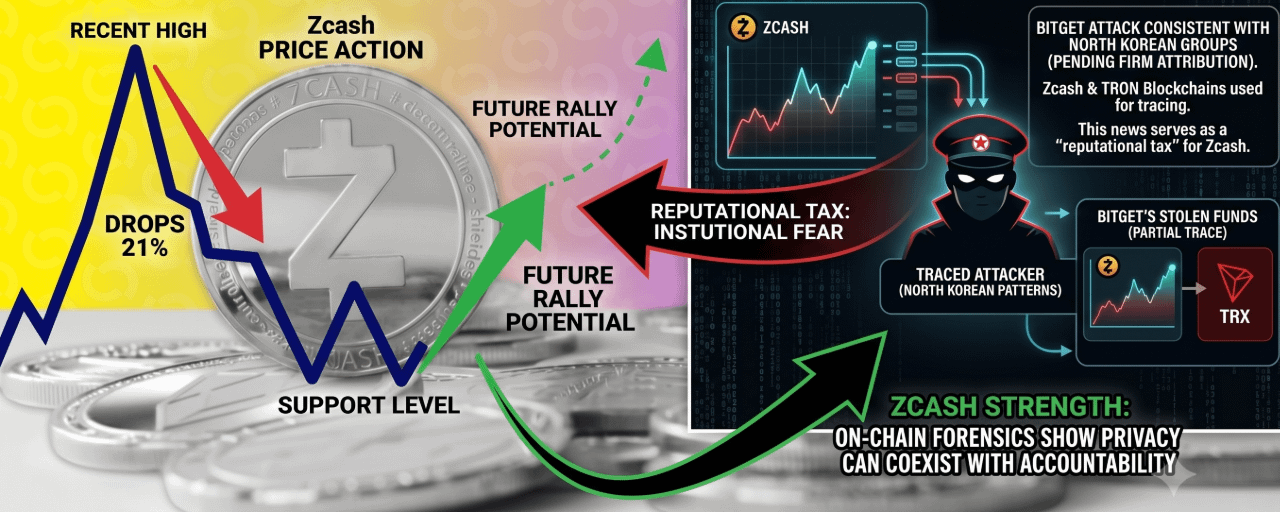
Zcash is trading at $1,333.50, down 7.29% on the day and roughly 21% below its late-September peak of $1,698.00 — a violent cooldown after a 253% vertical run from a $480.72 base.
Two catalysts hit the tape within days of each other: a $30.25 million net outflow from Grayscale's Zcash ETF (ticker ZCSH) on Sept. 30, and a $387 million exchange hack at Bitget that routed stolen funds through Zcash and Tron rails — an attribution headache the privacy coin did not need while courting Wall Street.
The question now: is this a healthy reset inside a structural repricing, or the first leg of a distribution cycle?
Cold Open: The Privacy Premium Meets Its First Real Stress Test
ZEC spent September doing what almost no altcoin could — ripping 253% while the broader market chopped. That kind of move attracts two things: momentum capital and exit liquidity. Both showed up this week.
The $30.25M ETF outflow is the first meaningful redemption since ZCSH launched on Aug. 25, and it lands against a cumulative net inflow base of roughly $268 million. One red day does not break a trend, but it does force the market to reprice the "institutional bid is unconditional" thesis.
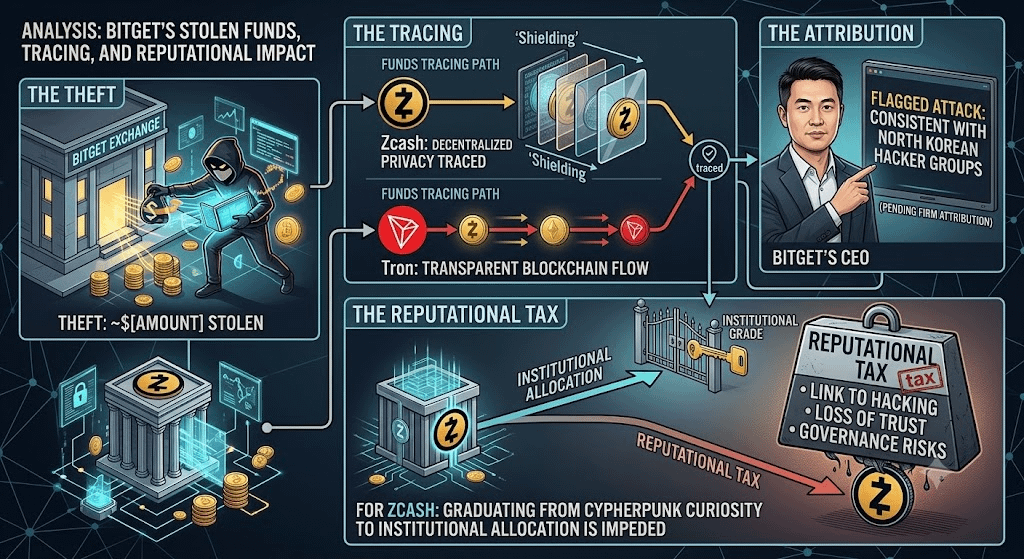
Then came the hack. Bitget's stolen funds were partially traced through Zcash and Tron blockchains, with the exchange's CEO flagging the attack as consistent with North Korean hacker groups — though firm attribution is still pending. For a privacy asset trying to graduate from cypherpunk curiosity to institutional allocation, that headline is a reputational tax.
Chronological Timeline & Verified Data
Aug. 25 — Grayscale launches its Zcash ETF under ticker ZCSH. The vehicle becomes the first clean institutional wrapper for ZEC exposure.
Mid-September — ZCSH accumulates $233 million in net inflows. ZEC simultaneously prints a $1,698.00 peak, capping a 253% advance from its $480.72 base.
Sept. 24 — Hackers drain approximately $387 million from Bitget, revised upward from an initial $351.6 million estimate once transfers on the Zcash and Tron blockchains were counted. Bitget's CEO points to North Korean-linked groups; attribution remains unconfirmed.
Sept. 30 — ZCSH records a $30.25 million net outflow — its first significant redemption — while a 3-for-1 share split takes effect that morning. Cumulative net inflows settle near $268 million.
Oct. 1 — ZEC trades at $1,333.50, down 7.29% on the day, roughly 21% off the peak. Cointelegraph's daily tape shows ZEC at $1,335.25, down 7.19%, confirming the move across independent feeds.
Macro backdrop — Bitcoin spiked to $85,600 on Wednesday after softer-than-expected PCE inflation data, then gave it all back. The 10-year Treasury yield closed at 5.29%. CME FedWatch shows October rate-hike odds collapsing from 70% to below 50%. BTC last printed $84,708, ETH $2,702.57, SOL $118.27, XMR $545.45.
Regulatory crosscurrent — New York's DFS and the Wyoming Division of Banking agreed to coordinate crypto oversight, including shared examination data and a potential six-month expedited review path for firms holding a license or charter for at least three years without enforcement action. Separately, Binance's use of an EU licensing exemption drew regulatory scrutiny, and MetaMask began exiting affected Ethereum staking validators while investigating an undisclosed security incident.
Why the Rally May Not Be Over
Strip out the noise and the structural bid for Zcash remains intact.
First, the ETF flow math is asymmetric. A $30.25M outflow against $268M in cumulative inflows is a 11.3% drawdown in net positioning — meaningful, but not a reversal. The 3-for-1 split mechanically reshuffles share counts and can distort flow optics for a session or two. Watch the next three to five sessions for confirmation of whether this is a one-day redemption or the start of a persistent bleed.
Second, the hack narrative cuts both ways. Yes, Zcash's shielded pool being used to move stolen funds is a compliance red flag. But it is also the single most powerful advertisement for the product's core value proposition. Every enforcement headline that mentions Zcash's privacy guarantees reinforces why the asset exists — and why a subset of capital will keep paying a premium for it.
Third, the macro tape is turning. Rate-hike odds falling from 70% to below 50% is a meaningful shift in the discount-rate regime that has pressured long-duration risk assets all year. If the Fed pivots dovish into October, high-beta privacy names with fresh ETF wrappers are exactly the kind of instrument that catches a bid.
Fourth, the chart structure. A 21% pullback after a 253% advance is textbook profit-taking, not trend destruction. The $1,333 zone sits well above the $480.72 base, and the $1,698 peak is now the level that defines whether this is a bull flag or a lower high.
Trading Angle
Market structure: ZEC's open interest profile after a 253% run is the key variable. If OI is declining alongside price, this is a healthy deleveraging — longs taking profit, not a liquidation cascade. If OI is holding flat or rising into the drop, the setup is fragile and a sweep of late-long stops below $1,300 becomes the base case.
Key levels to monitor:
$1,698 — the prior peak. Reclaiming this invalidates the pullback thesis and opens the door to price discovery.
$1,333–$1,300 — current spot and the first psychological support shelf. A daily close below this zone shifts the bias to neutral.
$1,100–$1,150 — the next structural demand zone if the ETF outflow proves persistent rather than episodic.
$480.72 — the base of the entire move. A retest here would require a full narrative collapse, not just a sentiment wobble.
ETF flow watch: ZCSH's daily net flow is now the single most important sentiment gauge for ZEC. Two consecutive green days would confirm the outflow was a split-related artifact. Three consecutive red days would signal genuine institutional de-risking.
Relative value: ZEC's 7.29% drawdown against Monero's $545.45 print (down 0.66%) shows the selling is Zcash-specific, not a privacy-sector rotation. That divergence is either an opportunity or a warning — the tape will decide.
Macro overlay: With the 10-year at 5.29% and Fed odds shifting, any dovish surprise in October data is a tailwind for high-beta names. Conversely, a hot inflation print re-arms the hawkish case and pressures ZEC back toward the $1,100 shelf.
The hack overhang: Watch for on-chain analytics firms publishing detailed flow tracing of the Bitget funds. If the Zcash shielded pool is named prominently in follow-up reports, expect a second sentiment leg down. If the story fades, the reputational hit is contained.
Positioning takeaway: The structural thesis — institutional wrapper, privacy premium, macro tailwind — is intact. The tactical setup — first ETF outflow, hack headline, 21% drawdown — is messy. Traders buying the dip need a defined invalidation level, and $1,300 on a daily close is the cleanest one available.
Sources
Decrypt: Zcash Drops 21% From Recent High—Here's Why the Rally May Not Be Over
Cointelegraph: Here's what happened in crypto today (NY-Wyoming pact, Binance EU scrutiny, MetaMask security incident)
💡 Disclaimer: This analysis compiles verified media reports and open-source intelligence for independent research (DYOR). Digital asset markets are highly volatile; scenarios discussed do not constitute financial advice or investment recommendations.
#Zcash #CryptoNews #BinanceSquare #MarketUpdate #PrivacyCoins