

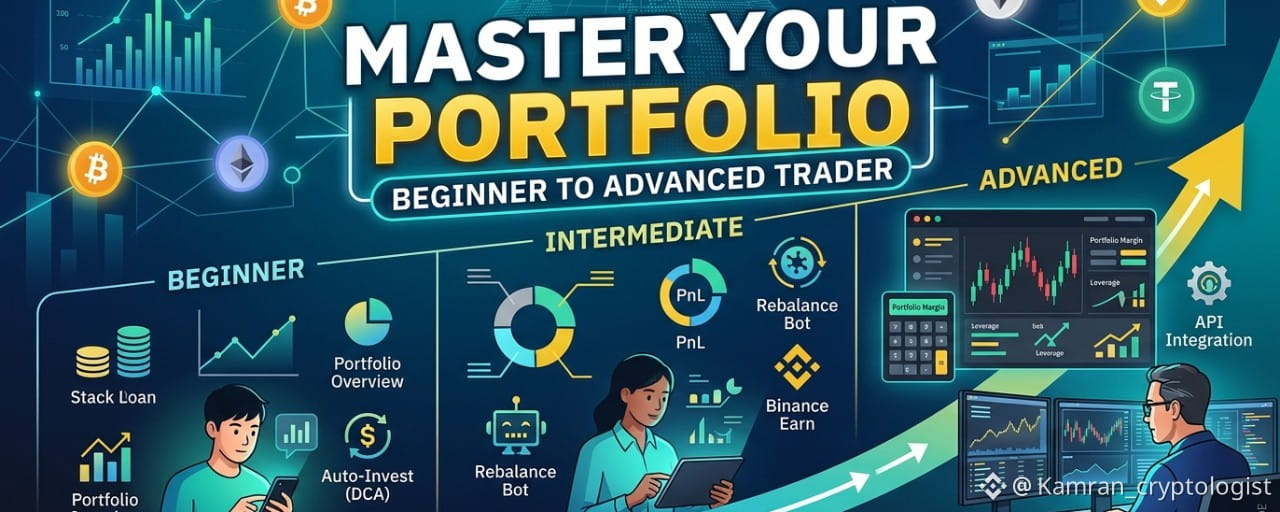

Whether you are placing your very first spot trade or managing complex multi-asset positions, taking control of your portfolio management is key to long-term success.
Here is how you can leverage Binance's built-in portfolio features at every stage of your trading journey. 👇
🟢 Level 1: The Beginner Trader (Focus: Organization & Clarity)
When starting out, clarity is everything. Avoid clutter and keep track of your holdings effortlessly.
Portfolio Overview: Navigate to Wallets > Overview to see your total asset distribution split by currency and asset type.
Hide Small Balances: Clean up your wallet view by toggling off low-value residual balances or using the Convert Low-Value Balances to BNB feature.
Auto-Invest (Dollar-Cost Averaging): Set up automated daily or weekly buys for blue-chip assets to build a disciplined portfolio without timing the market.
🟡 Level 2: The Intermediate Trader (Focus: Asset Allocation & PnL Tracking)
Once you begin diversifying across Spot, Earn, and Futures, tracking individual asset performance becomes crucial.
Binance PnL (Profit & Loss) Analytics: Check your daily and cumulative profit/loss charts under Spot Wallet > Analytics. Identify which coins are driving returns and which are dragging down performance.
Portfolio Rebalancing: Use the Rebalance Bot (under Trade > Trading Bots) to maintain your target asset allocation automatically. If BTC surges while altcoins lag, the bot auto-adjusts to preserve your risk ratio.
Binance Earn Integration: Don't let idle assets sit around. Allocate a portion of your portfolio to Simple Earn (Flexible or Locked) to earn passive yield while holding.
🔴 Level 3: The Advanced Trader (Focus: Risk Hedging & Capital Efficiency)
Advanced traders focus on margin efficiency, risk management, and cross-market strategies.
Portfolio Margin Mode: Unify your equity across Spot, Cross Margin, USDT-M Futures, and COIN-M Futures. This enhances capital efficiency by allowing unrealized profits in one product to offset margin requirements in another.
Sub-Accounts: Separate distinct strategies (e.g., long-term holding vs. high-frequency grid trading) by creating Sub-Accounts to prevent one strategy's risk from impacting another.
API Integration & Analytics: Connect your Binance portfolio to external analytics dashboards or automated trading systems using Binance APIs for custom performance metrics and risk monitoring.
💡 Pro-Tip: Proper portfolio management isn't just about maximizing gains—it's about managing downside risk. Set clear stop-loss levels and never over-leverage a single asset class.
How do you structure your portfolio management strategy? Drop your tips below! 👇


#cryptotrading #PortfolioManagement #tradingtips #cryptoeducation