South Korea isn't treating tokenized securities as a separate crypto experiment. It’s trying to bring blockchain into the existing capital market.
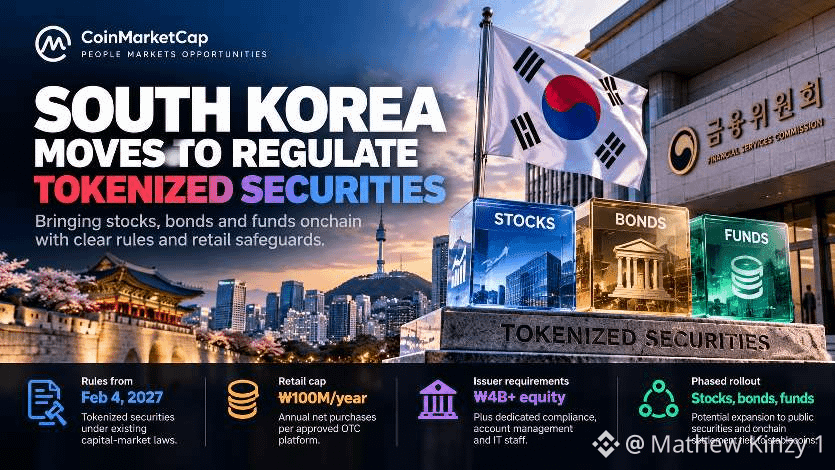
The Financial Services Commission has proposed rules supporting the tokenization of traditional securities including stocks, bonds and funds, with the legal framework scheduled to begin taking effect on February 4, 2027. Importantly, these assets would remain securities under existing capital-market rules rather than becoming a separate crypto asset class.
The rollout is deliberately phased. The first stage focuses on areas including institutional private MMFs and bonds, unlisted shares and fractional-investment securities. Later phases could expand into publicly offered securities and ultimately an onchain settlement layer connected to stablecoins, although those later stages have no fixed timetable.
There are guardrails too. The proposal currently sets a ₩100M annual net-purchase limit per approved OTC venue for retail investors, while certain institutions directly managing token-security accounts would need at least ₩4B in equity capital plus dedicated compliance, account-management and IT personnel. Those details remain subject to consultation from October 2 to November 11.
That’s what makes this bigger than another RWA headline.
If tokenization moves from experimental assets into ordinary stocks, bonds and funds, the real opportunity may increasingly shift toward the infrastructure connecting issuance, compliance, custody, distribution and settlement.
The RWA race isn't only about putting assets onchain anymore.
It’s about rebuilding the rails underneath capital markets.
$LINK $ETH $SOL $ONDO $BKN
The Financial Services Commission has proposed rules supporting the tokenization of traditional securities including stocks, bonds and funds, with the legal framework scheduled to begin taking effect on February 4, 2027. Importantly, these assets would remain securities under existing capital-market rules rather than becoming a separate crypto asset class.
The rollout is deliberately phased. The first stage focuses on areas including institutional private MMFs and bonds, unlisted shares and fractional-investment securities. Later phases could expand into publicly offered securities and ultimately an onchain settlement layer connected to stablecoins, although those later stages have no fixed timetable.
There are guardrails too. The proposal currently sets a ₩100M annual net-purchase limit per approved OTC venue for retail investors, while certain institutions directly managing token-security accounts would need at least ₩4B in equity capital plus dedicated compliance, account-management and IT personnel. Those details remain subject to consultation from October 2 to November 11.
That’s what makes this bigger than another RWA headline.
If tokenization moves from experimental assets into ordinary stocks, bonds and funds, the real opportunity may increasingly shift toward the infrastructure connecting issuance, compliance, custody, distribution and settlement.
The RWA race isn't only about putting assets onchain anymore.
It’s about rebuilding the rails underneath capital markets.
$LINK $ETH $SOL $ONDO $BKN