

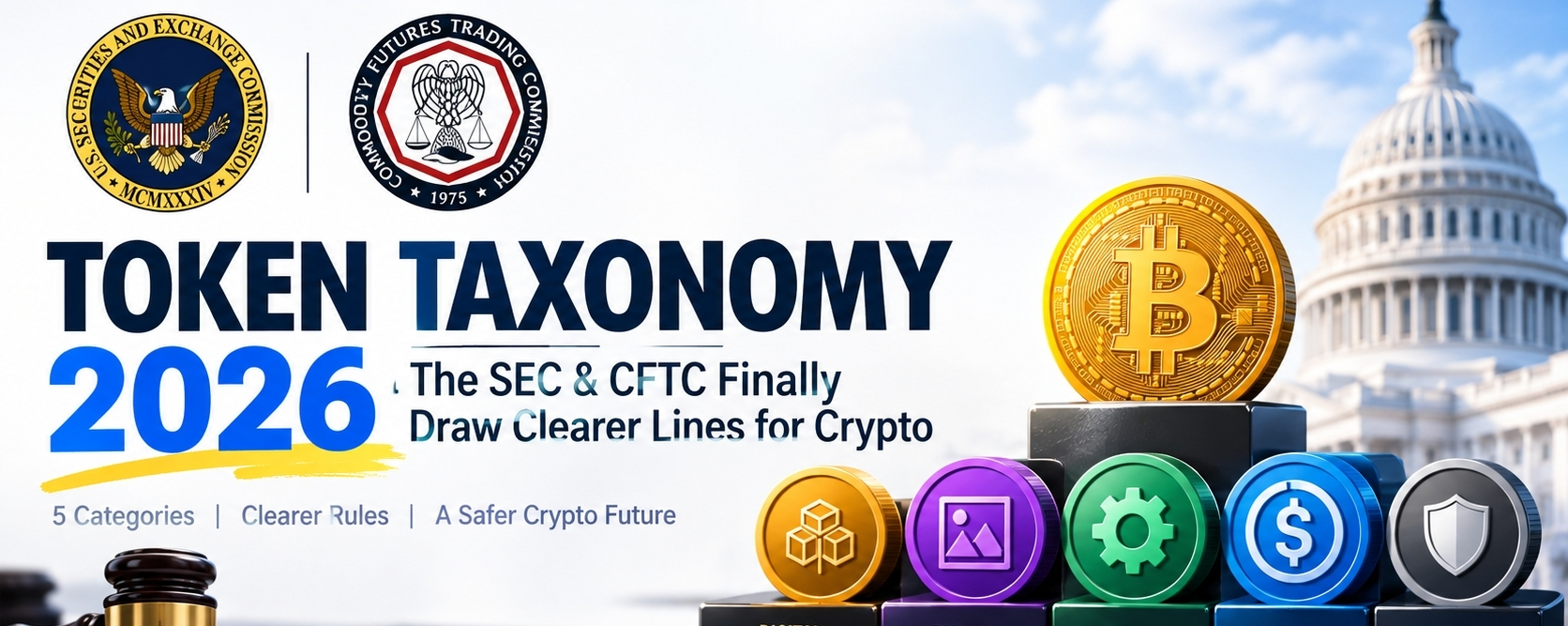

The U.S. crypto market entered a new regulatory phase in 2026.
On March 17, the SEC, with the CFTC joining its interpretation, released a framework that classifies crypto assets according to their characteristics, uses, and functions. The framework identifies five broad categories: digital commodities, digital collectibles, digital tools, stablecoins, and digital securities.
The most important takeaway for crypto investors is simple:
A token is not automatically a security just because it exists on a blockchain.
Under the new interpretation, digital commodities, digital collectibles, and digital tools are generally treated as non-securities in themselves, while digital securities remain securities. Stablecoins require analysis based on their specific characteristics.
But there is an important distinction that investors should not overlook.
A non-security crypto asset can still be offered or sold through an investment contract. The SEC says this can depend on whether buyers were led to expect profits from essential managerial efforts promised by the issuer. In other words, the token itself and the investment contract surrounding its sale can be legally distinct.
This distinction could become increasingly important for crypto projects, exchanges, developers and investors.
Why does this matter?
Regulatory clarity can reduce uncertainty around how different crypto assets are treated. It may also make it easier for market participants to understand where SEC and CFTC jurisdiction may apply. The CFTC stated that certain non-security crypto assets could also fall under the definition of commodities under the Commodity Exchange Act.
However, this should not be interpreted as a blanket approval of cryptocurrencies.
A token's classification depends on its actual characteristics, structure, use, and the circumstances surrounding its offering. Investors should still examine tokenomics, decentralization, issuer involvement, disclosures, liquidity, and the project's underlying fundamentals rather than relying only on a regulatory narrative.
Another important development is that the SEC proposed additional rules in August 2026 concerning certain investment contracts involving crypto assets. That proposal is still a proposal, with public comments due October 20, 2026.
SEC The bigger picture
Crypto regulation is moving from a simple “security vs. non-security” debate toward a more detailed classification framework.
For the industry, that means regulatory analysis is becoming more nuanced.
For investors, it means one thing: don't buy a token simply because a headline says it is “not a security.” Understand what the token actually does, how it was distributed, and what promises were made to purchasers.
The 2026 SEC/CFTC framework is therefore not just a regulatory update—it is an important development in how the U.S. may define the next phase of the digital-asset market.
DISCLAIMER:
This is educational content, not financial or legal advice. Crypto assets remain highly volatile and regulatory treatment can evolve.