


Crypto markets can be confusing.
Prices move quickly, social media is full of opinions, and news can change market sentiment within minutes.
But there is another source of information that can help crypto learners understand what is happening beneath the surface:
**On-chain data.**
So, what exactly is on-chain analysis?
## What Is On-Chain Analysis?
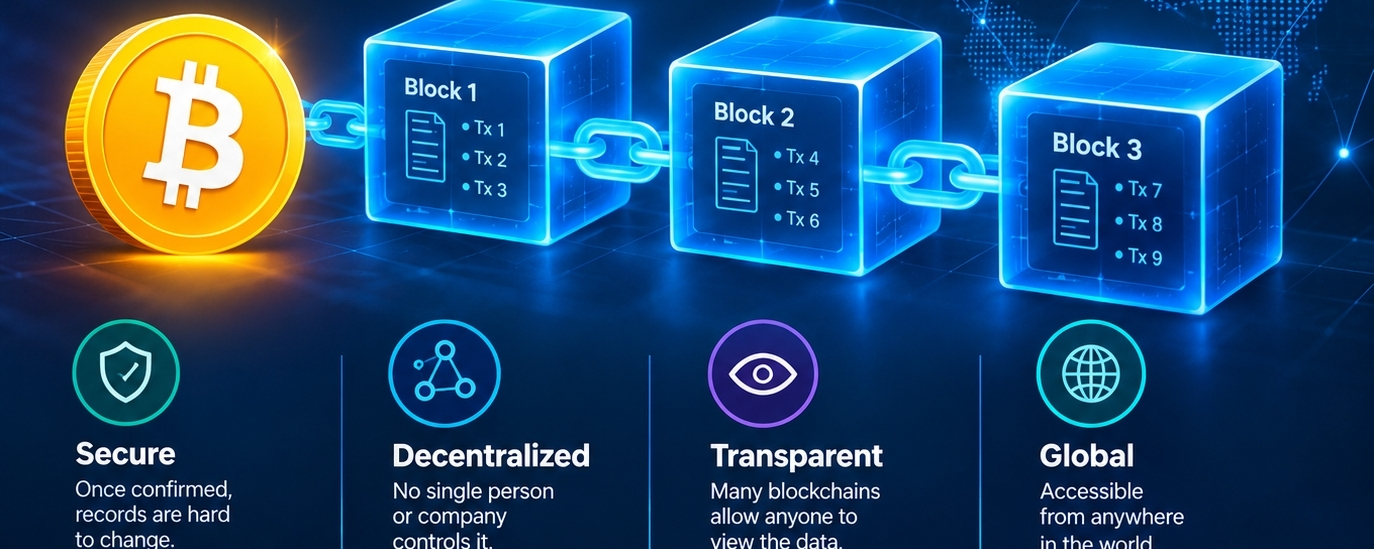
**On-chain analysis** means studying data that is recorded directly on a blockchain.
Unlike traditional financial markets, many public blockchains make transaction activity publicly visible.
Researchers can examine information such as:
* Wallet activity
* Transaction volume
* Exchange inflows and outflows
* Token transfers
* Whale activity
* Active addresses
* Network activity
* Supply movements
In simple terms:
> **On-chain analysis = studying blockchain activity to understand market behavior.**
## A Simple Example
Imagine Bitcoin's price is moving sideways.
Instead of looking only at the price chart, you might examine blockchain data.
You could ask:
**Are large wallets accumulating BTC?**
**Are more coins moving toward exchanges?**
**Is network activity increasing or decreasing?**
These observations don't automatically tell you what the price will do.
However, they can provide additional context.
## What Is Whale Activity?
A **whale** generally refers to an entity or wallet holding a large amount of cryptocurrency.
On-chain analysts monitor large transfers because significant movements can sometimes provide useful information about how large holders are moving their assets.
For example:
**Large wallet → Exchange**
This may indicate that the holder is preparing to sell, although it does **not** prove that a sale will happen.
Similarly:
**Exchange → Private wallet**
This may indicate that coins are being withdrawn from an exchange, but the reason for the transfer can vary.
That's why on-chain data should be interpreted carefully.
## Exchange Inflows and Outflows
One commonly discussed metric is exchange flow.
### Exchange Inflow
Coins move **into an exchange**.
Possible reasons include:
* Preparing to trade
* Selling
* Moving assets between accounts
* Other operational reasons
### Exchange Outflow
Coins move **away from an exchange**.
Possible reasons include:
* Long-term holding
* Self-custody
* Transfers to another platform
* Other operational reasons
Therefore, an inflow or outflow should not automatically be interpreted as bullish or bearish.
## Active Addresses
Another useful metric is **active addresses**.
It measures blockchain addresses involved in transactions during a particular period, depending on the methodology used by the data provider.
Increasing activity can indicate that more addresses are interacting with the network.
But more active addresses don't automatically mean the cryptocurrency's price will increase.
Context matters.
## Transaction Volume
On-chain analysts can also examine transaction activity.
For example, unusually high transaction volume may indicate increased network activity.
But transaction volume alone doesn't tell us whether buyers or sellers are in control.
It needs to be combined with other information.
## Why On-Chain Analysis Matters
Traditional market analysis often focuses on:
**Price + Volume + Technical Indicators**
On-chain analysis adds another layer:
**Blockchain Activity + Wallet Behavior + Network Data**
This can help traders, researchers, and investors understand how assets are moving across a blockchain.
## On-Chain Analysis vs Technical Analysis
These two approaches are different.
### Technical Analysis
Technical analysis primarily studies market data such as:
* Price
* Volume
* Candlestick patterns
* Support and resistance
* Moving averages
* Momentum indicators
### On-Chain Analysis
On-chain analysis focuses on blockchain data such as:
* Wallet movements
* Transactions
* Exchange flows
* Token supply
* Network activity
* Holder behavior
Some crypto analysts use both approaches together.
## Important Limitations
On-chain analysis is useful, but it isn't a crystal ball.
A wallet address doesn't always reveal the identity or intention of its owner.
One entity may control multiple addresses, while exchanges and other services may use many addresses.
Transfers can also happen for reasons unrelated to buying or selling.
Therefore:
**On-chain data provides clues, not guaranteed predictions.**
## Beginner On-Chain Checklist
When studying a cryptocurrency, start with a few simple questions:
1. Is network activity increasing or decreasing?
2. Are large wallets moving significant amounts?
3. Are tokens moving toward or away from exchanges?
4. Is transaction activity changing?
5. Is the circulating supply changing?
6. What is happening with price and volume at the same time?
7. Is there a fundamental or news event that explains the movement?
This approach can help you avoid relying on a single metric.
## Final Takeaway
On-chain analysis is essentially about **looking inside the blockchain**.
Instead of watching only the price chart, you can study how wallets, tokens, and transactions are moving across the network.
Remember:
**Price tells you what happened in the market.**
**On-chain data can provide additional context about what is happening on the network.**
The key is not to treat one metric as a guaranteed signal.
**Learn the data. Check the context. Do your own research.**
### Disclaimer
This article is for **educational and informational pu
rposes only**. It is not financial, investment, or trading advice. Cryptocurrency markets are highly volatile and involve significant risk. Always conduct your own research before making financial decisions.