

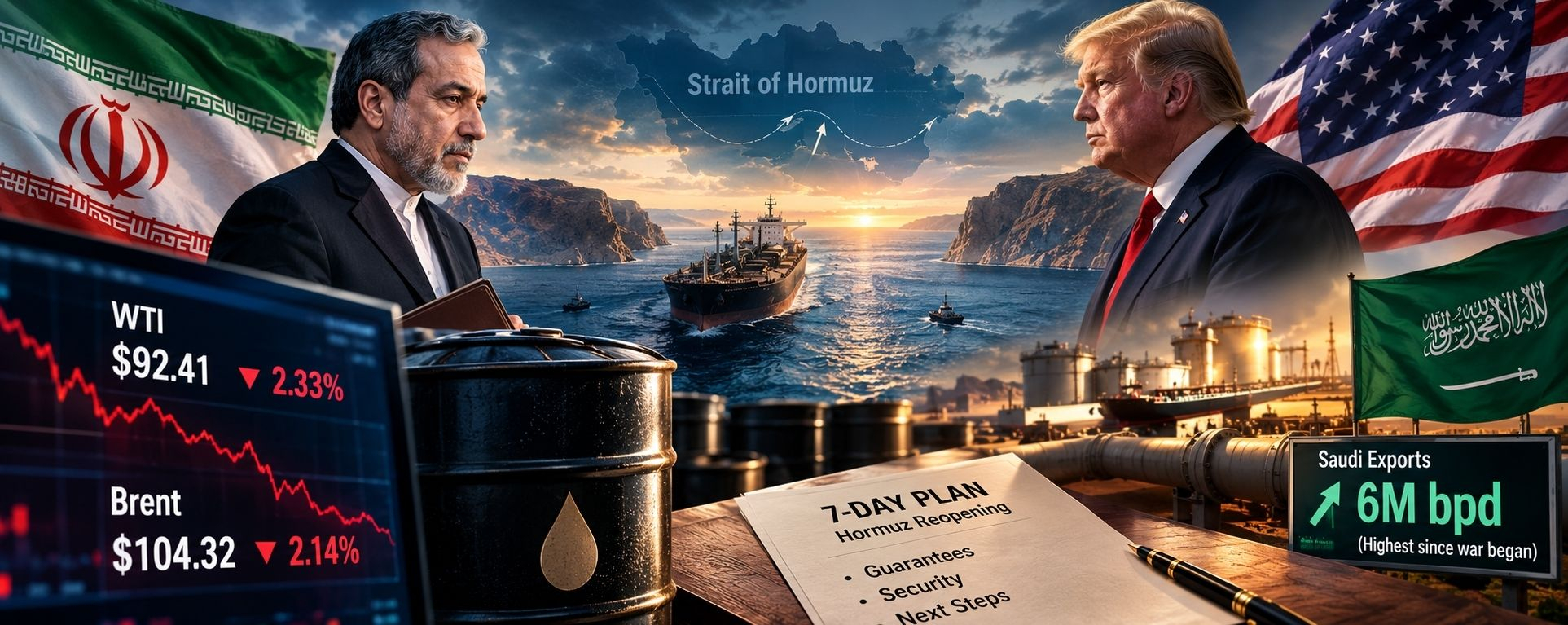

Oil prices took another sharp turn lower on Friday after reports that Iran had presented the United States with a seven-day framework aimed at reopening the Strait of Hormuz.
The move immediately caught the attention of traders because the strait remains one of the biggest pressure points in the global oil market. Any credible sign that traffic could resume normally would reduce fears of a prolonged supply disruption.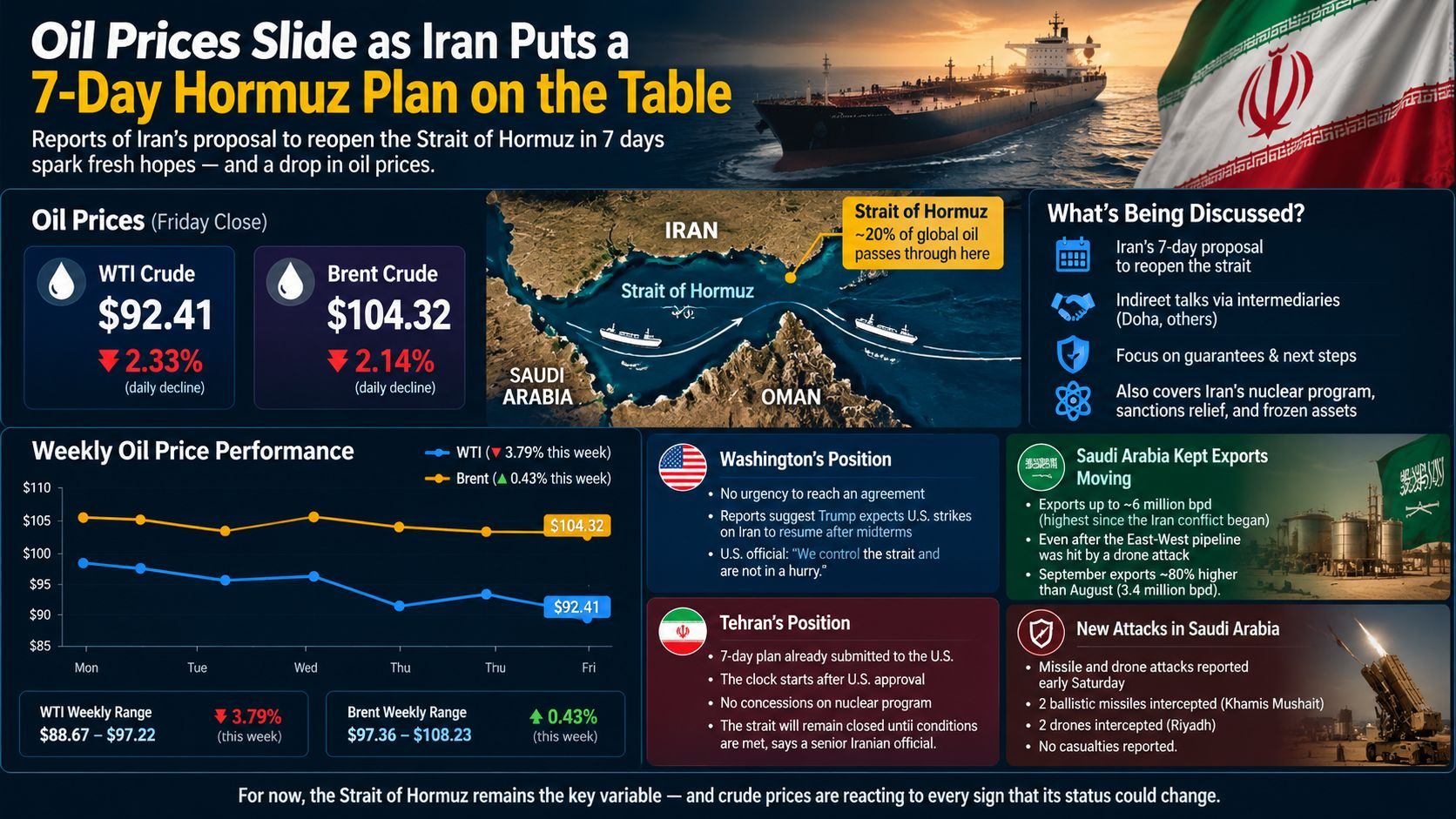
WTI crude settled at $92.41 a barrel, down 2.33%, while Brent ended the session at $104.32, falling 2.14%.
WTI has been particularly volatile. The contract started the week around $96.75, briefly climbed to $97.22 and then plunged as low as $88.67 before recovering. Over the week, WTI fell 3.79%, following a 3.97% decline the previous week.
Brent has behaved somewhat differently. It gained 0.43% over the week, despite Friday's decline, after losing 0.71% the week before.
Iran Says the Next Move Is Washington's
According to Iranian officials, Tehran has already put a concrete proposal in front of Washington.
Iranian Foreign Minister Abbas Araghchi said the plan would begin once the United States agrees to it. Tehran's position is that the necessary steps have already been outlined in the earlier memorandum of understanding.
Indirect contacts between the two sides are reportedly continuing through intermediaries. Sources cited by regional media say discussions are focusing on guarantees, sequencing and what would happen after an initial agreement.
The talks have reportedly moved beyond informal political contacts into more technical discussions, with representatives from both sides taking part.
Qatar has also emerged as an important intermediary, pushing a much faster timetable for reopening the Strait of Hormuz.
Seven Days vs. Sixty Days
The proposed seven-day timeline is significantly shorter than the 60-day framework that had previously been discussed.
But reopening the strait is not simply a matter of announcing a ceasefire or reaching a political understanding.
Questions remain over how shipping would be protected, what rules would govern the passage of American vessels and how Iran, Oman, other regional countries and the United States would coordinate operations.
That makes the Strait of Hormuz issue much more complicated than the headline numbers suggest.
Washington Has Its Own Timeline
The biggest obstacle may be that Tehran and Washington do not appear to be working against the same clock.
Iran is presenting the seven-day proposal as an immediate path toward reopening the strait.
The Trump administration, meanwhile, has shown little indication that it is under the same pressure to reach an agreement. Reports have also suggested that Washington remains skeptical about whether Tehran would honor a new deal.
That gap between the two positions is one reason oil traders remain cautious.
A diplomatic breakthrough could quickly remove part of the geopolitical premium built into crude prices. But if negotiations stall, the market could once again focus on the physical risk to oil shipments through the Gulf.
Saudi Arabia Is Adjusting to the Disruption
Saudi Arabia is meanwhile finding ways to keep barrels moving.
Trade intelligence data from Kpler indicates that Saudi exports have climbed to around 6 million barrels per day, the highest level since the conflict with Iran began and roughly back in line with the kingdom's 2025 average.
That is particularly significant because Saudi Arabia has also faced problems with alternative export infrastructure.
Even after the East-West pipeline was taken offline following a drone attack launched from Iraq, Riyadh has managed to maintain substantial export volumes.
September exports are reportedly close to 80% higher than August's average of about 3.4 million barrels per day.
The Risk Hasn't Disappeared
Higher Saudi exports may be helping to calm some supply fears, but the broader situation remains fragile.
Saudi authorities reported another wave of missile and drone attacks early Saturday, including interceptions involving missiles heading toward Khamis Mushait and drones directed toward Riyadh.
No casualties were reported.
For oil traders, the bigger question is now what happens next.
Iran has put a seven-day framework on the table. Qatar is pushing for rapid progress. Washington appears less willing to move on Tehran's timetable.
Until those positions converge, the oil market is likely to remain highly sensitive to every headline coming out of Washington, Tehran and the Gulf.