

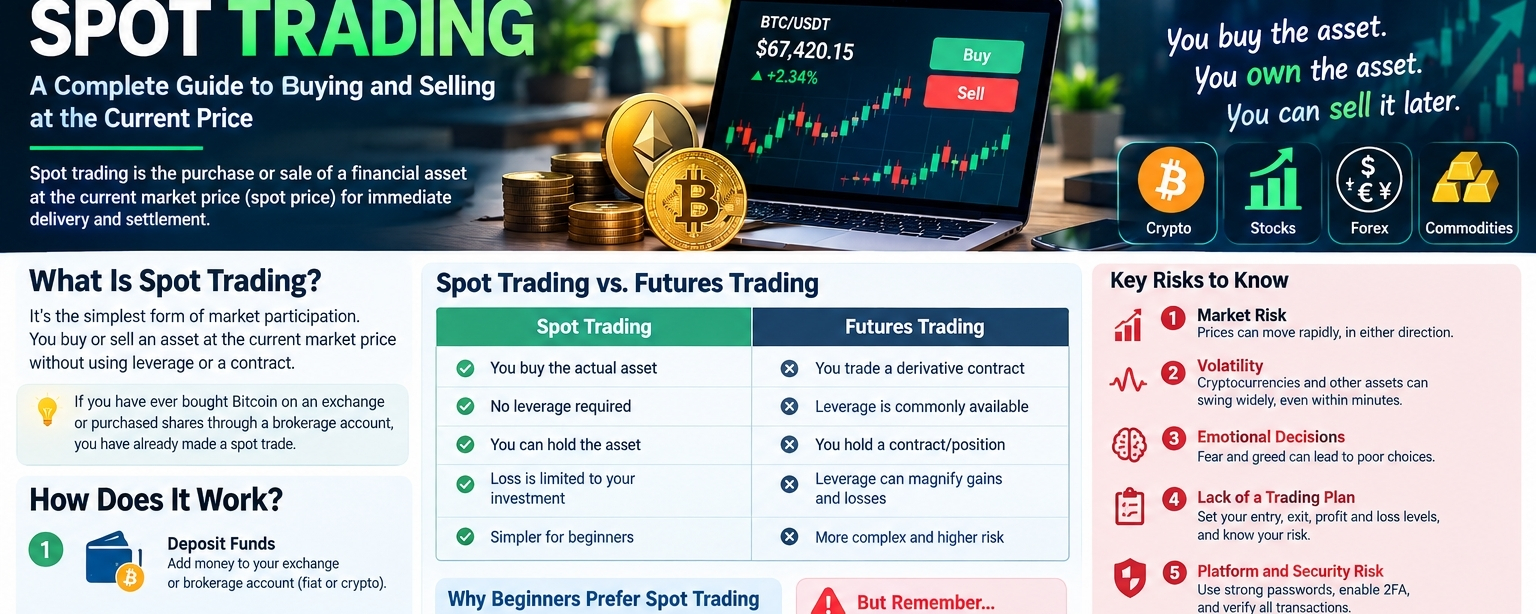

Spot Trading: A Complete Beginner’s Guide to Buying and Selling at the Current Price
Spot trading is one of the simplest ways to participate in financial markets. You buy or sell an asset at its current market price—known as the spot price—and, in the case of an immediately settled asset such as cryptocurrency, you receive ownership of that asset.
If you have ever bought Bitcoin on a cryptocurrency exchange or purchased shares through a brokerage account, you have experienced the basic idea behind spot trading.
Unlike futures or other derivatives, spot trading generally involves buying the actual asset rather than a contract whose value is based on that asset.
What Is Spot Trading?
In simple terms:
You buy an asset → you own the asset → you can later sell it.
For example, suppose Bitcoin is trading at $100,000.
If you use $1,000 to buy Bitcoin through spot trading, you receive approximately 0.01 BTC, before fees and assuming the market price remains unchanged during execution.
If Bitcoin later rises to $110,000 and you sell your 0.01 BTC, the value would be approximately $1,100 before fees and taxes.
The opposite is also possible. If Bitcoin falls to $90,000, your 0.01 BTC would be worth approximately $900.
This is the basic principle of spot trading: your profit or loss comes from the change in the asset's price.
How Does Spot Trading Work?
A typical spot trade has four basic steps:
1. Deposit funds
You first add money to your exchange or brokerage account.
Depending on the platform, this might be fiat currency such as USD or PKR, or another cryptocurrency.
2. Select an asset
You choose what you want to trade—for example:
Bitcoin (BTC)
Ethereum (ETH)
Stocks
Currency pairs
Gold or other commodities
3. Place an order
You decide how you want to buy or sell the asset.
Common order types include:
Market order: Executes at the best available price.
Limit order: Executes only at your specified price or better.
Stop order: Used to trigger an order when the market reaches a specified level.
4. Hold or sell
After purchasing an asset through spot trading, you can hold it or sell it later.
Your result depends on the difference between your purchase price and selling price, minus applicable fees and other costs.
Spot Trading vs. Futures Trading
One of the most important concepts for beginners is understanding the difference between spot and futures trading.
Spot TradingFutures TradingYou generally buy the underlying assetYou trade a derivative contractNo leverage is requiredLeverage is commonly availableYou can hold the assetYou hold a contract/positionLoss is generally limited to the amount invested in the assetLeverage can magnify gains and lossesSimpler for beginnersMore complex and higher risk
For example, if you buy $500 worth of Bitcoin in the spot market, you are purchasing Bitcoin.
In a futures market, you could instead open a contract based on Bitcoin's price without actually owning the Bitcoin.
Why Beginners Often Prefer Spot Trading
Spot trading can be easier to understand because the basic transaction is straightforward.
You purchase an asset and can hold it for as long as you want, subject to the platform and asset involved.
There is generally no liquidation mechanism simply because the market price falls, as there can be with leveraged positions.
However, spot trading is not risk-free.
If you buy an asset at $100 and its price falls to $50, your investment has lost 50% of its market value.
Important Risks of Spot Trading
1. Market risk
Prices can move rapidly, particularly in cryptocurrency markets.
An asset that rises significantly can also fall sharply.
2. Volatility
Cryptocurrencies can experience large price movements within hours or even minutes.
Beginners should avoid assuming that recent price increases will continue indefinitely.
3. Emotional decisions
Fear and greed can influence trading decisions.
Buying because a price is rapidly increasing or selling because of a sudden drop can lead to poor decisions.
4. Lack of a trading plan
Before entering a trade, consider:
Why am I buying?
At what price would I take profit?
At what point would I accept a loss?
How much capital am I willing to risk?
Am I investing or actively trading?
Having clear rules can help reduce impulsive decisions.
5. Platform and security risk
When trading cryptocurrency, the exchange or wallet you use also matters.
Use strong passwords, enable two-factor authentication, and carefully verify withdrawal addresses and transaction details.
Spot Trading Does Not Mean Guaranteed Profit
This is perhaps the most important lesson for beginners.
Spot trading is simple in structure, but making consistent profits is not simple.
Buying an asset does not guarantee that its price will increase.
Successful trading requires understanding market conditions, managing risk, controlling emotions, and accepting that some trades will lose money.
A Simple Example
Imagine you have $1,000 and decide to buy an asset at $100.
You receive:
$1,000 ÷ $100 = 10 units
If the price rises to $120:
10 × $120 = $1,200
Your gross gain is:
$1,200 − $1,000 = $200
If instead the price falls to $80:
10 × $80 = $800
Your unrealized loss is:
$800 − $1,000 = −$200
Trading fees, spreads, taxes, and other costs can reduce the actual result.
Final Thoughts
Spot trading is one of the most straightforward ways to participate in financial markets. You buy an asset at the current market price and can later sell it at another price.
For beginners, understanding the difference between spot, margin, and futures trading is essential before putting real money into the market.
Start by learning the basics, use small amounts if you decide to practice, understand the risks, and never trade money you cannot afford to lose.
Spot trading may be simple to understand—but disciplined risk management is what makes it sustainable.