


September 26, 2026
One of the most important crypto developments this year happened without a major Bitcoin price candle.
It happened in Washington.
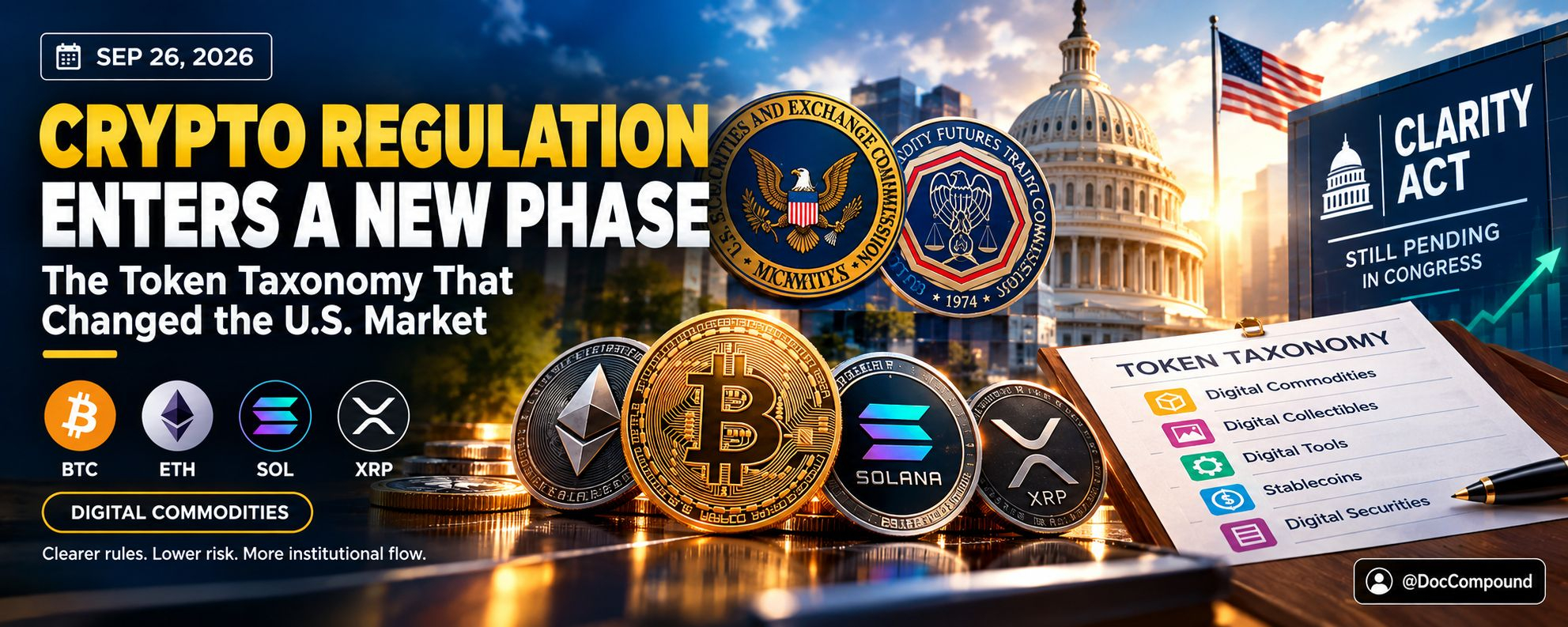
On March 17, the SEC and CFTC jointly clarified how U.S. securities and commodities laws apply to crypto assets. The framework created five categories: digital commodities, digital collectibles, digital tools, stablecoins, and digital securities.
And for major cryptocurrencies, the implications are significant.
1️⃣ BTC, ETH, SOL & XRP: Digital Commodities
The SEC's framework explicitly identifies Bitcoin, Ether, Solana and XRP, alongside other assets including LINK, ADA, AVAX and DOT, as examples of digital commodities.
Importantly, the release lists 18 assets as digital commodities—not 16. Sixteen of those currently underlie CFTC-regulated futures contracts.
That's an important distinction.
This isn't simply a list of cryptocurrencies receiving a regulatory "stamp of approval." The agencies explained the classification based on the characteristics, functionality and economics of the underlying crypto systems.
Commodity Futures Trading Commission
2️⃣ Why This Matters
For years, one of the biggest uncertainties surrounding crypto in the U.S. was:
Is this token a commodity, a security, or something else?
The March framework provides a much clearer regulatory taxonomy.
That can reduce uncertainty for:
🏦 Financial institutions
🏢 Exchanges and intermediaries
📊 ETF and investment-product providers
💰 Institutional investors
🛠️ Developers and crypto businesses
The SEC itself said the interpretation was intended to provide market participants with greater clarity regarding the regulatory jurisdiction between the SEC and CFTC.
3️⃣ But Here's the Catch
Regulatory clarity is not the same thing as permanent statutory certainty.
The March framework is an SEC interpretation accompanied by CFTC guidance. It is not the same as Congress passing a comprehensive market-structure law.
And this distinction became especially important this month.
On September 15, the Senate failed to invoke cloture on H.R. 3633, the Digital Asset Market CLARITY Act, with the procedural vote failing 49–50.
The House Financial Services Committee leadership subsequently said Congress still needs to enact legislation for lasting legal certainty, while also noting that the SEC and CFTC can continue using existing authority in the meantime.
House Financial Services Committee
So the regulatory story has split into two tracks:
Agency clarity → already here.
Congressional statutory framework → still unresolved.
4️⃣ What I'm Watching
The key question now isn't simply whether U.S. crypto regulation is becoming clearer.
It is how durable that clarity becomes.
I'll be watching:
📌 Further SEC/CFTC rulemaking
📌 Whether the CLARITY Act returns in a revised form
📌 ETF and institutional-product expansion
📌 How exchanges adapt to the new taxonomy
📌 Whether additional tokens receive clearer classifications
There is also evidence that the agencies are continuing to build on the March framework. On September 24, the CFTC updated its crypto FAQs covering tokenized permitted investments and blockchain-based recordkeeping.
Commodity Futures Trading Commission
🧠 Bottom Line
The regulatory landscape for major U.S.-traded crypto assets looks materially different from where it stood a year ago.
But clarity ≠ certainty.
The SEC/CFTC framework provides an important interpretive foundation. Congress still has the opportunity to turn that foundation into a statutory framework.
For crypto investors, that's the development worth following.
The next major crypto catalyst may not come from a chart. It may come from Washington.
#BinanceSquare #CryptoRegulation #CFTC #CLARITYAct #CryptoInvesting
Informational only. Crypto assets remain highly volatile and involve substantial risk.