



Why Integrator Economics Can Affect User-Facing Quotes
The quote you see isn't always the raw quote the market produced — sometimes it's been through another business's hands first, and understanding why explains a lot of confusing price differences between interfaces.
Here's a question that sounds simple and turns out to have a genuinely interesting answer: if two different apps both route a swap through the same underlying liquidity — say, both ultimately pulling from STON.fi pools via Omniston — why would the quote you see on one ever differ from the quote on the other? Same assets, same underlying pools, same moment in time. You'd expect identical numbers. Often they're close. Sometimes they're not, and the reason has nothing to do with the liquidity itself and everything to do with the business sitting between you and it.
That business is called an integrator — a wallet, an aggregator front-end, a trading bot, any application that builds on top of infrastructure like STON.fi and Omniston rather than being STON.fi itself. And integrators, being businesses, generally need to make money somehow. Understanding exactly how they do that, and where in the transaction flow that economics gets inserted, changes how you read a quote forever.
I used to assume "the quote" was just a neutral fact about the market. Once I understood how many hands can touch it before it reaches your screen, I stopped treating any single quote as gospel and started treating it as one business's version of the truth.
🏗️ What an Integrator Actually Is, and Why They Exist
An integrator is any third-party application that plugs into infrastructure like STON.fi's liquidity and Omniston's routing rather than building its own DEX from scratch. This is an enormously common pattern in DeFi, and for good reason — building deep, competitive liquidity from zero is expensive and slow, while integrating with existing infrastructure lets a new wallet, trading bot, or aggregator offer swap functionality almost immediately.
A mobile wallet that lets users swap tokens without leaving the app
A trading bot or terminal that executes swaps programmatically on a user's behalf
A separate aggregator front-end that itself pulls from multiple sources, STON.fi and Omniston included
A portfolio tracker or DeFi dashboard that adds a "swap" button as a convenience feature
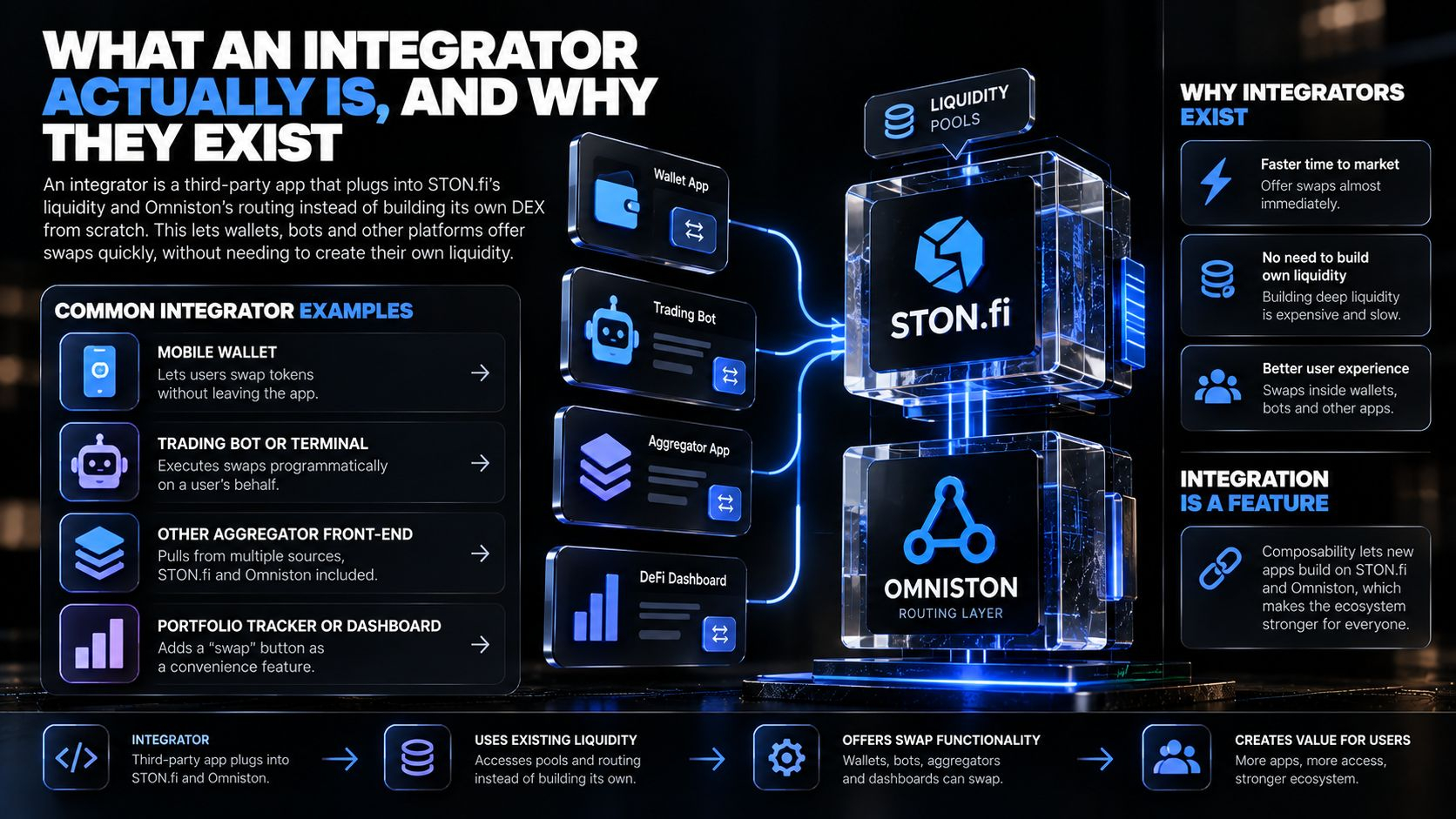
None of these businesses are doing anything wrong by existing, and integration is precisely the kind of open composability that makes DeFi infrastructure valuable in the first place — STON.fi and Omniston being integrable is a feature, not an incidental side effect. But every one of these businesses needs a revenue model, and the swap flow itself is often exactly where that revenue model gets built in.
💰 The Mechanics of How a Markup Actually Gets Inserted
This is the part worth understanding precisely, because "integrator fees" sounds abstract until you see exactly where in the pipeline they show up. The underlying liquidity — the actual STON.fi pools, the actual competing resolver quotes coming through Omniston — produces a raw, unmodified price. That's the number the infrastructure itself generates. What the integrator does, in many common models, is take that raw quote and present a slightly adjusted version to the end user, pocketing the difference.
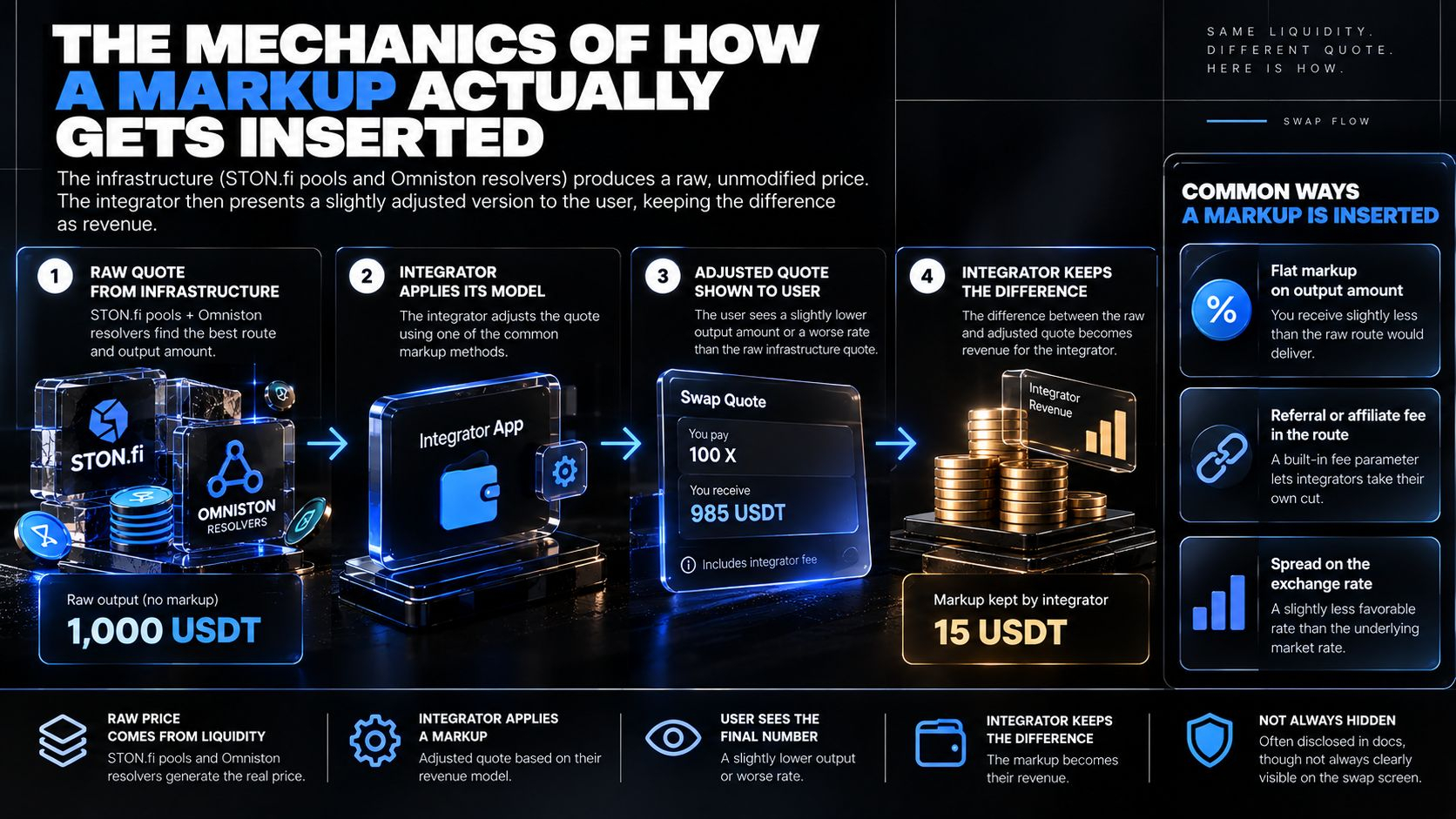
A few common patterns for how this actually happens:
A flat markup on the output amount — the integrator quotes you slightly less than the raw route would deliver, keeping the difference as revenue
A referral or affiliate fee baked into the route — some routing infrastructure supports a built-in fee parameter specifically designed for integrators to attach their own cut transparently
A spread on top of the displayed exchange rate — subtly less favorable than the underlying market rate, similar in spirit to how a currency exchange counter at an airport marks up its rates compared to the interbank rate
None of these mechanisms require the integrator to lie about anything or hide what's happening in some nefarious sense — many are disclosed, at least somewhere in documentation or terms, even if not prominently on the swap screen itself. But the practical effect is the same regardless of how transparently it's disclosed: the number you see isn't purely a reflection of the underlying market and available liquidity. It's that number, adjusted by whatever the specific business showing it to you needed to make its own model work.
The moment this actually clicked for me was realizing that "best price" displayed by any single app is really "best price, after this specific app took its cut" — and different apps take different cuts, which is the whole reason the same underlying liquidity can produce visibly different numbers depending on where you're looking.
🧮 Why This Explains Quote Differences Across Apps
This mechanism is exactly why you can occasionally see two different interfaces, both ultimately routing through the same STON.fi and Omniston liquidity, showing you meaningfully different final numbers for what should be an identical trade. It's not that one app has access to better liquidity than the other — they're drawing from the same underlying pool of routing options. It's that each app's own economics get layered on top before the number ever reaches your screen.
Consider a simplified scenario: you want to swap the same amount of TON for USDT, checked at the same moment across two different apps that both integrate with STON.fi's infrastructure.
App A takes a small, disclosed 0.1% integrator fee on top of the raw route
App B takes a larger, less obviously disclosed 0.5% spread baked into its displayed rate
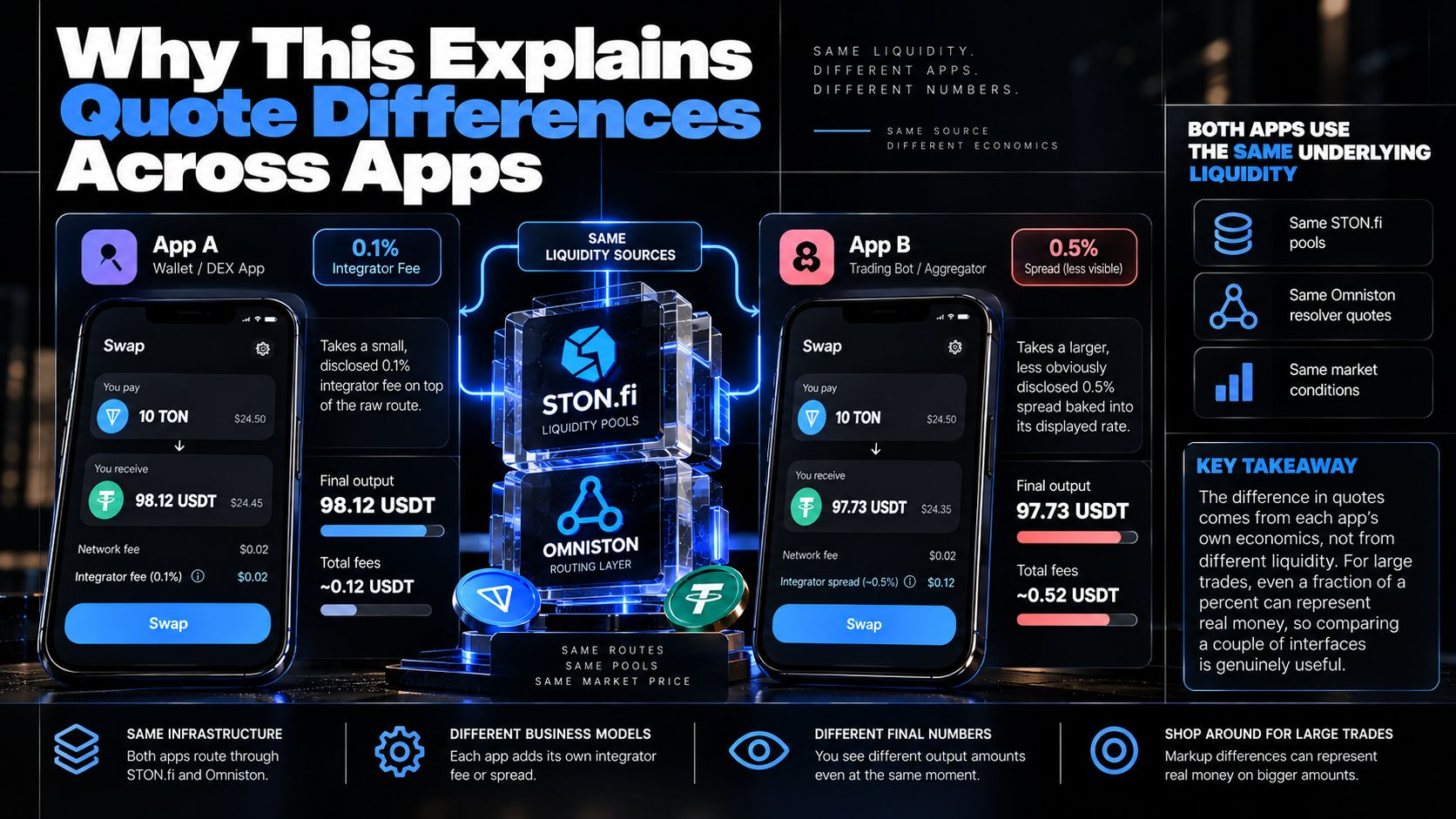
Both apps are technically routing through the same underlying liquidity sources. But the number you actually see, and the amount that actually lands in your wallet after confirming, will differ meaningfully between them — not because the market moved, not because one has access to deeper pools, but purely because of the business layer sitting between you and the infrastructure each time.
This is also exactly why "shop around across a couple of interfaces before a large trade" is genuinely useful practical advice, not just generic caution. For a small trade, the difference between integrator markups is often trivial. For a large trade, even a fraction-of-a-percent difference in markup can represent real money, and it's money that has nothing to do with market conditions and everything to do with which specific app's business model you happened to be using.
🔍 Why This Isn't Automatically a Bad Thing
It would be easy to read all of this as "integrators are quietly ripping people off," and I want to push back on that framing, because it's not accurate and it's not fair to a genuinely reasonable business model. Building and maintaining a wallet, a trading bot, or an aggregator front-end costs real money — development, infrastructure, security audits, ongoing maintenance. A small, disclosed fee on swap volume is a legitimate way to fund that work, no different in principle from how a traditional broker charges a spread or commission for facilitating a trade.
The distinction that actually matters isn't "does this integrator take a cut" — most do, in some form, and that's fine. The distinction that matters is transparency: does the app tell you, clearly and before you confirm, what you're actually paying and to whom? A well-designed integrator shows you the final number and lets you evaluate it honestly. A poorly-designed one buries the markup inside a rate that looks deceptively competitive at a glance, relying on most users never actually comparing it against the raw underlying quote.
I don't actually mind paying a small, honest fee to a wallet I like using. What bothers me is not being able to tell the difference between an honest small fee and a dishonest large one, just from looking at the number on screen.
✅ How to Actually Spot This as a User
None of this requires becoming a routing expert to protect yourself from — a few practical habits go a long way toward making integrator economics visible rather than invisible.
Check the same trade across more than one interface, especially for anything beyond a small, routine swap — meaningful discrepancies for otherwise identical trades are a signal worth investigating
Look for an explicit fee disclosure in the app's interface or documentation rather than assuming "no visible fee line" means "no fee" — a spread baked into the rate doesn't always show up as a separate line item
Compare against STON.fi's own interface directly when possible, since going straight to the source removes at least one layer of potential markup from third-party integrators
Pay closer attention as trade size grows — a markup that's negligible on a small trade becomes genuinely meaningful money on a large one, so the incentive to double-check scales with your trade size
None of this means every third-party wallet or app integrating with STON.fi is doing something to be suspicious of — plenty are perfectly reasonable, transparent businesses funding themselves fairly. It just means the number on any single screen deserves the same healthy skepticism you'd apply to any quoted price from a business with its own incentives, because that's precisely what it is.
🧭 The Bigger Picture
What this whole topic really points to is something worth internalizing generally about DeFi's composable structure: openness and integration are genuine strengths — they're exactly why an ecosystem like STON.fi and Omniston can power swap functionality across dozens of different wallets and apps rather than being locked into one single interface. But that same openness means the number displayed to you has, in many cases, passed through a business layer with its own incentives before it ever reaches your screen, and pretending otherwise doesn't actually protect you from it.
The healthy habit isn't paranoia about every integrator — it's simply remembering that "quote" and "raw market price" aren't always perfectly synonymous, and that the gap between them, when it exists, is where an integrator's business model actually lives. Once you know to look for that gap, it stops being invisible.
❓ Frequently Asked Questions
Why would two apps show different prices for the same swap through STON.fi? Different integrators can apply their own markups, spreads, or referral fees on top of the same underlying liquidity before displaying the final quote to you, which is why identical trades routed through the same infrastructure can show different numbers across apps.
Is it wrong for a wallet or app to take a fee on swaps? Not inherently. Building and maintaining an app has real costs, and a disclosed, reasonable fee is a legitimate revenue model. The meaningful distinction is transparency — whether the fee is clearly disclosed rather than quietly baked into an unfavorable rate.
How can I tell if a quote includes a hidden integrator markup? Compare the same trade across a couple of different interfaces, including STON.fi's own official app directly, and check whether the app explicitly discloses any swap fee in its interface or documentation.
Does this affect small trades as much as large ones? Not in absolute terms. A small percentage markup is often negligible on a small trade but can represent meaningful money on a large one, which is why checking multiple sources matters more as trade size increases.
$BTC
