



Executive Abstract
Digital asset markets no longer trade in a retail-dominated, insular speculative silo. Global financial flows, interest rate regimes, systemic geopolitical fractures, and distributed ledger mechanics have merged into an interdependent macro ecosystem.

Digital assets navigate an intricate inflection point: benchmark digital liquidity led by Bitcoin (BTC) and Ethereum (ETH) is challenging key institutional supply boundaries, while
utility grade public architectures like the XRP Ledger (XRPL) transition from isolated cross border transaction engines into multi-asset settlement and tokenization rails.
This analysis examines the macro financial framework driving global markets, details structural order book and derivative mechanics, breaks down international regulatory and sovereign alignments, and provides an architectural investigation into the consensus mechanisms, tokenomics, and institutional settlement layers of the XRP Ledger.
1. Global Macroeconomic & Geopolitical Landscape
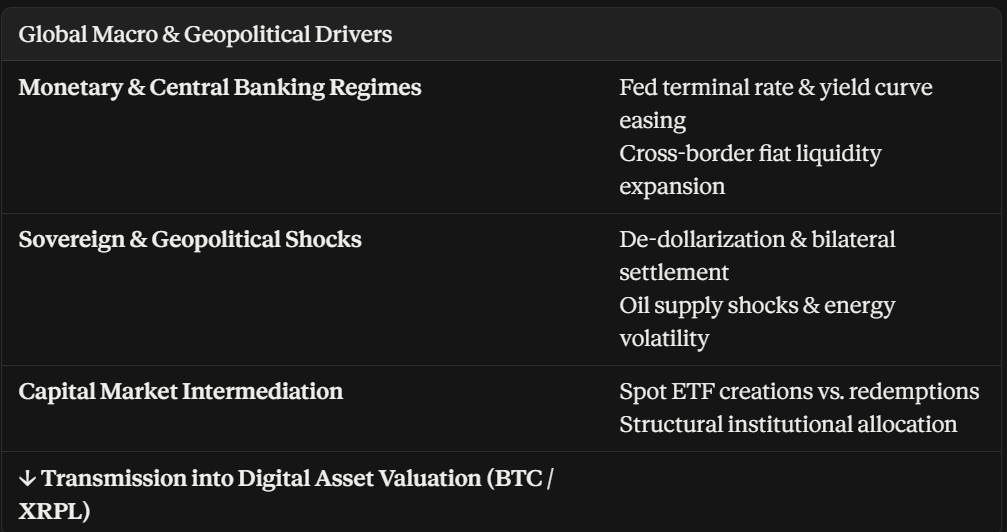
The price action of digital assets cannot be evaluated in isolation from central bank balance sheets, sovereign bond yields, currency debasement pressures, and fractured trade corridors.
1.1 Monetary Policy, Central Bank Rates, and Cross-Border Liquidity
Over recent monetary cycles, global central banks principally the U.S. Federal Reserve, the European Central Bank (ECB), and the Bank of Japan (BOJ) have transitioned from aggressive tightening regimes into nuanced, rate calibration environments.
The Cost of Capital: When benchmark rates hover at elevated levels, sovereign debt yields (e.g., U.S. 10-Year Treasury yields testing sub-5% thresholds) compete directly against risk assets for capital allocations. Once yields stabilize and market participants price in rate-easing cycles, capital costs diminish, increasing risk tolerance across equities and digital assets alike.
Global Liquidity Dynamics: Cross-border liquidity measures (the aggregate expansion of central bank balance sheets, repo facilities, and foreign exchange reserves) correlate directly with capital inflows into liquid spot digital assets. Digital assets function as a sensitive gauge of global fiat debasement.
The Dollar Index (DXY) Correlation: Historically, persistent strength in the U.S. Dollar Index creates headwinds for commodities and cryptocurrencies. Conversely, local plateaus or downtrends in the DXY correspond with range breakouts across large-cap digital currencies.
1.2 Geopolitical Fractures and Cross-Border Settlements
Bilateral currency settlements and alternatives to legacy clearing rails have altered how sovereign entities view financial sovereignty.
Fragmented Clearing Networks: The weaponization of foreign reserves and sanctions has prompted emerging economies specifically within the BRICS+ trade bloc—to research decentralized, non-jurisdictional settlement networks and tokenized bilateral liquidity pools.
Energy Shocks and Supply Chain Pressures: Fluctuations in crude benchmarks (e.g., Brent and West Texas Intermediate) directly impact headline inflation readings. When energy markets normalize, central banks gain leeway to maintain neutral-to-dovish stances, preventing liquidity crunches in leveraged digital markets.
The Dual Mandate of Digital Capital: In times of acute geopolitical stress, Bitcoin and blue-chip digital assets exhibit a bifurcated profile: an initial reflexive "risk-off" liquidation phase driven by global margin calls, followed by sustained accumulation as an unseizable alternative to fractured legacy payment networks.
2. Institutional Market Structure & Benchmark Asset Dynamics
The maturation of crypto market infrastructure has replaced retail-driven speculative volatility with order books characterized by spot Exchange Traded Funds (ETFs), centralized market makers, and institutional prime brokerages.
2.1 Bitcoin ($BTC) Structural Architecture and Supply Absorption
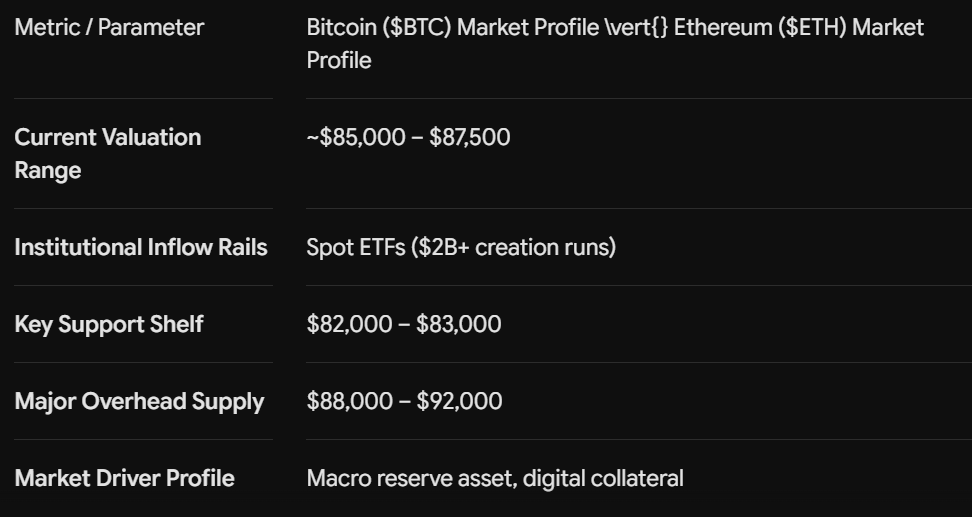
Bitcoin trades in the $85,000 to $87,500 band, testing the upper limits of multi month accumulation structures.
Spot ETF Absorption vs. Miner Outflows: Daily miner block emissions are eclipsed during expansion phases where institutional spot ETF creations consistently absorb thousands of BTC per trading week.
Derivative Positioning: Perpetual futures funding rates hover in neutral-to-moderately positive territory, which contrasts with the over leveraged long positions of historical blow off tops. Liquidation cascades have predominantly cleared short liquidity clusters above $84,000.
Macro Moving Averages: Bitcoin reclaiming its 50 week exponential moving average (EMA) establishes a structural foundation; maintaining weekly closes above the
$82,000 – $83,000 zone confirms structural trend strength, targeting institutional liquidity overhead into $88,000 – $92,000.
2.2 Ethereum ( ETH) and the Altcoin Rotation Horizon

Trading between $2,700 and $2,780, Ethereum serves as the primary transmission gate between core institutional liquidity and the broader altcoin ecosystem.
Ecosystem Capital Rotation: Historically, sustained bull cycles adhere to a four-stage capital flow:
Phase 1: Bitcoin expansion driven by spot institutional onboarding.
Phase 2: Capital rotates into large-cap networks ( ETH, SOL, XRP).
Phase 3: Expansion into specialized Layer-1 chains, modular rollups, and high-revenue DeFi protocols.
Phase 4: Broad market dispersion across high-beta mid and micro caps.
The Layer-2 Fee Paradox: High-throughput rollup execution (EIP-4844 blobs) has sharply reduced transaction costs on L2 networks. This shifts Ethereum's fundamental metric from transaction fee burning back to its role as a decentralized security and settlement anchor.
3. Comprehensive Breakdown: XRP & The XRP Ledger (XRPL)

While general market narratives often focus purely on proof-of-work mining or generalized proof-of-stake rollups, the XRP Ledger represents one of the longest-running, specialized enterprise consensus architectures in Web3.
3.1 Architectural Underpinnings of the XRP Ledger
Designed in 2011 and launched in 2012 by Jed McCaleb, Arthur Britto, and David Schwartz, the XRPL was engineered specifically for rapid, cost-effective cross border value transfer, bypassing the performance bottlenecks of early blockchain consensus designs.
The XRPL Consensus Protocol
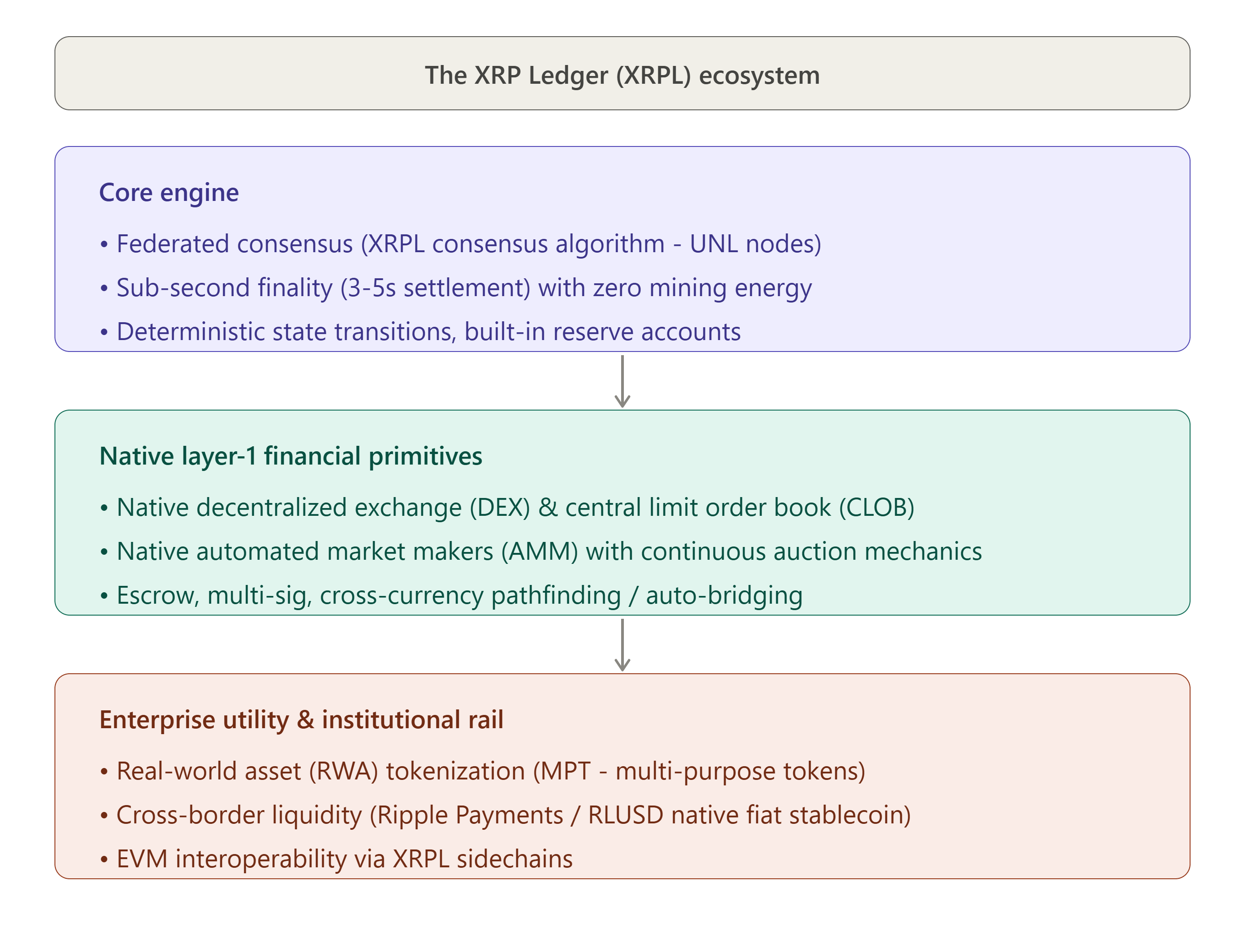
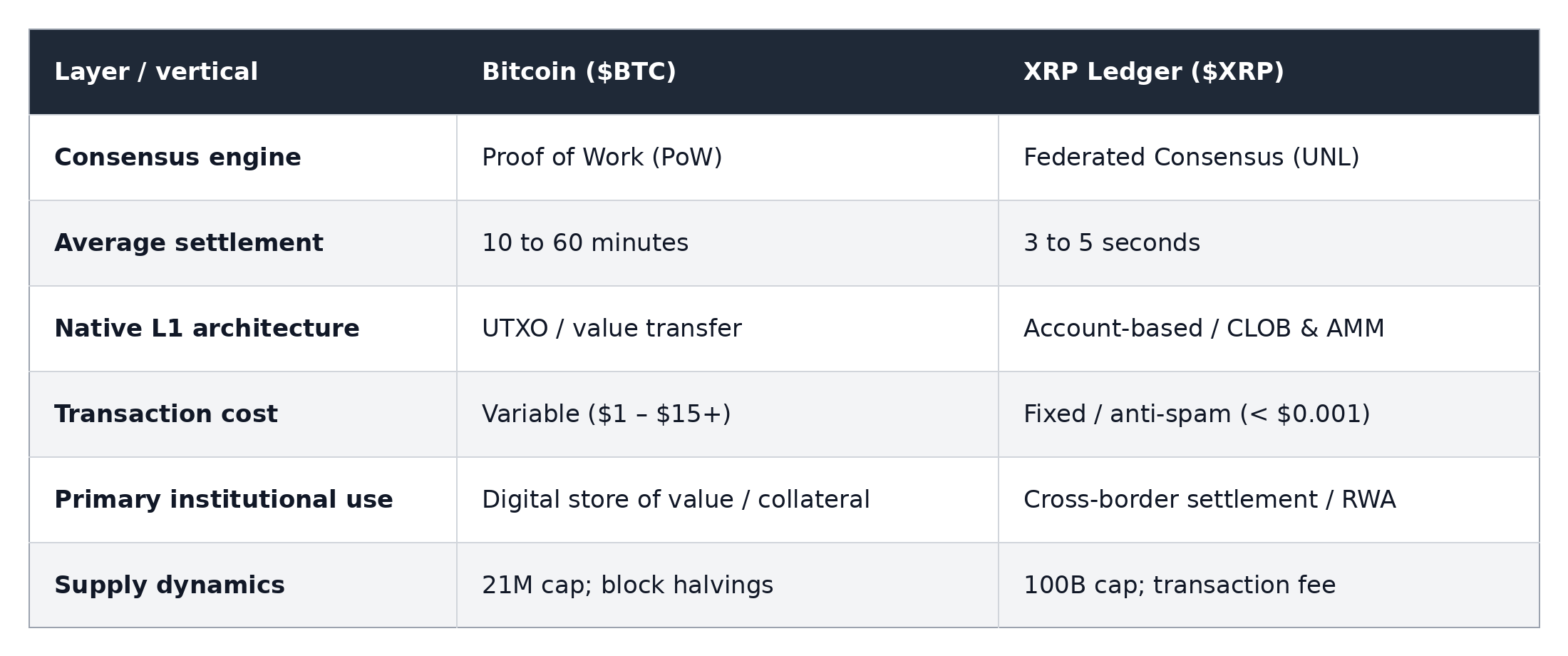
The XRPL operates on a federated Byzantine consensus algorithm, differing from both Proof of Work (PoW) and Proof of Stake (PoS).
Unique Node Lists (UNLs): Each validating node in the network specifies a trusted subset of validators, known as its Unique Node List (UNL). To prevent double-spending and ledger bifurcation without a central coordinator, nodes cross-verify transaction proposals until a deterministic supermajority of 80% consensus agreement is reached across overlapping UNL sets.
Deterministic Finality: The XRPL does not exhibit probabilistic settlement (as seen in PoW chain re-organizations). Once a validation round is ratified into a closed ledger, finality is absolute and takes 3 to 5 seconds.
Environmental Profile: Because consensus relies on cryptographic voting rounds rather than computational hash work or locked capital staking weights, validation requires minimal electrical energy, matching the power requirements of standard enterprise servers.
Native Layer-1 Capabilities
Unlike platforms that require complex, external smart contracts for basic decentralized exchange functions, the XRPL implements core financial tools directly into its Layer-1 base code:
Native On-Chain Central Limit Order Book (CLOB): The XRPL introduced the first functional native decentralized exchange embedded within the ledger itself, allowing peer-to-peer trading of issued assets against XRP without third-party smart contract risk.
Native AMM (Automated Market Maker) Framework: Enhanced via governance amendment (XLS-30D), the XRPL integrates an on-chain AMM system that operates alongside the native order book. It includes an auction slot feature that reduces impermanent loss for liquidity providers through rapid arbitrage pricing updates.
Deterministic Auto-Bridging and Pathfinding: When cross-currency payments are executed across the ledger (e.g., USD to EUR), the engine calculates the most cost-efficient route across the central limit order books and native AMM pools, dynamically routing through XRP as the bridge asset whenever it minimizes conversion slippage.
3.2 Tokenomics, Supply Dynamics, and Deflationary Velocity
XRP functions as the native utility token and gas asset of the XRPL.
Total Genesis Supply: 100 Billion XRP (Immutable Hard Cap)
├── Circulating Supply: ~58-60 Billion XRP (Open Liquid Float)
└── Programmatic Escrow Lockup: Transparent monthly release & re-lock cycle
The Anti-Spam Fee Burn: Unlike systems that distribute gas fees to miners or staking pools, every transaction fee paid in XRP on the ledger is cryptographically destroyed (burned). While standard baseline fees are small (fractions of a cent, e.g., 0.00001 XRP under standard conditions), fee schedules dynamically escalate during malicious spam storms or heavy congestion to protect validator compute resources.
Base Account Reserves: To prevent unconstrained ledger state bloat on validator nodes, every wallet address must maintain a base reserve (currently configured at 1 to 2 XRP), plus an owner reserve for each issued trust line, escrow, or open offer. This ensures that network resource consumption directly correlates with token lockups.
Cryptographic Escrow Architecture: In 2017, Ripple committed 55 billion XRP into a series of on-ledger escrows governed by cryptographic contracts that release 1 billion XRP per month. The unallocated majority of each released tranche is returned directly into new time-locked escrows at the end of every cycle, ensuring programmatic supply transparency.
3.3 The Enterprise Settlement Paradigm
The primary institutional application of the XRP Ledger centers on resolving the structural inefficiencies of legacy Nostro/Vostro account mechanisms.
Pre-Funding Capital Traps: In traditional cross-border settlement (e.g., the SWIFT framework), commercial banks must maintain costly pre-funded accounts denominated in foreign currencies inside destination jurisdictions. This traps trillions of dollars in idle capital.
On-Demand Liquidity (Ripple Payments): By pairing regional fiat on/off-ramps with the XRP Ledger, financial institutions can settle cross-border transactions in real time.
This structure eliminates bilateral pre-funding requirements and lowers transaction costs by 40% to 60%.
Multi-Purpose Tokens (MPT) & RWA Tokenization: The introduction of the XLS-33 standard enables banks and asset managers to tokenize treasury bills, corporate credit, and institutional debt natively on the XRPL. These tokens benefit from native clawback controls, freezing flags, and compliance hooks directly embedded at the base protocol level.
Stablecoin Integration (e.g., RLUSD): Enterprise-grade stablecoins pegged 1:1 with cash equivalents and short-term treasuries provide regulated fiat rails directly on the ledger. These operate alongside XRP, allowing institutions to choose between yield-bearing, dollar-pegged settlement assets and volatility-neutral cross-currency bridging.
3.4 Regulatory Clearance and Global Jurisdictional Standing
XRP holds a distinct position among top-cap digital assets regarding legal clarity within the United States. Following landmark federal court rulings that determined secondary market sales of XRP do not constitute investment contracts as a matter of law, institutional clarity has allowed regulated platforms, banks, and investment managers to custody, trade, and develop commercial products around the asset without the overhang of unclassified asset status.
Globally, regulators across Switzerland (FINMA), Japan (JFSA), the United Kingdom (FCA), Singapore (MAS), and the European Union (under the MiCA framework) classify XRP as an exchange token, utility asset, or crypto-asset, facilitating its integration into licensed bank digital custody platforms.
4. Current Market Technical Analysis: $XRP/USDT
As of the current market structure, ( XRP ) is consolidating within an established high-timeframe accumulation zone, testing key overhead levels.
4.1 High-Timeframe Moving Average Confluence
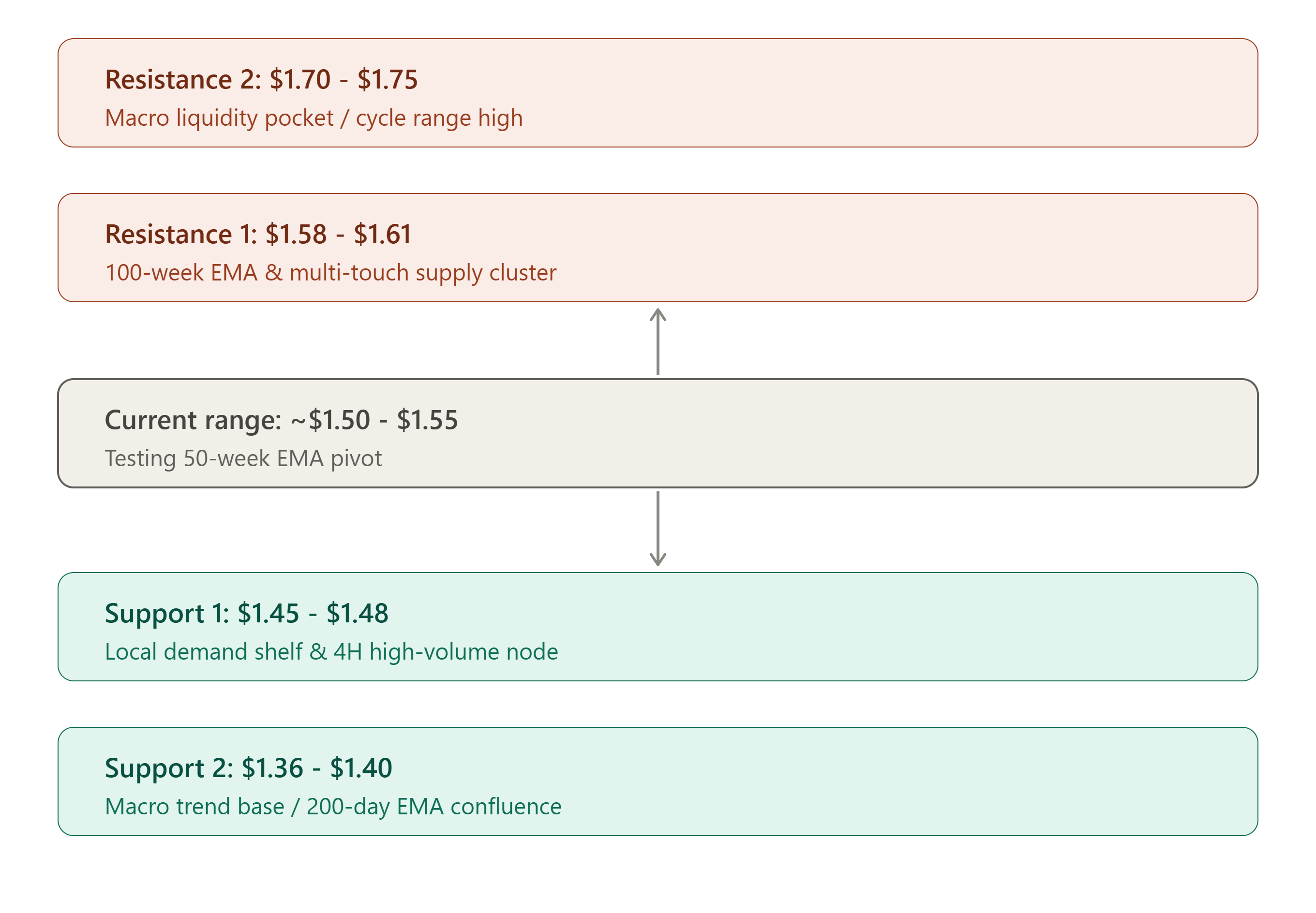
The 50-Week EMA Pivot: XRP has reclaimed its 50-week EMA (~$1.50), converting multi-month resistance into support. Maintaining a structural floor above $1.50 confirms buyer accumulation across institutional spot desks.
The 200-Day EMA Baseline: The primary trend floor rests at $1.36 – $1.40. Unless a systemic macroeconomic liquidation event breaches this support, the high-timeframe trend remains structurally bullish.
The Multi-Week Supply Barrier: Overhead resistance is concentrated between $1.58 and $1.61. A high-volume daily close above $1.61 would clear the local consolidation shelf, opening a direct technical path toward the cycle pivot between $1.70 and $1.75.
4.2 Key Scenarios and Structural Forecasts
Scenario A (Bullish Expansion): Sustained spot inflows and favorable macro conditions propel XRP cleanly above the $1.61 resistance cluster. This triggers a short squeeze across perpetual exchanges, driving price action into the $1.70 – $1.75 supply zone. A confirmed weekly close above $1.75 sets up a multi-month path toward testing cycle highs above $2.00.
Scenario B (Range Accumulation): Continued consolidation between the $1.45 support and $1.60 resistance. This allows daily momentum indicators (RSI and Stochastic oscillators) to reset from overbought thresholds while open interest stabilizes, forming a base for a future breakout.
Scenario C (Macro Pullback): Broader market pullbacks (triggered by hawkish central bank shifts or geopolitical escalation) break the $1.45 shelf, initiating a stop-run toward the major 200-day EMA support at $1.36 – $1.40. Bulls must defend this base to preserve long-term bullish market structure.
5. Strategic Playbook & Capital Allocation Framework
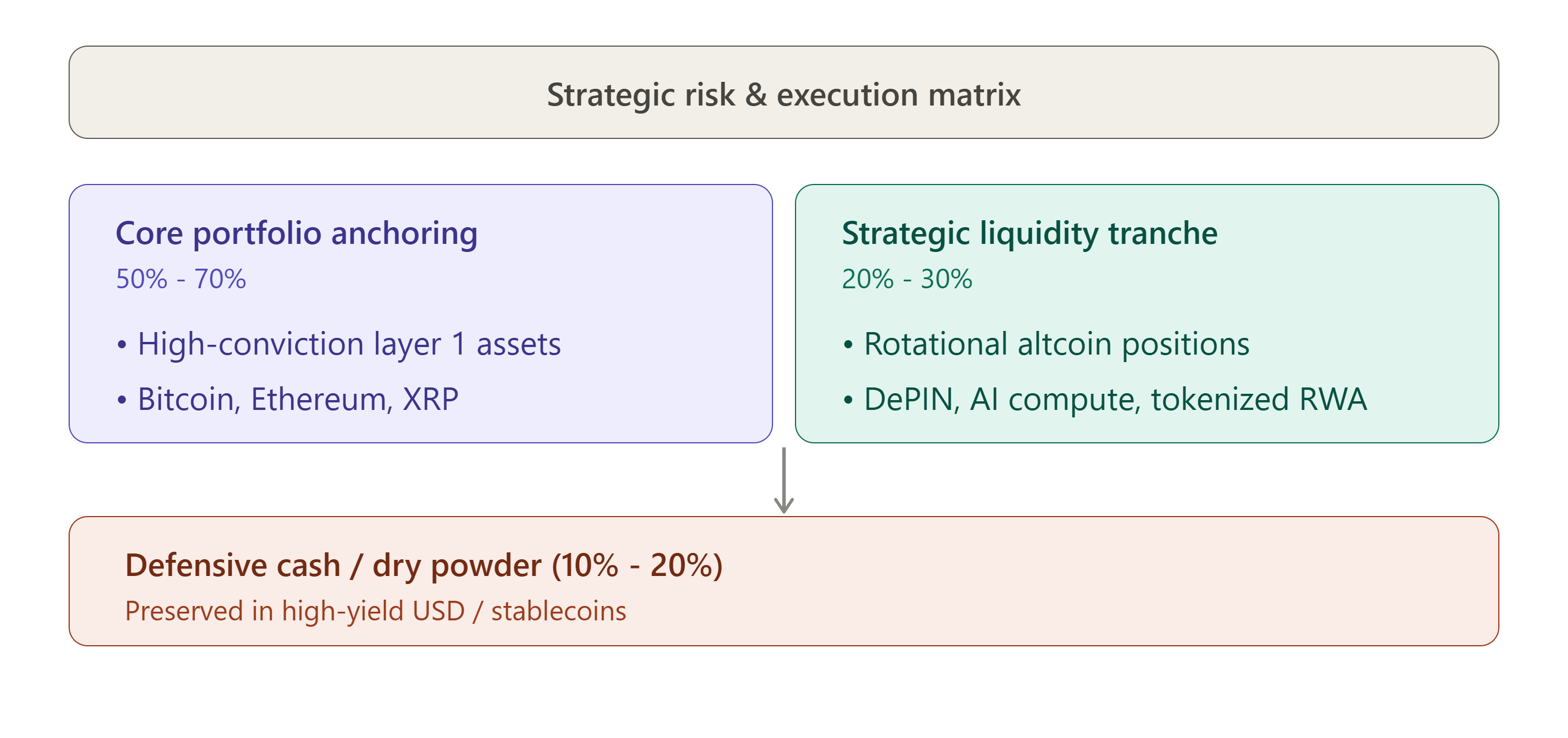
Operating within an institutional crypto market demands structured position sizing, risk management, and narrative alignment.
5.1 Risk Mitigation and Portfolio Construction
Systematic Dollar-Cost Averaging (DCA): Chasing green breakout candles into major resistance clusters ($87.5K BTC, $1.60 XRP) exposes portfolios to sudden leverage flushes. Structuring recurring accumulation within confirmed support zones ($82K–$83K BTC, $1.40–$1.48 XRP) lowers average entry cost while avoiding emotional trade execution.
Derivatives and Leverage Restraint: In a spot driven market characterized by institutional algorithms, retail traders utilizing 10x–50x leverage face liquidation wicks designed to sweep order book imbalances. Prudent strategy relies on spot allocation or low-leverage (<2x) swing structures with documented stop-losses.
Liquidity Management: Maintaining an active allocation in stable liquidity (fiat or enterprise-grade stablecoins) ensures the capacity to capitalize on sudden geopolitical or macroeconomic dips without liquidating core high timeframe assets.
Disclaimer: This analysis is provided for educational and research purposes only and does not constitute financial, investment, legal, or tax advice. Digital asset markets carry significant financial risks; always conduct your own research (DYOR) and evaluate your personal risk tolerance before participating in market opportunities.
#xrp #etf #BTC #ETH #squarecreator