


The growth of blockchain technology has created new ways for people to interact with financial assets. One area receiving increasing attention is tokenized securities. Binance bStocks are an example of this approach, bringing certain traditional-market exposure into a blockchain-based environment.
What Makes bStocks Different?
Binance describes bStocks as blockchain-based tokenized securities that provide exposure to the price performance of underlying listed equities. However, bStocks are not ordinary stocks or shares and do not give holders direct ownership of the underlying company or normal shareholder rights. �
Binance +1
This distinction is important for anyone learning about tokenized assets. A person should understand what they are actually holding before using any financial product.
The Role of Blockchain
Blockchain technology allows digital assets to be represented and transferred through blockchain infrastructure. In the case of bStocks, the technology provides a connection between traditional financial instruments and digital-asset infrastructure.
Binance has listed various bStocks on its Spot platform. For example, Binance has announced bStocks related to companies and securities including NVIDIA, Tesla, Microsoft, Apple and other underlying assets at different times. Availability and supported products can change over time. �
Binance +1
How Can Users Access bStocks?
For eligible users, Binance has supported bStocks through different services, including Spot trading and conversion features. Binance also announced that eligible users can convert certain supported tokenized securities into corresponding bStocks on a 1:1 basis, subject to the applicable terms and limits. �
Binance
Some bStocks can also be available for 24/7 trading, depending on the specific product and the user's eligibility and location. This is one difference between blockchain-based trading infrastructure and traditional stock-market trading schedules. �
Binance
Why Is Tokenization Important?
Tokenization is interesting because it can connect traditional financial markets with blockchain technology. Instead of keeping financial exposure entirely within traditional market infrastructure, tokenized products can use blockchain-based systems.
This development may make the financial ecosystem more interconnected. Crypto users can learn about traditional-market exposure, while people interested in traditional finance can explore blockchain-based financial products.
However, tokenization does not mean that risk disappears. The value of an asset can change because of market conditions, liquidity, issuer-related factors, technology, regulation and other risks.
bStocks Are Not the Same as Owning Shares
One of the most important points to understand is the difference between a bStock and a traditional company share.
A traditional stock represents ownership in a company under the relevant legal and market structure. Binance states that bStocks represent an interest in underlying securities held by the issuer rather than direct ownership of the underlying shares. �
Binance
Therefore, users should not assume that holding a bStock automatically gives them the same rights as a shareholder.
Availability Depends on Eligibility
bStocks are not available to every user in every country. Binance states that tokenized securities are available only to eligible users in permitted jurisdictions, and regional restrictions may apply. �
Binance
Before accessing a bStock, users should check Binance's latest product information, eligibility requirements, applicable terms and the laws that apply in their own jurisdiction.
Final Thoughts
Binance bStocks provide an interesting example of how blockchain technology can interact with traditional financial markets. They demonstrate how tokenization can create digital representations connected to underlying financial instruments.
At the same time, users should understand the product structure and risks rather than assuming that a bStock is simply the same as buying a normal company share.
Learning how tokenized securities work is an important step for anyone interested in the future connection between block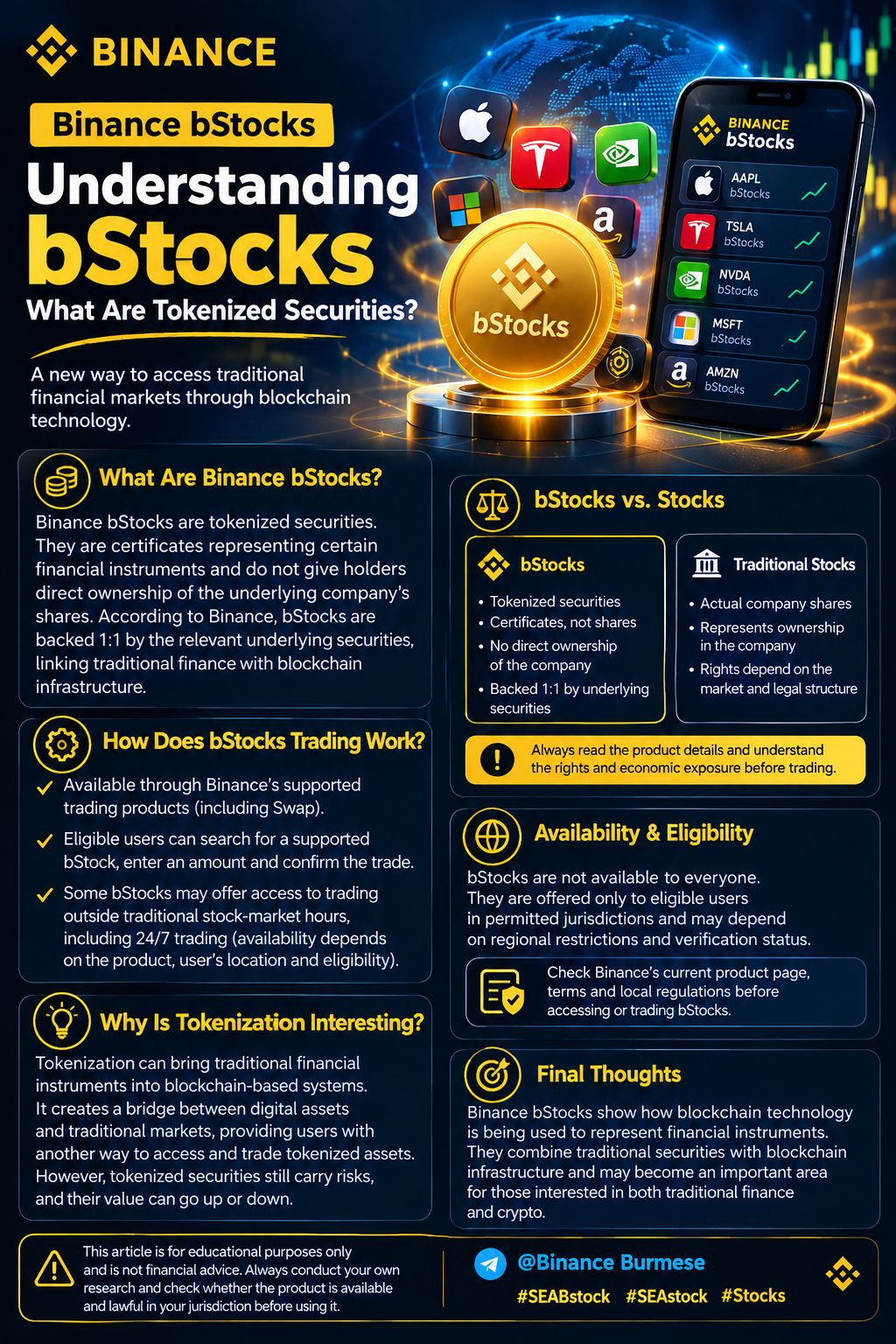 chain and traditional finance.