

Lately, I’ve started focusing quite a bit on SagaVolt, and the reason is pretty straightforward: the projects that actually make me want to spend time researching these days aren't driven by pure hype, trending narratives, or short-term clout.
They are the infrastructure projects capable of truly embedding Web3 tech into real-world industries—and creating long-term, sustainable demand.
SagaVolt feels like a prime candidate in that direction.
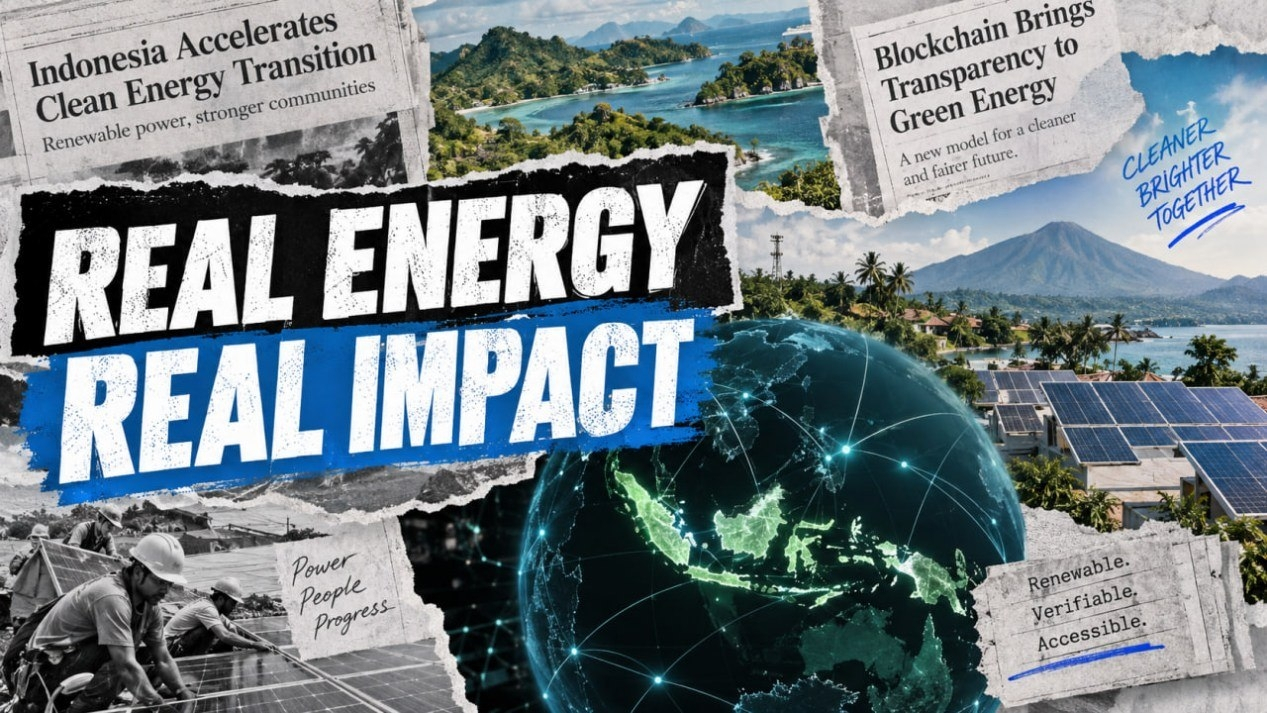
Its wedge into the market is the distributed green energy sector in Indonesia.
When a lot of people see the word "energy," their first reaction might be that it feels pretty disconnected from Crypto.
But look at it from another angle: this might actually be one of the most imaginative, high-potential use cases for RWAs moving forward.
Indonesia consists of thousands of islands, meaning its energy supply naturally leans distributed.
Industrial parks, community microgrids, fishing ports, cold chains, mining sites, and remote areas all have a very real, non-negotiable demand for stable power.
At the same time, renewable energy sources like solar, micro-hydro, biomass, and wind are widely scattered across different regions.
The catch?
If you want these energy resources to scale into a real market, there's a whole stack of underlying infrastructure issues to fix first:
How do you measure power output in a tamper-proof way?
How do you prove its green attributes?
How do participants settle payments?
How do long-term Power Purchase Agreements (PPAs) get standardized?
How can data be verified while preserving privacy?
What makes SagaVolt stand out is that it isn't just tackling a single isolated step.
It's building an end-to-end network spanning metering, proof generation, settlement, assetization, clearing, and governance.
The project designed PoG—or the Proof-of-Green mechanism—combining ZK (zero-knowledge proofs), TEE (Trusted Execution Environments), device identities, and on-chain verification so that energy data isn't just recorded, but crucial to point out, verifiable.
From an investor's perspective, I think this point is huge.
The RWAs that actually bring value in the future won't just be tokenized versions of real-world assets.
The winners will be the ones that solve the hardest problem before assets ever hit the chain: the authenticity problem.
You can turn a contract into an NFT or wrap an asset into a Token, but if the underlying data can't be verified, your RWA is ultimately just financial packaging.
SagaVolt builds trust from the ground up starting at the hardware and metering layer, then scales up to eKWh, PPA-NFTs, RECs, and carbon assets.
That logical chain is rock solid.
Another point I really value is that SagaVolt doesn't stop at energy data—it actively tries to unlock "energy assetization."
For instance, eKWh can serve as an on-chain power accounting unit, PPA-NFTs can hold long-term power purchase agreements, while RECs and carbon assets can enter independent green asset markets.
If real devices and real-world energy use cases continue onboarding in the future, it won't just generate a single product, but a full-fledged ecosystem of on-chain assets and cash flows revolving around energy.
And that’s what sets SagaVolt apart from pure narrative plays.
Its growth thesis can theoretically stem from real business expansion:
More devices.
More metering data.
Higher energy transaction volume.
More PPAs.
Higher oracle call frequency.
Expanding data services.
All of which convert into organic demand for the network.
Now let’s talk about SAVLT.
When I personally analyze a Token, the main thing I care about is:
Is this Token genuinely a vital component of the network's operation?
SagaVolt’s design here is crystal clear.
SAVLT plays an active role in Gas fees, validator staking, restaking, oracle collateral, settlement collateral, insurance pools, governance, and ecosystem incentives—it’s far from just a governance voting chip.
Validation nodes need SAVLT, metering witnesses need to stake, oracle nodes need to participate in staking, while hardware and data contributors get rewarded in ecosystem incentives.
Once this flywheel starts spinning, Token demand becomes directly tied to real network activity.
Even more interesting is the upside of SagaVolt’s data market layer.
Energy networks naturally generate massive amounts of daily data spanning pricing, equipment metrics, weather, carbon emissions, power consumption, and supply.
SagaVolt designed a Decentralized Energy Oracle along with a Data DAO, aiming to turn raw data into authorized, subscribable, revenue-generating data products.
In short, it’s not just an energy settlement network—it could gradually evolve into a full-scale energy data infrastructure.
Taking an investor's view, what makes SagaVolt worth watching isn't just a buzzword.
It hits multiple long-term macro trends simultaneously:
RWAs, Green Energy, DePIN, Decentralized Data, ZK Privacy, and Real-World Asset Digitalization.
Plus, it isn't targeting already mature Western energy markets, but rather region-specific environments like Indonesia that organically demand distributed energy, island-tailored solutions, and infrastructure upgrades.
If it successfully scales from individual microgrids, industrial zones, cold chains, ports, and power devices into a unified regional energy web, SagaVolt's upside could go way beyond just a typical "energy concept" token.
Right now, I view it as:
Gradually transforming real-world "electricity" into an on-chain digital asset that can be verified, settled, traded, and financed.
The projects truly worth tracking long-term aren't always the best storytellers—they're the ones getting real-world industries that previously had zero on-chain demand to actually start using the blockchain.
SagaVolt is actively building that bridge.
That’s why I’m keeping a close eye on the SagaVolt and SAVLT ecosystem moving forward.
The above content represents personal research and observations only and does not constitute financial or investment advice.