
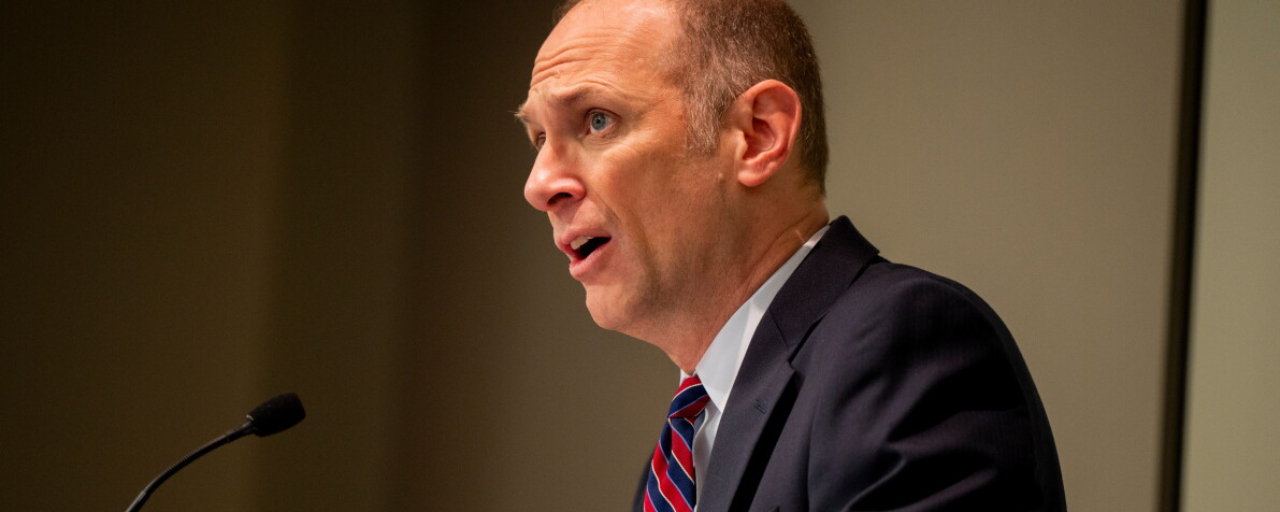

Austan D. Goolsbee, President and Chief Executive Officer of the Federal Reserve Bank of Chicago, who is not a voting member of the Federal Open Market Committee (FOMC) in 2026 because the Chicago Fed's seat rotated off the voting list, argued in a written essay for the Official Monetary and Financial Institutions Forum (OMFIF) event in London, England, on Monday that central banks should stop looking through persistent supply shocks, the standard response since the 1970s.
A cost shock that lasts multiple years forces a rethink, he wrote, and his presumption is that big shocks end up lasting longer than first thought. He pointed to the U.S. record as proof. Oil still sits around $100 a barrel months after war broke out in the Gulf, even though futures markets projected a rapid fall, and tariffs have followed a pattern of repeated escalation instead of the one-time price increase in the textbook.
Forecasters have pushed the expected inflation peak from Q4 2025 out to sometime in 2027, and he wrote that the pattern is not a comforting one. Without evidence that these shocks are fading, he sees no credible path back to 2% inflation.
Goolsbee's prescription is blunt: don't do nothing, because looking through won't work. The response to a persistent cost shock does not need to mirror the response to a demand shock, he stressed, but it won't be painless either.
The reason is sticky wages. Because they adjust slowly, forcing inflation back to target in the short run means pushing employment below target and output below potential, the painful trade-off stagflationary shocks always impose on a central bank. He also keeps a separate eye on demand.
He is especially attuned to elevated inflation in service-sector industries and to any sign that AI data center construction is spilling out of its own lane and raising output beyond what the economy can absorb, and he called both areas of concern in the recent data. If demand is overheating, he wrote, there is no ambiguity about how the Fed needs to respond. Persistent supply shocks leave no easy exit, he concluded: the only way back is the hard way.
Key Quotes:
Supply Shocks & Looking Through
Normally we think of the central banking challenge of economic stabilization and the business cycle as being about fluctuations in demand. But over the last several years we have lived through a repeated series of supply shocks that have exposed the limits of that thinking and forced new consideration of how central banks should handle supply-side disruptions.
Since the experience of the 1970s, the oft-stated intuition has been that central banks should “look through” supply shocks and only respond if they start to have secondary effects on other industries or begin unanchoring inflation expectations.
Lately, though, we seem to have entered a period where large supply shocks—from wars, tariffs, weather, supply chain disruptions, oil shocks, and so on—have become a regular feature of the economy.
My argument is that in this new environment, there are some supply shocks that central banks should not simply look through—namely, the persistent ones.
Much of this “look-through” intuition comes from the historical observation that shocks to aggregate supply have tended to produce more transitory inflation than demand shocks do.
Weather events, supply bottlenecks, and oil price shocks often resolve relatively quickly—and even when they don’t fully reverse, they are frequently one-time level shifts rather than persistent inflation shocks. They do not change long-run potential growth, and monetary policy takes months or years to work its way through an economy. So it’s largely pointless—and prone to timing errors—to use monetary policy in response to something short-lived. Why fight against something that’s going away on its own?
Lately, though, supply shocks have come more frequently, hit harder, and lasted longer. And once supply shocks to inflation become persistent, some of the logic behind “looking through” no longer holds.
If the proper response to a temporary six-month supply shock is to look through it, then a temporary 60-month supply shock—so long as it is forecast to go away on its own—would seem to call for the same response. Ten times zero is still zero.
A cost shock that lasts multiple years forces us to revisit the rationale for looking through.
No one said to automatically look through persistent inflationary supply shocks.
These days, when you see a large supply shock, it’s usually more accurate to assume it will be persistent than to assume it will quickly go away. That’s certainly been the U.S. experience over the last six years: Covid supply chains were supposed to heal within months.
So the key becomes recognizing when a shock stops being temporary and should be treated as persistent. My presumption—especially for big shocks—is that they will end up lasting longer than we initially think.
Inflation & the 2% Target
If a central bank commits to hitting 2% inflation in the medium term and commits to not respond to supply shocks, then a repeated or persistent supply shock to inflation means one of those two commitments can’t hold up.
On the supply side—oil, tariffs, and commodity prices—forecasters have spent more than a year pushing back the date when inflation was supposed to peak and start falling. Originally it was supposed to happen in Q4 2025. Then Q1 2026. Then Q2, then Q3, then Q4—and now sometime in 2027. That’s not a comforting pattern.
Whether you attribute this to a steady stream of new supply shocks or to old shocks proving more persistent than expected, this has been nothing like the “one and done” pattern that underpins the case for looking through. We need evidence that these shocks are actually fading, or it’s hard to see a credible path back to 2% inflation—and harder still to justify continuing to look through them.
Energy & External Risks
When war broke out in the Gulf, futures markets projected oil prices to fall rapidly; months later, oil is still around $100 a barrel and potentially heading higher.
Tariffs have been nothing like the stylized textbook example of a one-time price increase—they’ve instead followed a pattern of repeated escalation.
Monetary Policy & the Fed's Response
At a fundamental level in modern macro thinking, the Fed responds to inflationary pressures that come from imbalances between aggregate demand and aggregate supply. When demand is high relative to supply, it creates inflationary pressure. Because the Fed has a dual mandate—to stabilize prices and maximize employment—it raises rates to bring that overheating back into balance.
In a purely mechanical sense, the economy can generate the same gap between supply and demand whether demand goes up or supply goes down. But the standard wisdom says not to react the same way, even when the gap is the same size.
If the forecast calls for large, persistent, recurring shocks, the central bank still has to restore price stability under its legal mandate—and the only way to bring inflation down is to raise rates and narrow the gap between supply and demand, even if it’s not in the same sectors where the cost shocks are occurring.
So what’s a central bank to do if the economy is hit by an unending string of supply shocks that push inflation up persistently and keep it above target? Well, the first answer is, don’t do nothing. Looking through won’t work.
It’s important to recognize that the response to a persistent cost shock does not need to mirror the response to a demand shock, even for an identically sized imbalance between supply and demand.
Monetary policy works through the demand channel. In principle, the central bank can directly counter a shock to demand that overheats the economy by raising rates—putting supply and demand back into balance without forcing a trade-off between mandate goals. But an identical-sized gap that comes from a negative supply shock puts the Fed in a tougher spot because it doesn’t control supply.
If inflationary pressure rises from a negative supply shock, the only way the central bank can close the gap is by reducing demand—and, with it, output and employment.
Our policy response to persistent supply shocks may not need to be as large as it would be if the inflation were coming from demand overheating.
But it won’t be painless either. This is exactly the painful trade-off between employment and inflation that stagflationary shocks always impose on a central bank. Unfortunately, in environments like that, the only way back is the hard way.
Wages, Employment & the Dual Mandate
The critical fact is that wages are sticky. They don’t adjust instantaneously.
For an economy to rebalance after a lasting negative supply shock, people would need to adjust to a new, less favorable equilibrium, and wages would need to fall. If wages adjusted instantly, the central bank’s response to supply shocks and demand shocks would be the same. But wages adjust slowly.
Forcing inflation back to target in the short run means pushing employment below target and output below potential.
In the short run, supply shocks force a difficult trade-off for the dual mandate that demand shocks simply don’t. That’s why the central bank may not react as aggressively to a supply-driven imbalance as it does to a demand-driven one. But again, if the shock is lasting, it can’t simply be ignored.
Demand Overheating
Demand-driven overheating, by contrast, has historically built up slowly but persisted much longer—which is why the standard prescription is for monetary policy to respond strongly to demand overheating. There are real dangers of escalation if problems on that side are left to fester.
I’m especially attuned to elevated inflation in service-sector industries, and to any evidence that AI data center construction is spilling out of its own lane and raising aggregate output beyond what the economy can absorb.
Either could be signs of old-fashioned demand overheating—and if demand overheats, there is no ambiguity about how the Fed needs to respond. Both are areas of concern in the recent data.