An oracle can have great data and still have a security problem.
So I've been looking more closely at how DIA handles the security side.
The architecture has several layers.
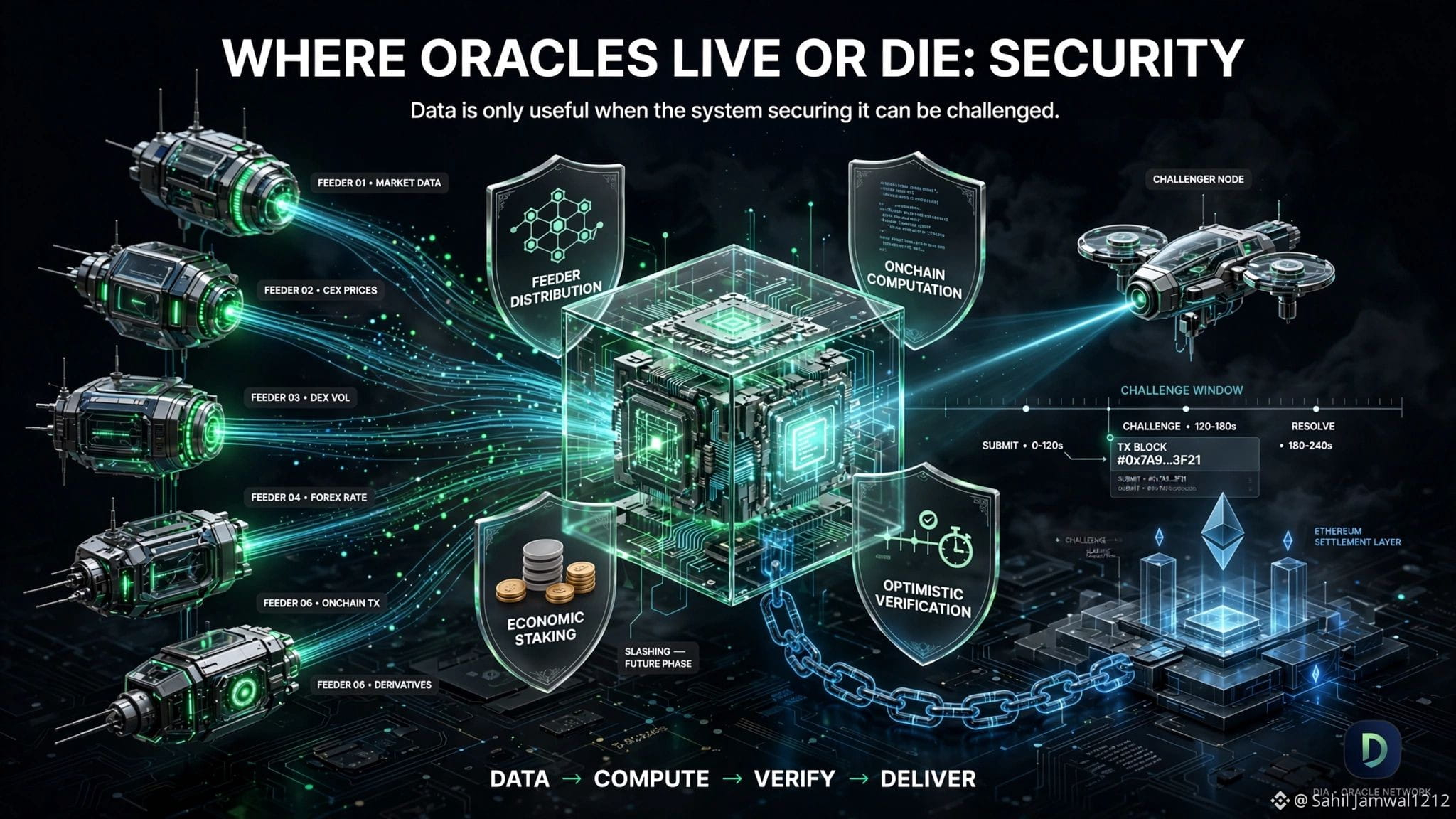
1. Onchain computation
DIA's Lasernet handles oracle operations through smart contracts, making the computation and data processing inspectable onchain.
2. Optimistic verification
Lasernet uses an optimistic-rollup model: transactions are initially assumed valid, while a challenge period provides an opportunity to dispute invalid activity using fraud proofs.
3. Distributed feeders
Multiple independent feeder operators collect and process market data rather than relying on one data provider.
4. Economic security
DIA staking locks $DIA to secure oracle operations and rewards accurate data delivery.
One important distinction: slashing is not live yet. $DIA says it is planned for a future phase.
5. Audited infrastructure
DIA says MixBytes audited its core and staking architecture.
That's why I wouldn't reduce DIA's security model to simply “feeders stake tokens and bad actors get slashed.”
The actual picture is broader:
Distributed data → onchain computation → optimistic verification → economic security → Ethereum-anchored rollup.
That's a much more interesting system to analyze.
And like any decentralized system, its security ultimately depends on the assumptions and mechanisms actually deployed—not just the ones planned for the future.
So I've been looking more closely at how DIA handles the security side.
The architecture has several layers.
1. Onchain computation
DIA's Lasernet handles oracle operations through smart contracts, making the computation and data processing inspectable onchain.
2. Optimistic verification
Lasernet uses an optimistic-rollup model: transactions are initially assumed valid, while a challenge period provides an opportunity to dispute invalid activity using fraud proofs.
3. Distributed feeders
Multiple independent feeder operators collect and process market data rather than relying on one data provider.
4. Economic security
DIA staking locks $DIA to secure oracle operations and rewards accurate data delivery.
One important distinction: slashing is not live yet. $DIA says it is planned for a future phase.
5. Audited infrastructure
DIA says MixBytes audited its core and staking architecture.
That's why I wouldn't reduce DIA's security model to simply “feeders stake tokens and bad actors get slashed.”
The actual picture is broader:
Distributed data → onchain computation → optimistic verification → economic security → Ethereum-anchored rollup.
That's a much more interesting system to analyze.
And like any decentralized system, its security ultimately depends on the assumptions and mechanisms actually deployed—not just the ones planned for the future.