

Most Layer 2s are designed to move activity away from the base layer.
Kinetiq’s Elysium takes a different approach: build a faster execution environment around Hyperliquid while keeping economic activity connected to the Core.
That sounds simple, but the architecture and economics behind it are worth examining.
Why Hyperliquid Needs Another Execution Layer
#Hyperliquid already has a powerful on-chain trading engine through HyperCore, particularly for perpetuals.
The challenge is HyperEVM.
Today, HyperEVM uses different block types, mempools and fee markets for fast and slow execution. It also has limitations around atomicity between EVM transactions and HyperCore actions.
The research points to real examples of this friction, including a documented gas spike from around 0.15 to 60 gwei and reports of simple swaps costing more than $10.
At the same time, HyperCore perps generate roughly $1M–$6M in daily revenue, while HyperEVM's reported revenue has been much smaller.
#Elysium is essentially an attempt to close that execution gap.
 What Elysium Is Actually Trying to Change
Elysium is proposed as an OP Stack-based L2 that settles to HyperEVM while using $HYPE as its gas token.
That distinction matters.
There is no new Elysium gas token being introduced, meaning the design does not follow the common L2 model of creating another token-based economy.
Instead, Elysium is designed to extend Hyperliquid's existing ecosystem.
Two major pieces stand out:
➜ PropAMMs
The idea is to create a faster EVM environment where professional market makers can operate while accessing HyperCore data and liquidity more closely.
➜ Expanded L1Read
Elysium proposes deeper access to HyperCore order-book data, potentially turning Hyperliquid into a more native source of market data and oracle infrastructure.
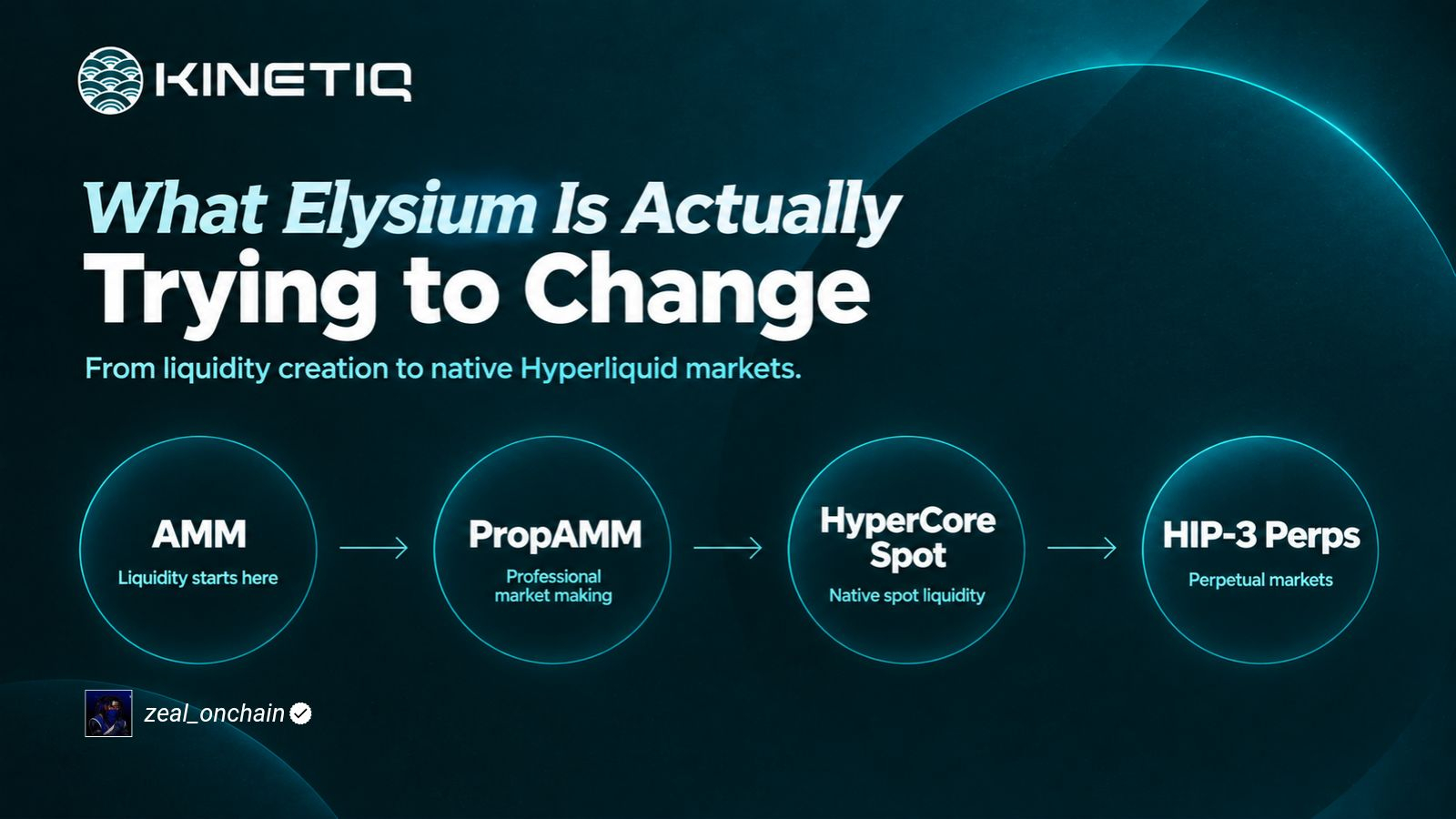
Kinetiq also describes a token lifecycle that could move from AMM → PropAMM → HyperCore spot → HIP-3 perpetuals.
The architecture is interesting, but actual adoption by market makers and users remains an open question.
Where KNTQ Becomes Central
The most important part of Elysium may not be the technology.
It is the fee model.
Kinetiq proposes splitting sequencer fees:
- 25% → builders
- 25% → Kinetiq treasury
- 50% → KNTQ open-market purchases and burns
That creates a direct relationship between Elysium activity and KNTQ.
But there is an important distinction:
The 50% allocation is for KNTQ, not $HYPE.
Meanwhile, $HYPE benefits from being the gas asset used by Elysium.
The 25% treasury allocation is intended for Kinetiq Inc./Foundation operations.
So there are effectively three different economic beneficiaries:
➜ Hyperliquid / $HYPE: gas demand and potential additional Core activity.
➜ Kinetiq: treasury revenue and a new execution environment for its ecosystem.
➜ KNTQ holders: the proposed buy-and-burn mechanism.
Also, calling KNTQ “hyper-deflationary” today would be premature. Elysium is not live yet, so this mechanism is still a proposed future design.
Elysium vs. the Traditional L2 Playbook
Traditional L2s often introduce their own token, attract users and liquidity away from the base layer, and capture sequencer economics.
Elysium is designed around a different philosophy:
Build on the edge. Flow back to the Core.
Kinetiq describes this as the first “value-accretive L2” model, although that is a Kinetiq positioning claim rather than an independently established fact.
There are still important questions.
The sequencer appears centralized in the proposed architecture, and details around decentralization, upgrade control and the proof pipeline are not yet public.
There are also no published independent benchmarks, audits, named launch partners or confirmed mainnet date as of the research period.
And one feature in the manifesto is deliberately redacted, so its impact cannot be evaluated yet.
My Take
Elysium is more interesting when viewed as infrastructure rather than simply another L2 launch.
Its thesis is straightforward:
make EVM execution faster and more useful without forcing activity to leave Hyperliquid.
That could create a stronger connection between EVM applications, HyperCore liquidity, professional market makers and Hyperliquid's broader economy.
There is also a business angle for Kinetiq. Its kHYPE supply contracted significantly from its 2025 peak, so building another execution venue can be viewed partly as an attempt to expand where Kinetiq's ecosystem can generate activity.
But the thesis is still unproven.
The things I would watch most closely are:
- Elysium's actual mainnet launch
- independent audits and performance benchmarks
- PropAMM adoption
- real user and spot-market activity
- sequencer decentralization
- how the proposed fee/burn model performs in practice
The architecture has a clear idea behind it. The next step is proving that the idea works under real economic activity.