

Every new era begins with an idea, but ideas only become eras when the infrastructure exists to carry them.
#Crypto has spent years building faster chains, cheaper transactions, and increasingly sophisticated financial applications. Now, scaling these technologies is not simply about adding more capacity, but rather about building the right infrastructure for the activity you want to attract.
That is why I will be talking about Elysium today.
Kinetiq is proposing a Layer 2 infrastructure called ELYSIUM. This infrastructure is built specifically around the needs of the Hyperliquid ecosystem.
It has $HYPE as its native gas token, tighter connectivity with HyperCore, infrastructure for high-frequency applications, and a sequencer revenue model that sends half of that revenue toward KNTQ token buybacks and burns.
If it works as designed, Elysium will not be just another chain sitting beside Hyperliquid. It could become an execution layer that expands what can be built within the ecosystem.
Join me in this article, let's explore Elysium together, but before we discuss the solution, we need to understand the problem that led to it.
The Existing Problem
One of the oldest problems in technology is not necessarily the lack of a powerful machine, but what I call a road problem.
Now, imagine putting a Ferrari engine into a city where the roads are narrow, congested and full of traffic lights. The engine may be extraordinary, but the environment around it prevents you from enjoying its full potential.
That is the challenge Elysium is attempting to address.
In crypto, #blockchains constantly balance three things which are speed, cost and composability.
The HyperCore environment of Hyperliquid is built around high-performance trading infrastructure, particularly its native order-book system. And for HyperEVM to compose with HyperCore, it has introduced certain complexities that can delay the execution of user demands.
Major problems include:
Low Throughput and Performance: And when throughput is limited, applications have less room to handle a large number of transactions quickly, especially when demand increases.
Expensive Transaction: When activity spikes, transactions can become more expensive because users compete for limited execution capacity. For example, gas can jump from 0.15 Gwei to 60 Gwei in two days. That is an increase of about 39,900%.
Dual-Block Architecture: HyperEVM uses a design that splits transactions between two types of blocks which is 3M-gas small blocks at one-second intervals and 30M-gas large blocks every 60 seconds. Normally, this architecture helps HyperEVM maintain composability with HyperCore, but it also introduces complexity for applications that require consistently high-frequency execution.
Other Problems are
Hyperliquid's spot markets have also struggled to match its dominance in perpetuals, with Kinetiq pointing to spot volumes and HIP-2 liquidity sitting near multi-month lows.
Kinetiq's core market has also faced pressure. As previously reported, kHYPE supply fell significantly from its August 2025 peak through May, while the share of liquid-staked HYPE also declined.
So, What Exactly Is Elysium?
To simplify what Elysium is, let's think of Hyperliquid as a city. HyperCore is the financial district, the place where much of the serious trading infrastructure lives. And HyperEVM is the broader application environment where developers can build smart contracts.
Now, Elysium is being designed as a high-performance road connecting those worlds, giving applications more room to move while remaining inside the Hyperliquid ecosystem.
Technically, Elysium is described by Kinetiq as a Hyperliquid-aligned Layer 2 built with Arbitrum Orbit, settling to HyperEVM and co-located with HyperCore. It is an EVM-compatible environment designed for general DeFi, with high-frequency trading and professional market-making applications as important use cases
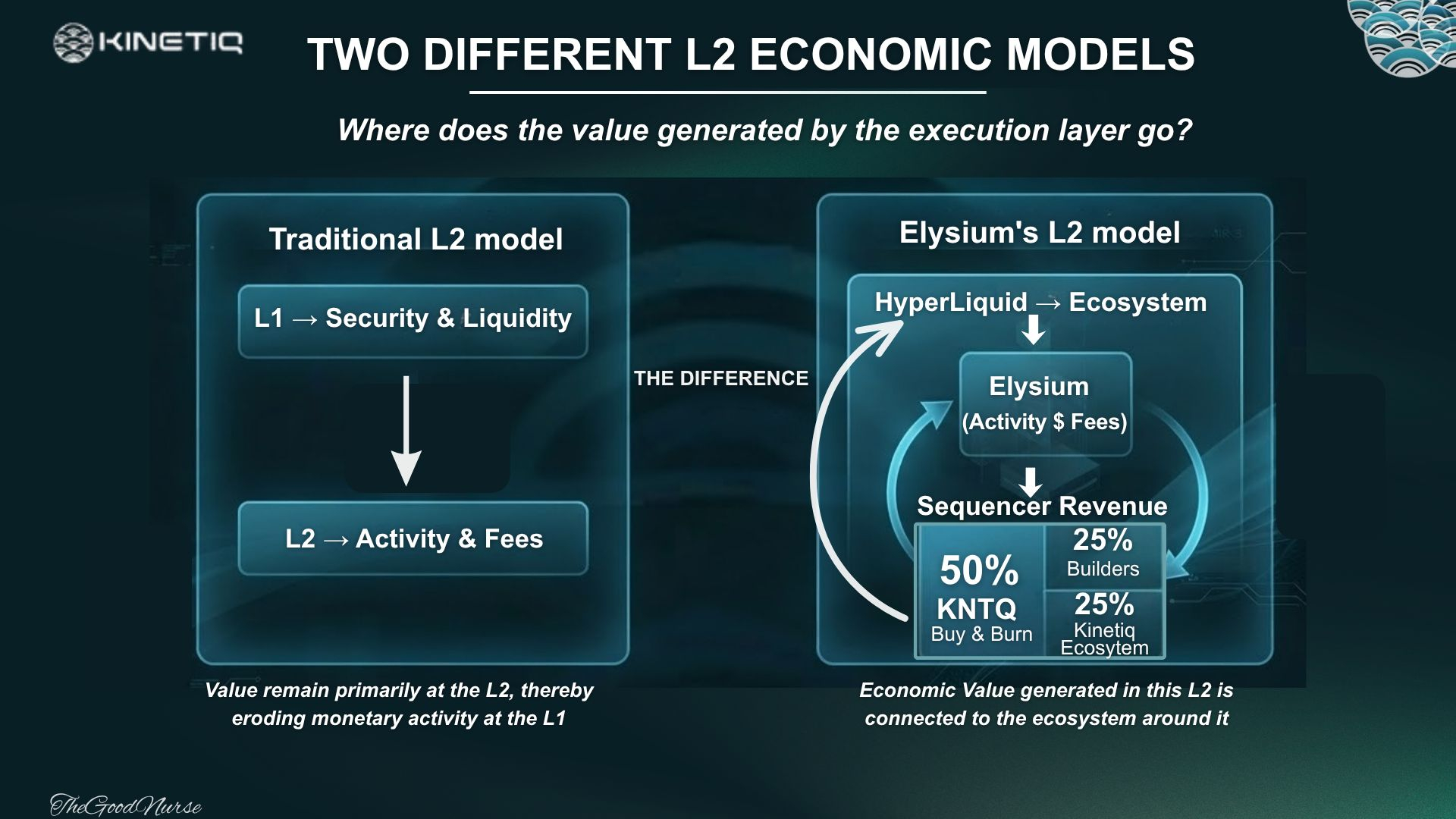
Image showing how Elysium is different from traditional L2 infrastructure
Why Elysium Could Be Different From Traditional L2 Infrastructure
Layer 2 infrastructures were introduced about 5 years ago, and most are designed in a way that the L1 they are built upon provides security and liquidity, while the L2 captures the activity and fees.
This is not a bad idea, but if we look at it critically, “How much of the economic value generated by the L2 actually flows back to the L1 ecosystem underneath it?” This can put pressure on the L1's economic value, especially when a significant amount of activity is redirected to a faster and cheaper L2.
But with Elysium, the stated architecture keeps it tightly connected to Hyperliquid, while its sequencer revenue is explicitly divided among builders, Kinetiq's treasury, and KNTQ buybacks.
So instead of thinking of Elysium as a new island, think of it as an extension of the existing city.
The more activity it attracts, the more block space is consumed, and the more block space is consumed, the more sequencer revenue can be generated. And part of that revenue is deliberately redirected into the wider Kinetiq economy.
That is why it is called a “value-accretive L2.” Meaning that the economic value generated by the execution layer is designed to flow back into the ecosystem around it.
The Core Features of Elysium
Now that we understand the problems, let's look at how Elysium is designed to address them.
Uses HYPE as Gas
Instead of creating a new gas token, Elysium maintains HYPE as the gas token of the network, and this does not require users to hold a separate gas token or a wrapped version simply to transact.
More importantly, it keeps Elysium economically connected to the wider Hyperliquid environment, and if it attracts meaningful activity, HYPE gains another source of transaction utility.
Supercharging Spot Trading Using PropAMMs
I already stated in the problems that Hyperliquid's spot market has struggled to match its dominance in perpetuals. To address this, Elysium is built to supercharge spot trading by giving PropAMMs, also called proprietary automated market makers, a faster execution environment.
But remember, a market maker does not only require speed. It also requires information and on that Knetiq says its customized L1Read precompile essentially provides a free oracle for PropAMMs, giving them access to fresh HyperCore data at the top of the block so they can price more efficiently and quote tighter.
Token Generation Lifecycle
Elysium provides the suitable environment for the launch of a new token since it has co-location with HyperCore, a high-performance EVM environment, and access to HIP-3 permissionless perpetual deployments.
It also enables all launch activities to take place within the Hyperliquid ecosystem. Meaning that a token can be launched on an Elysium AMM, become deeply integrated with Elysium PropAMM liquidity, have the option of bootstrapping a HyperCore spot market, and can secure a HIP-3 perp listing.
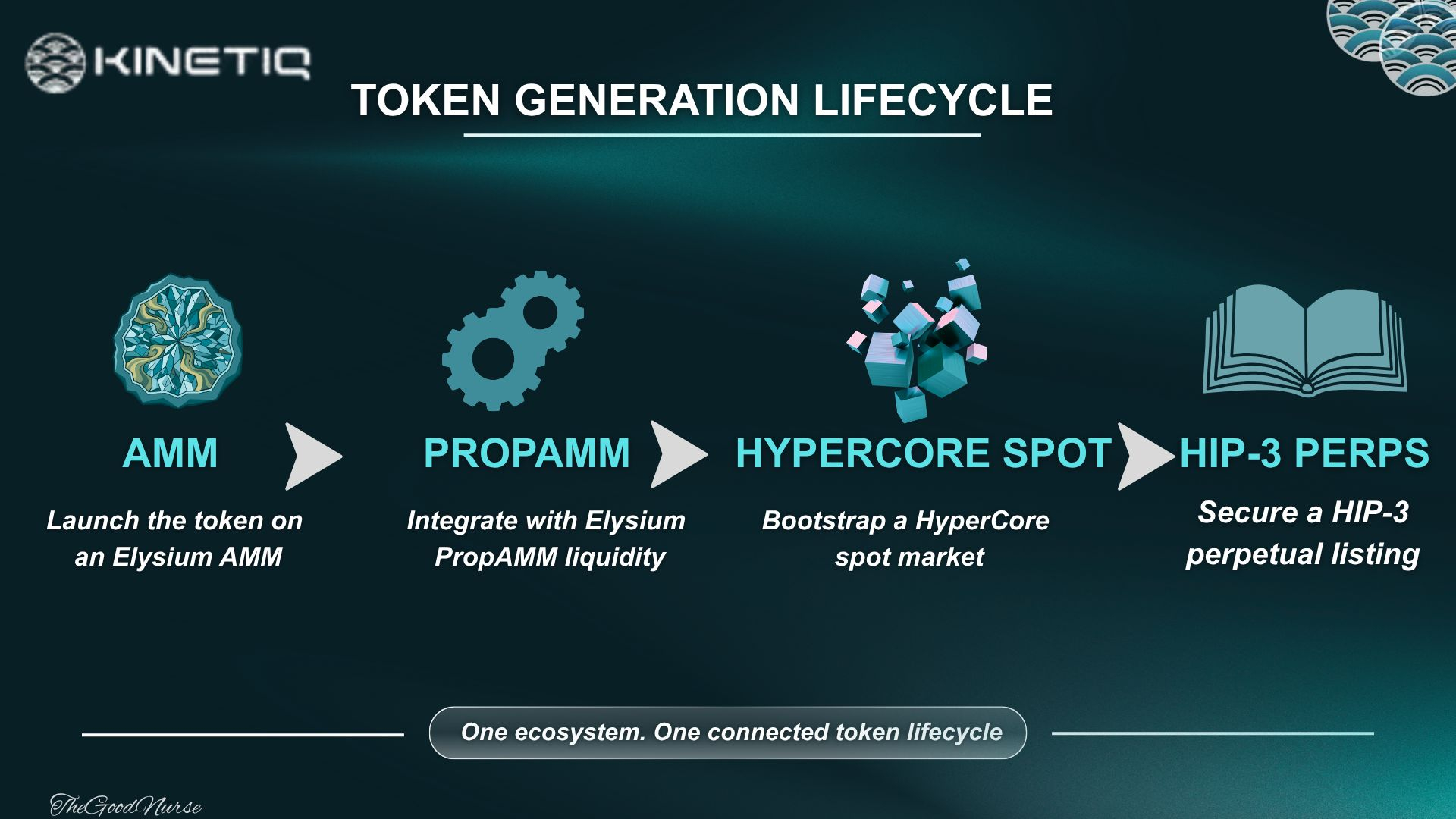
The Token Generation Lifecycle on Elysium
The Sequencer Revenue Model
This is what I will call the most distinctive part of the Elysium proposal.
For every $100 of sequencer revenue that is generated, the planned allocation is:
$25, which is 25%, to the Builders, to create a direct economic incentive or rebates for users of applications that consume block-space demand.
$25, which is 25%, to the Kinetiq Treasury to support the wider Kinetiq ecosystem operations.
$50, which is 50%, is used in the buyback of KNTQ on the open market. And all of the KNTQ purchased through this mechanism is burned by being sent to the Hyperliquid Assistance Fund.
How Does the Model Align the Ecosystem?
If the Elysium infrastructure is delivered as powerfully as promised...
Then it will attract more builders, and more builders will generate more applications, which means more trading activity, and this leads to more Sequencer Revenue.
Now the Sequencer Revenue is divided as explained earlier, that is to the builders, to the Kinetiq Treasury, and buying back of KNTQ. And when the bought KNTQ is burned, availability is reduced, which may accrue value to the token.
This is the reason it is deflationary, because as the ecosystem grows and more activity generates more Sequencer Revenue, a portion of that revenue is continuously used to buy and burn KNTQ.
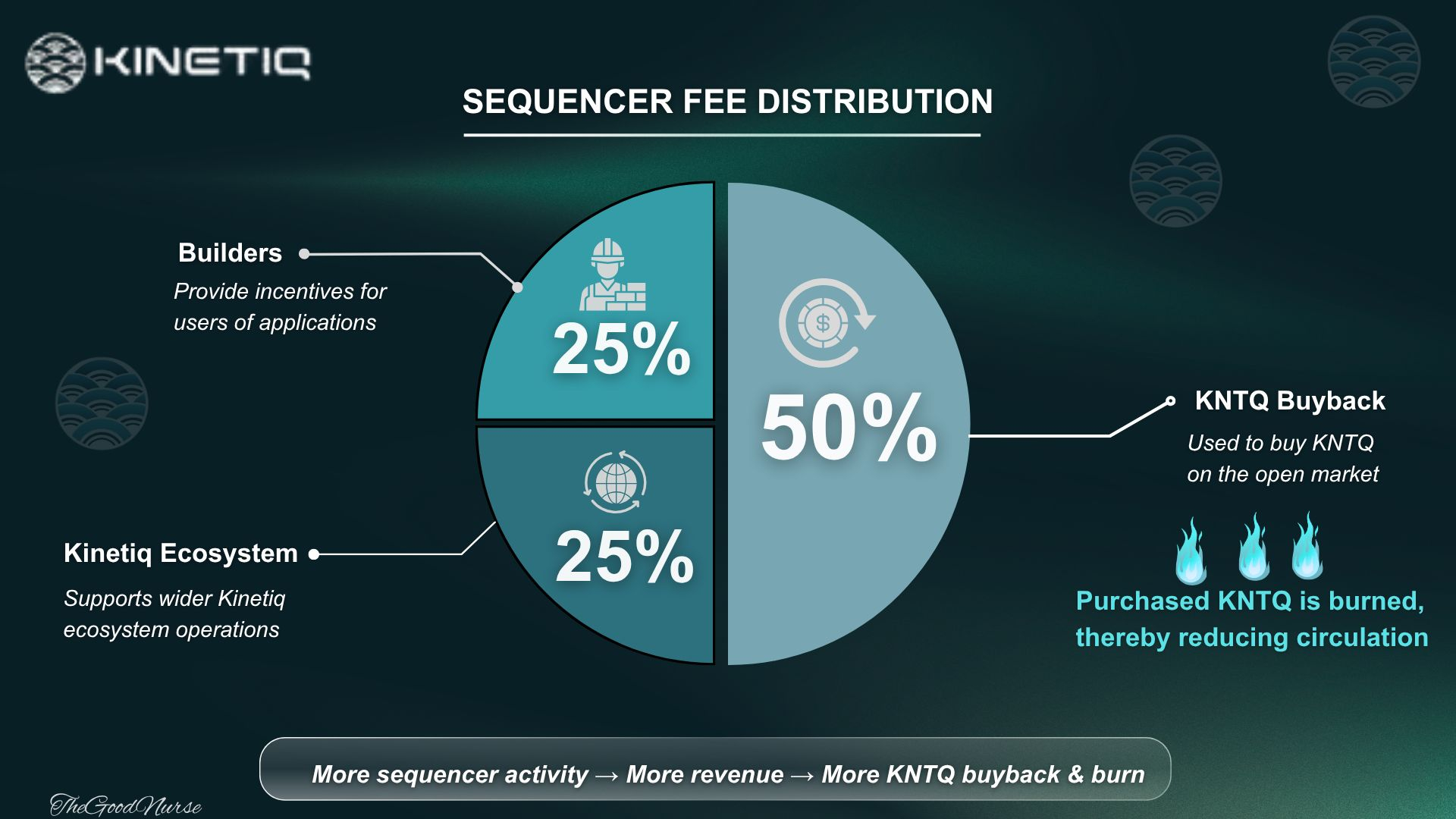 Image showing the Sequencer Fee Distribution
My Honest Perspective
The Elysium architecture makes sense. I love the idea of using HYPE as gas to avoid unnecessary token fragmentation, and also the token generation life cycle seems like a walk in the park.
I have some important questions that I would love for Hyperliquid to put into consideration before the launch.
How will the network perform during extreme market volatility?
How secure will the sequencing and bridging architecture be?
And most importantly, "can Elysium generate enough sustainable economic activity for the KNTQ buy-and-burn mechanism to become significant?
These are not criticisms of the idea but the tests that every ambitious infrastructure project eventually faces.
As the old saying goes, “The proof of the pudding is in the eating.” Elysium has presented an interesting recipe and now the market will judge the meal.
Conclusion
Crypto has no shortage of Layer 2s.
What it has fewer of are Layer 2s designed around a very specific economic relationship with the ecosystem beneath them, and that is what Elysium is banking on.
For now, Elysium is not a finished success story. It is a bet on what Hyperliquid could become when its financial engine gets an execution layer built specifically to keep pace with it.
And sometimes, the biggest technological leaps begin not by replacing the engine, but by finally giving it a road wide enough to run..
Note that this is a thesis not a guaranteed outcome. No spaces or launch has been held yet by the organisation and remember always do your own research