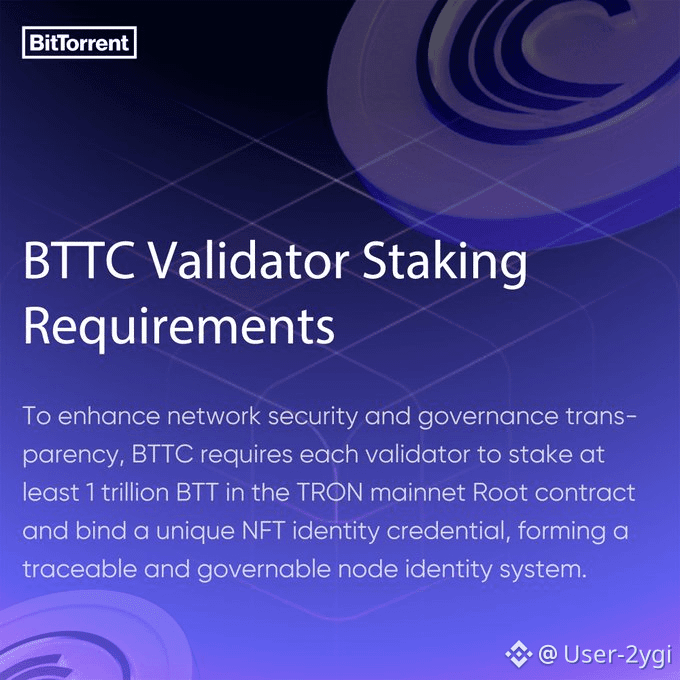
🛡️ VALIDATORS: THE CORNERSTONE OF BTTC CONSENSUS SECURITY & NETWORK INTEGRITY
In a heterogeneous multi-chain ecosystem bridging TRON, Ethereum, and BNB Chain, consensus security cannot rely on assumptions or soft trust. BitTorrent Chain (BTTC) enforces strict technical and operational criteria across its validator set to guarantee deterministic finality, prevent state divergence, and secure high-frequency, sub-cent EVM execution.
As the physical anchor of the network, validators bear the responsibility of signing block checkpoints and securing cross-chain asset movements.
1. Dual-Node Topology: Sentry & Validator Architecture
BTTC employs a defense-in-depth, dual-layer node architecture designed to insulate consensus signing from distributed denial-of-service (DDoS) vectors and network jitter:
🛡️ Sentry Node Layer: Runs on public interfaces to connect directly with the broader peer-to-peer network. Sentry nodes validate incoming transactions, propagate state changes, and shield the validator node from direct public IP exposure.
🔐 Validator Node Layer: Operates in an isolated, private environment accessible only through trusted Sentry nodes. It is solely dedicated to executing the consensus engine, signing block headers, and pushing periodic cryptographic checkpoints back to Layer 1 smart contracts.
2. Core Validation Criteria & Operational Standards
To maintain active status and participate in block rewards, validator operators must satisfy rigorous operational benchmarks:
3. Anchoring Planetary DePIN & AI Compute
💾 BitTorrent File System (BTFS): Validators cryptographically log storage challenge audits, dispute resolutions, and payment escrows across host hard drives storing Reed-Solomon $(k + m)$ shards.
🤖 BTTInferGrid AI Coordination: Secures micro-transactions and reward flows governed by the Dynamic Supply-Demand Balance Mechanism, matching compute payouts strictly to verified developer task execution.
@BitTorrent_Official @Justin Sun孙宇晨 #TRONEcoStar
In a heterogeneous multi-chain ecosystem bridging TRON, Ethereum, and BNB Chain, consensus security cannot rely on assumptions or soft trust. BitTorrent Chain (BTTC) enforces strict technical and operational criteria across its validator set to guarantee deterministic finality, prevent state divergence, and secure high-frequency, sub-cent EVM execution.
As the physical anchor of the network, validators bear the responsibility of signing block checkpoints and securing cross-chain asset movements.
1. Dual-Node Topology: Sentry & Validator Architecture
BTTC employs a defense-in-depth, dual-layer node architecture designed to insulate consensus signing from distributed denial-of-service (DDoS) vectors and network jitter:
🛡️ Sentry Node Layer: Runs on public interfaces to connect directly with the broader peer-to-peer network. Sentry nodes validate incoming transactions, propagate state changes, and shield the validator node from direct public IP exposure.
🔐 Validator Node Layer: Operates in an isolated, private environment accessible only through trusted Sentry nodes. It is solely dedicated to executing the consensus engine, signing block headers, and pushing periodic cryptographic checkpoints back to Layer 1 smart contracts.
2. Core Validation Criteria & Operational Standards
To maintain active status and participate in block rewards, validator operators must satisfy rigorous operational benchmarks:
3. Anchoring Planetary DePIN & AI Compute
💾 BitTorrent File System (BTFS): Validators cryptographically log storage challenge audits, dispute resolutions, and payment escrows across host hard drives storing Reed-Solomon $(k + m)$ shards.
🤖 BTTInferGrid AI Coordination: Secures micro-transactions and reward flows governed by the Dynamic Supply-Demand Balance Mechanism, matching compute payouts strictly to verified developer task execution.
@BitTorrent_Official @Justin Sun孙宇晨 #TRONEcoStar