

What Bitcoin Holders Really Want in 2026 (And How Binance Is Answering)
Bitcoin isn't behaving like a "buy and forget" asset for most holders anymore — it's behaving like a portfolio they actively manage. That shift shows up clearly in what people are asking exchanges to deliver in 2026: not just a place to buy BTC, but a place to protect it, grow it quietly, and trade it without getting blindsided.
Here's what that audience wants — and where Binance fits into each demand.
Table of Contents
Yield Without Selling the Bitcoin
Genuine Fund Security, Not Just Marketing Copy
Clarity on Fees That Actually Add Up
Tools to Survive Volatility, Not Just Watch It
Regulatory Confidence in a Still-Shifting Landscape
Small, Frequent Wins Alongside the Big Trade
The Bottom Line
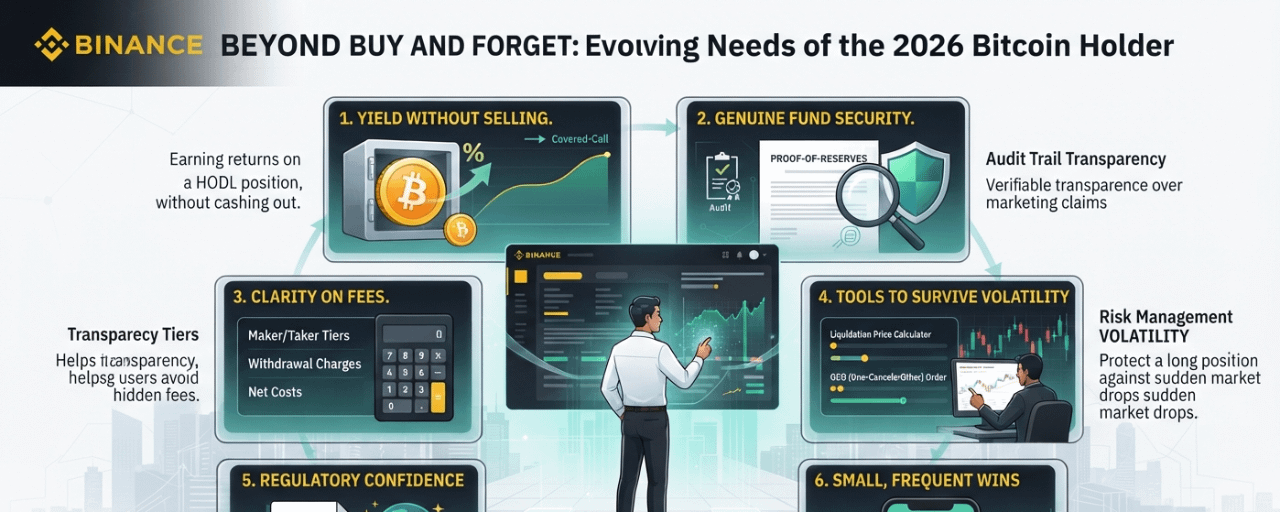
1. Yield Without Selling the Bitcoin
The single biggest behavioral shift this year: holders are refusing to sell, even when tempted. On-chain data shows long-term holder wallets — those untouched for 155 days or more — now control close to 79% of Bitcoin's circulating supply as of September 2026, a record high. That's not passive indifference; it's a deliberate hold strategy, and it comes with a new demand — "let me earn on this coin without cashing it out."
Binance's response has been to build products specifically for that mindset. Its BTC Yield product, a covered-call income strategy, was built exclusively for people who already hold Bitcoin — letting long-term holders generate a return on their sitting position instead of choosing between HODL and cash flow. For a reader-first article, this is worth flagging honestly: covered-call yield caps some of your upside if BTC spikes hard, so it suits holders prioritizing steady income over full upside exposure, not aggressive bulls expecting a breakout.
2. Genuine Fund Security, Not Just Marketing Copy
Every serious guide to choosing an exchange keeps circling back to the same non-negotiable: cold storage, two-factor authentication, and infrastructure that isn't sitting on a handful of vulnerable servers. Investors have grown numb to security claims, so what actually reassures them now is verifiable proof — proof-of-reserves data, audit trails, insurance funds — over adjectives like "bank-grade."
This is where an honest article should nudge readers to check for themselves rather than take any exchange's word: look up an exchange's proof-of-reserves page, confirm withdrawal history isn't restricted during volatile periods, and treat any platform that resists transparency as a red flag regardless of its fee structure.
3. Clarity on Fees That Actually Add Up
Fee sensitivity hasn't gone away — if anything, active traders are more fee-literate than ever, comparing maker/taker tiers, withdrawal charges, and volume-based discounts before committing capital. Tiered pricing that rewards higher-volume traders remains the norm across major platforms, but the fine print (withdrawal limits, inactivity charges) is where holders get caught off guard.
The practical advice worth giving readers: run their actual trading pattern — not the platform's headline rate — through a fee calculator before assuming "low fees" applies to their size and frequency of trades.
4. Tools to Survive Volatility, Not Just Watch It
September's price action has been a live lesson in why leverage without a plan is dangerous. Open interest and long-side positioning have stayed elevated, and that concentration cuts both ways — Binance alone was recently reported carrying roughly $3.00 billion in long liquidation leverage sitting below the price, against $1.80 billion in short leverage above it, meaning a modest downside move could trigger a cascade of forced liquidations.
What holders actually want from this environment isn't a prediction — it's risk-management tooling: liquidation-price calculators, OCO (one-cancels-other) orders, and clear margin-ratio alerts before a position gets force-closed rather than after. Any exchange piece worth reading should point people toward using these tools proactively, not toward chasing the leverage that created the risk in the first place.
5. Regulatory Confidence in a Still-Shifting Landscape
Institutional money hasn't stopped arriving, but it's arriving cautiously, watching how regulatory frameworks (like ongoing developments around the CLARITY Act) settle before committing further. Retail holders are picking up on that same caution — wanting to know an exchange's compliance posture, licensing footprint, and how it handles regional regulatory changes, rather than assuming "big platform" automatically means "safe platform."
6. Small, Frequent Wins Alongside the Big Trade
Not every demand is about yield curves and liquidation maps — plenty of holders also want low-stakes ways to stay engaged. Binance's Red Packet feature, adapted from the tradition of hóngbōo digital gifting, lets KYC-verified users redeem small daily reward codes for free crypto with no deposit or trade required. It's a minor perk in the scheme of a portfolio, but it reflects a real appetite: holders like feeling rewarded for showing up, not just for placing trades.
7. The Bottom Line
Line them up, and the pattern is clear: today's Bitcoin holder wants an exchange that protects the coin, quietly grows it, charges fees they can actually predict, and gives them the tools to not get liquidated in a sharp move — with regulatory footing solid enough that none of it evaporates overnight. Binance's current lineup — BTC Yield, tiered fees, OCO/margin tools, and transparency pushes — maps closely to that list. But the honest takeaway for readers is the same one that should anchor any crypto content: match the tool to your own risk tolerance and time horizon, verify claims yourself, and never treat yield or convenience features as a substitute for understanding what you're holding.
This is market commentary, not financial advice. Crypto markets are volatile — do your own research before acting on anything here.