
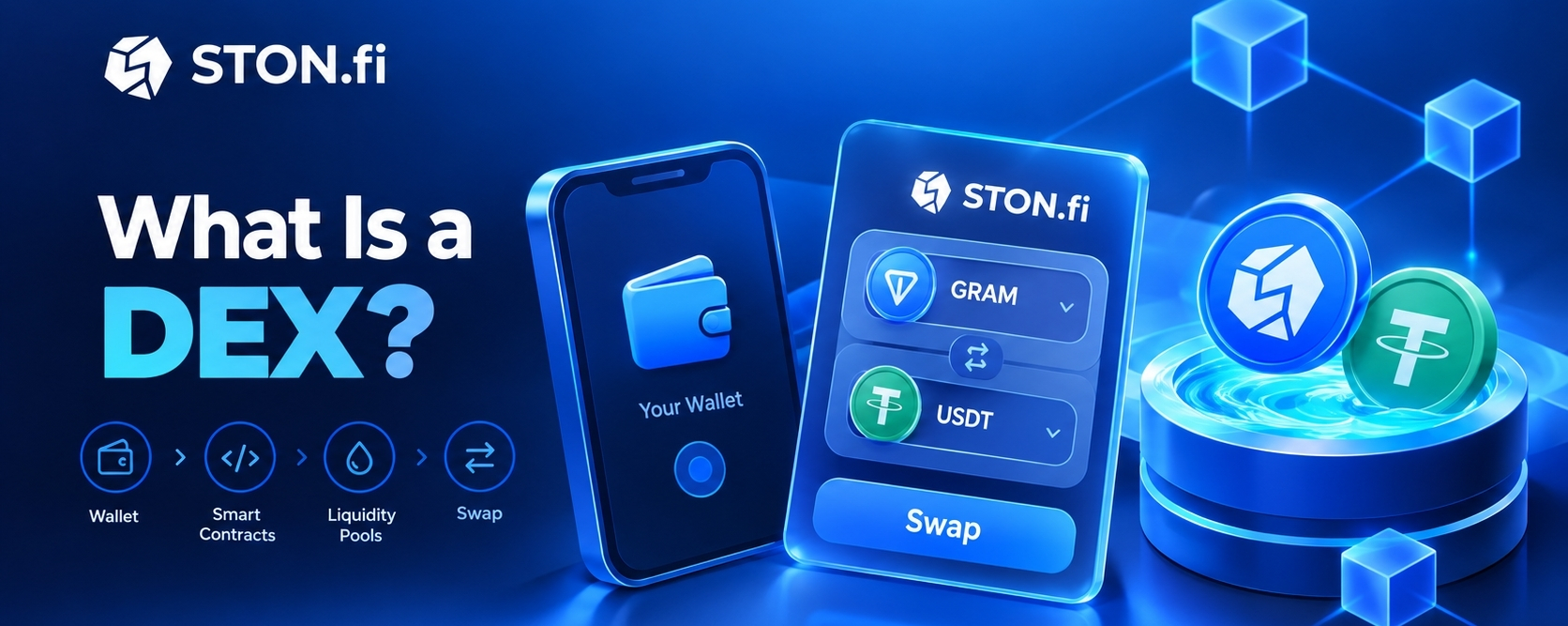

What Is a DEX and How Does It Work?
Decentralized exchanges, commonly called DEXs, are one of the fundamental building blocks of decentralized finance (DeFi). They allow users to exchange digital assets directly through blockchain infrastructure rather than depositing funds into a centrally controlled exchange account.
But a DEX is more than an interface with a “Swap” button. Underneath that interface are wallets, smart contracts, liquidity, pricing mechanisms, transaction messages and, in many cases, automated market makers (AMMs).
Understanding these components makes it easier to understand what actually happens when you exchange one token for another.
1. What Is a Decentralized Exchange?
A decentralized exchange is a blockchain-based trading system in which users interact with smart contracts or other on-chain mechanisms to execute asset exchanges without handing custody of their funds to a traditional centralized exchange.
The important distinction is where control and execution reside.
On a centralized exchange (CEX), a user normally deposits assets into an account controlled by the exchange. The platform maintains an internal ledger and operates the matching and settlement infrastructure.
With a DEX, the user's wallet remains the starting point for the transaction. Instead of transferring assets to an exchange-controlled balance first, the user authorizes blockchain transactions that interact with the exchange's smart contracts or liquidity infrastructure.
This does not mean every component surrounding a DEX must be decentralized. A DEX can have a web interface, APIs, indexing services or other infrastructure operated by particular entities. What matters is that the relevant asset-exchange logic and settlement are executed according to blockchain-based rules rather than requiring a centralized custodian to take possession of the user's trading funds.
That distinction also explains why “DEX” and “decentralized application” are not interchangeable terms. A DEX is a particular type of financial application that uses decentralized infrastructure to facilitate asset exchange.
2. Self Custody: Your Wallet Is the Starting Point
Self custody is one of the most important concepts behind DEX trading.
A self custodial wallet gives the user control over the private key or recovery credentials needed to authorize transactions. Instead of asking a company to move funds on the user's behalf, the user signs the transaction and the blockchain network processes it.
On TON, wallets are themselves smart contract based accounts. A wallet contract verifies signatures and uses transaction sequencing mechanisms such as seqno to prevent replayed transactions. The private key remains the critical authorization mechanism.
This changes the normal exchange experience.
You do not typically:
Deposit → receive an exchange balance → place a trade → withdraw.
Instead, the basic DEX model is closer to:
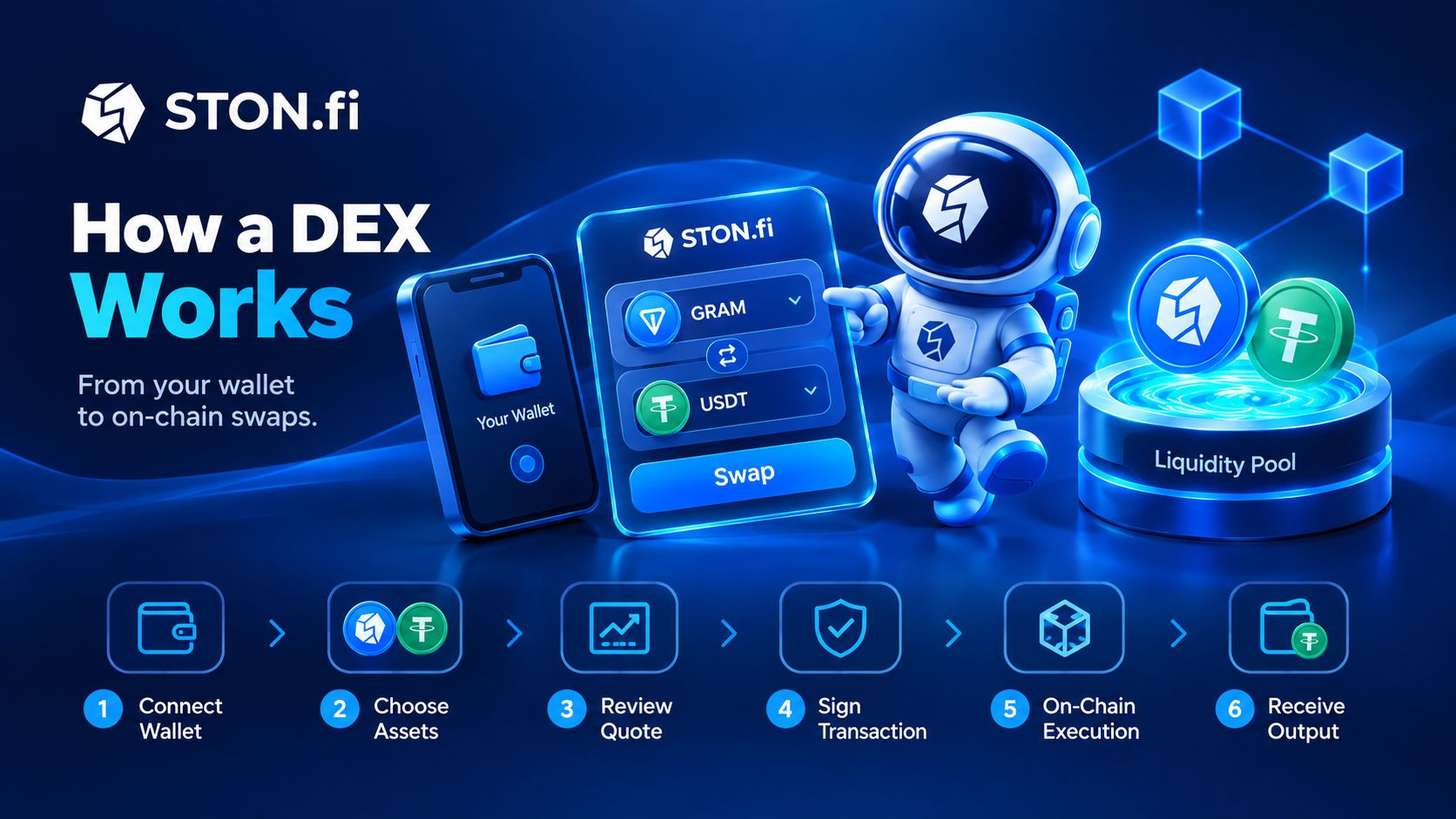
Connect wallet → select assets → review quote → authorize transaction → smart contracts execute → receive the output asset.
Self-custody provides control, but it also transfers responsibility to the user. Losing a recovery phrase, signing a malicious transaction, selecting the wrong token contract or misunderstanding transaction parameters can create risks that a centralized intermediary might otherwise absorb.
For TON specifically, fungible assets are generally represented using Jettons. TON documentation describes Jettons as consisting of a master contract plus individual wallet contracts associated with holders, rather than one centralized token-balance database.
3. Smart Contracts: The Execution Engine
Smart contracts are the programmable infrastructure that makes a DEX possible.
A smart contract is code deployed on a blockchain that responds to transactions and messages according to predefined rules. On TON, smart contracts contain code and persistent data and communicate through messages.
For a DEX, smart contracts can manage functions such as:
holding and accounting for liquidity;
calculating swap outcomes;
receiving one asset and sending another;
enforcing transaction conditions;
distributing trading fees;
issuing or accounting for liquidity-provider positions.
The key idea is that the exchange does not need an employee sitting behind the interface approving each trade.
The user signs a transaction, the blockchain processes it, and the contract executes its programmed logic.
This is why a DEX can operate continuously and transparently. The rules are encoded into blockchain infrastructure rather than relying entirely on an institution's internal database.
However, smart contracts are not automatically safe simply because they are on a blockchain. Bugs, flawed economic assumptions, malicious token contracts and poorly designed integrations can still create risks. Users therefore need to distinguish non-custodial execution from risk-free execution.
4. AMMs and Liquidity Pools
One of the most widely used DEX designs is the Automated Market Maker, or AMM.
Traditional markets often rely on buyers and sellers placing orders. An AMM takes a different approach: liquidity is deposited into pools and mathematical rules determine how assets are exchanged.
Imagine a pool containing two assets:
Asset A + Asset B
Liquidity providers deposit the assets into the pool. Traders can then swap one asset for the other directly against that liquidity.
Instead of asking:
“Is there another trader willing to sell me this exact amount?”
the AMM asks:
“Given the current state of the pool and its pricing rules, how much of the other asset can this transaction receive?”
This is one of the biggest conceptual differences between an AMM and an order-book exchange.
How does the pool determine the price?
The answer depends on the AMM's mathematical design.
A common model uses a constant-product relationship such as:
x × y = k
The important intuition is not the formula itself, but what happens when a trade changes the quantities of the two assets in the pool.
Suppose a pool contains $100,000 worth of Asset A and $100,000 worth of Asset B.
A relatively small trade changes the pool ratio only slightly.
A much larger trade moves the ratio more significantly.
That movement affects the effective execution price. This is why trade size and available liquidity matter.
Price impact vs. slippage
These concepts are often confused.
Price impact is the effect that your own trade has on the pool's price because your transaction changes the pool's asset ratio.
Slippage generally refers to the difference between the expected execution and the eventual execution caused by market or price changes during the transaction process.
STON.fi's educational material similarly distinguishes price impact from slippage and explains why larger trades relative to available liquidity can produce larger price impact.
This is one reason liquidity depth matters. A large pool can generally absorb a given trade more easily than a shallow pool.
5. Where Does DEX Liquidity Come From?
Liquidity does not simply appear.
It is supplied by liquidity providers, often called LPs.
An LP deposits assets into a liquidity pool so traders can use that capital.
For example, an LP might contribute:
$5,000 worth of $GRAM + $5,000 worth of another token
The liquidity becomes available for swaps.
In return, liquidity providers can receive a share of eligible trading fees generated by transactions using the pool. The exact mechanics depend on the DEX and pool design.
This creates an important relationship:
Traders need liquidity.
Liquidity providers supply liquidity.
Trading generates fees.
The protocol's smart contracts distribute those fees according to its rules.
Liquidity provision also introduces risks. If the relative prices of the deposited assets change significantly, an LP can experience impermanent loss compared with simply holding the assets outside the pool. STON.fi's documentation specifically explains this relationship between changing asset ratios and LP returns.
Therefore, the existence of an attractive APR does not automatically mean a liquidity position is profitable. Trading fees, token prices, incentives, volatility and impermanent loss all matter.
6. AMM vs. Order Book: The High Level Difference
An order-book DEX resembles the traditional trading model.
Users submit orders such as:
Buy 10 tokens at $5
or:
Sell 10 tokens at $5.10
A trade occurs when compatible orders meet.
An AMM DEX does not require a conventional list of matching buy and sell orders. Instead, trades interact with liquidity pools and pricing algorithms.
The distinction can be summarized conceptually:
Order BookAMMBuy and sell ordersLiquidity poolsOrders seek counterpartiesPool provides liquidityMatching engine/logicPricing algorithmTraders interact through bids and asksTraders interact with pool liquidityExecution depends on matching liquidityExecution depends heavily on pool state
Neither model removes the need for liquidity. They simply organize that liquidity differently.
STON.fi is an example of the AMM approach. STON.fi's own educational material describes AMM DEXs as pool based systems and distinguishes them from order-book DEXs.
7. A Simple Wallet to Swap Flow
Now put all of the pieces together.
Imagine a user wants to swap $GRAM for USDT on TON.
Step 1: Connect the wallet
The user opens the DEX interface and connects a compatible TON wallet.
The DEX interface can read the wallet address and relevant blockchain information, while the wallet remains responsible for authorizing transactions.
Step 2: Choose the assets
The user selects:
From: $GRAM
To: USDT
The interface then requests information about available liquidity and possible execution routes.
Step 3: Receive a quote
The DEX calculates an expected output amount.
The displayed result can depend on:
available liquidity;
trade size;
pool pricing;
fees;
price impact;
slippage settings;
and, where aggregation is involved, available routes across liquidity sources.
This quote is important because the headline market price is not necessarily the exact price a particular transaction will receive.
Step 4: Review the transaction
The user reviews the amount being exchanged and the expected amount received.
A self-custodial wallet may also show the transaction details and required network fee.
Step 5: Sign
The user approves the transaction in the wallet.
The private key authorizes the transaction; it is not handed to the DEX interface.
Step 6: Blockchain execution
The transaction reaches the blockchain.
The relevant smart contracts process the messages, move the input asset according to the protocol's rules, calculate the output and deliver the resulting asset.
Step 7: Receive the output
Once the transaction settles, the user's wallet reflects the received token.
There is no traditional exchange balance that needs to be withdrawn.
The blockchain itself records the resulting state.
That is the fundamental DEX experience:
Wallet → Authorization → Smart-contract execution → On-chain settlement → Wallet
8. STON.fi as a Practical Example on TON
STON.fi provides a concrete example of how these concepts come together within the TON ecosystem.
STON.fi is a decentralized exchange built on TON and uses the AMM model for its native liquidity infrastructure. Its pools provide liquidity against which swaps can execute, while users interact through their wallets rather than depositing funds into a conventional custodial exchange account.
The STON.fi guide organizes the user journey around connecting a wallet, swapping assets, understanding rate and price impact, providing liquidity, evaluating pools and managing other DeFi functions.
A STON.fi swap
A simplified STON.fi swap therefore looks like:
Connect TON wallet
Select the asset to sell
Select the asset to receive
Review rate, price impact and minimum received
Check network and swap costs
Confirm in wallet
Smart contracts execute the transaction
Receive the selected asset
The important point is that STON.fi is the practical implementation, while the underlying principles are the general DEX concepts discussed above.
9. Liquidity on STON.fi
STON.fi's liquidity pools are the infrastructure that allows AMM based swaps to take place.
Users can provide liquidity to supported pairs, becoming liquidity providers rather than simply traders.
The platform also provides pool information such as:
TVL the total value locked in the pool.
24-hour volume the amount traded through the pair over the specified period.
APR an estimate based on recent pool activity rather than a guaranteed future return.
STON.fi notes that higher liquidity can help accommodate larger transactions with less price impact, while volume influences the fees available to liquidity providers. It also warns that pool metrics can change significantly with market conditions.
This illustrates a central principle of DeFi:
Liquidity is not just a number displayed on a dashboard. It directly influences trading execution.
10. STON.fi and Permissionless Liquidity
Another important aspect of decentralized exchange infrastructure is permissionless participation.
STON.fi's documentation explains that tokens can become swappable at the protocol level through the creation of liquidity pools. The interface may nevertheless apply visibility or safety policies to certain assets.
This demonstrates an important distinction:
Protocol availability ≠ interface endorsement.
A token existing on-chain or having a pool does not automatically mean the token is legitimate, safe or officially endorsed.
Users still need to verify token contract addresses, liquidity, project information and transaction details.
STON.fi also notes that some assets can be hidden from the interface while remaining accessible through contract level or other interfaces, while certain categories can be filtered or blocked at the application layer.
That is why a DEX should never be treated as a substitute for personal verification.
11. Fees: What Are You Actually Paying?
DEX transactions can involve more than one type of cost.
There may be:
Network fees paid for blockchain computation and transaction processing.
DEX or pool fees charged according to the exchange and pool's fee structure.
Price impact an economic cost arising because your own transaction changes the pool's effective price.
Slippage the movement between expected and actual execution within the permitted transaction conditions.
On STON.fi, its documentation has described a default 0.3% swap fee structure for applicable pools, with 0.2% allocated to liquidity providers and 0.1% to the protocol; however, users should always check the current pool/interface information because fee structures can change.
Network fees are separate from the exchange's trading fee.
On TON, $GRAM is the native asset used for network fees and smart contract execution. TON documentation identifies Toncoin as the native cryptocurrency used to pay transaction and smart contract execution costs.
This means holding only the token you want to trade is not always sufficient. A user may also need some native network asset to pay for blockchain execution.
12. Routing and Fragmented Liquidity
There is another challenge beyond simply having liquidity: where the best liquidity exists.
Suppose one DEX has the best route for Token A → Token B, while another has deeper liquidity for a different part of the transaction.
An aggregator or routing layer can compare available liquidity sources and construct an execution path.
This is particularly relevant to the current STON.fi experience.
STON.fi introduced Omniston as a liquidity aggregation and routing layer and its documentation states that smart routing is enabled by default in the STON.fi dApp, allowing liquidity from multiple DEXs to be considered rather than restricting every swap to a single pool or protocol.
The distinction is important:
STON.fi's AMM pools provide liquidity infrastructure.
Omniston can aggregate and route liquidity across sources.
This helps explain why a modern DEX interface can feel simpler than the underlying infrastructure actually is.
The user sees:
“Swap A for B.”
Behind the interface, the system may need to determine:
Which pool?
Which liquidity source?
Which route?
What output?
What price impact?
What execution conditions?
That complexity can be abstracted away from the user while still being settled through blockchain-based mechanisms.
13. What a DEX Does Not Guarantee
Decentralization does not automatically mean:
No risk.
It does not guarantee that every token is legitimate.
It does not guarantee that every price is favorable.
It does not guarantee unlimited liquidity.
It does not eliminate smart-contract risk.
It does not eliminate market volatility.
It does not guarantee that a transaction cannot fail.
And self-custody does not mean someone else can recover your funds if you lose your recovery credentials.
The DEX removes or reduces particular forms of intermediary dependence, but the user takes on more responsibility for understanding what they are signing and interacting with.
14. The Bigger Picture
A DEX can be understood as the intersection of several technologies:
Wallets provide user-controlled authorization.
Blockchains provide the settlement layer.
Smart contracts provide programmable execution.
Liquidity pools provide capital for swaps.
AMMs provide mathematical pricing mechanisms.
Liquidity providers supply trading capital.
Routing systems can connect fragmented liquidity.
Interfaces turn this technical infrastructure into a usable product.
Remove any one of these components and the experience changes significantly.
This is why the “Swap” button is actually the final layer of a much deeper system.
Conclusion
A decentralized exchange is fundamentally a way to exchange digital assets through blockchain-based infrastructure without relying on a conventional centralized custodian to hold and settle the user's trading balance.
AMM-based DEXs achieve this by replacing traditional order matching with liquidity pools and mathematical pricing mechanisms. Liquidity providers supply the assets that traders use, while smart contracts enforce the rules for swaps and fee distribution.
The user experience can be remarkably simple:
Connect wallet → choose assets → review quote → sign → settle on-chain.
But underneath that simplicity are liquidity management, pricing algorithms, smart contracts, network transactions, fees, slippage, price impact and security considerations.
STON.fi provides a practical example on TON. Its AMM liquidity pools demonstrate the core mechanics of decentralized exchange trading, while its broader routing infrastructure, including Omniston, illustrates how modern DEX experiences can aggregate liquidity beyond a single pool.
The most useful way to think about a DEX, therefore, is not simply as a decentralized version of a traditional exchange.
It is a programmable, wallet driven financial system where liquidity, pricing and settlement are coordinated through blockchain infrastructure and smart contracts.
Once that model is understood, the next time you connect a wallet and press “Swap,” you can see what is really happening behind the button.
Read more about STONfi DEX : blog.ston.fi