


The U.S. Senate failed to advance the Digital Asset Market Clarity Act on Tuesday, closing off, for now, the crypto industry's best chance this year at the market-structure legislation it has wanted since the first spot bitcoin exchange-traded funds launched.
Bitcoin investors had been counting on the bill as a genuine catalyst. Its failure left the industry facing the same regulatory uncertainty the legislation was meant to resolve, just as a separate and more immediate headwind, a Federal Reserve rate increase, was also landing.
Supporters cast the bill as a long-overdue framework, splitting oversight of digital assets between the Securities and Exchange Commission and the Commodity Futures Trading Commission and finally telling the industry which rules apply and when.
Critics called it something closer to a giveaway, arguing its ethics provisions left too much room for officials, including the Trump family's own crypto ventures, to profit from the industry they would be regulating. The chamber's cloture vote fell short, 49 to 50, ten votes shy of the 60 needed just to open floor debate.
Bitcoin fell 3.28% to $75,620.40 on September 15 in the hours after that vote failed, sliding from an opening price of $78,188.50 to a session low of $75,025.50. It has since recovered some ground, rising 0.76% on September 16 and another 0.61% on September 17 to $76,653.80.
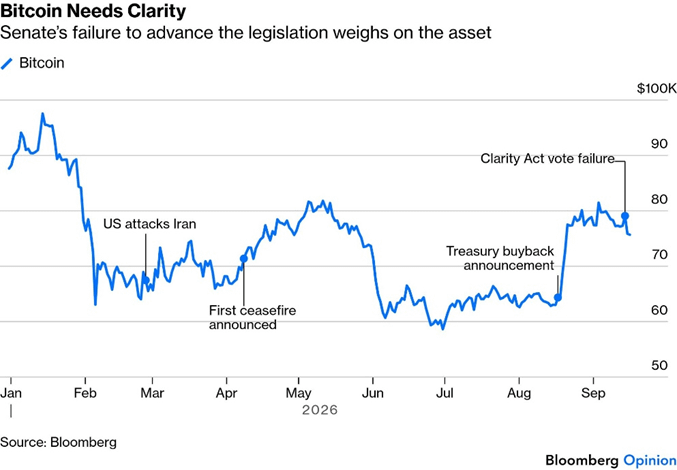
The coin is now on pace to break a two-month winning streak. September's decline stands at 2.83%, with bitcoin at $76,349, following gains of 24.96% in August and 7.24% in July. The pullback follows a September high of $82,178.60, reached before the retreat toward $75,000.
Widen the lens and the picture looks worse. Bitcoin is down 12.86% year to date and 29.47% over the past 12 months, against $87,614 at the start of 2026 and $108,247 a year ago. The all-time high of $126,186, set in October 2025, came on the back of a rotation into scarce assets as investors grew nervous about currency debasement. That momentum has since reversed hard.
A Hike the Fed Won't Call a One-Off
Selling pressure had been building before the Fed's own decision even landed. Bitcoin lost more than 3% on the day the Senate blocked the bill, and part of that weakness traces directly to what was coming the next afternoon. Higher rates tend to dull the appeal of an asset like bitcoin, which pays no yield and depends heavily on risk appetite to draw in fresh capital.
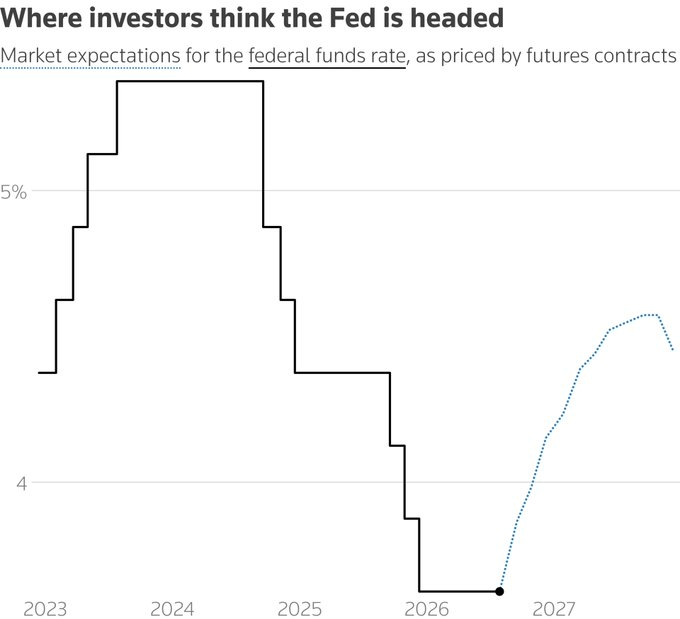
The Federal Open Market Committee delivered that higher-rate environment on Wednesday, raising the federal funds rate by 25 basis points to a target range of 3.75% to 4%, its first increase since 2023. Of the 18 policymakers, 16 penciled in at least one further hike before year-end, and four of those see room for a second. Two think Wednesday's move already did the job.
Federal Reserve Chairman Kevin Warsh defended the decision at his press conference, telling reporters inflation had been running "too high ... for too long," and that broad financial conditions were not restrictive enough to justify standing pat. He offered no forward guidance on what comes next, saying he would not fixate on any single data point.
That reluctance to commit runs in both directions. Warsh framed Wednesday's move as withdrawing only part of the Fed's accommodative stance, not the whole of it, which is exactly why nobody on trading desks is calling this one-and-done. Futures markets are already pricing in more tightening than the Fed's own median dot implies, and banks including Goldman Sachs, which correctly called September's hike ahead of time, are not ruling out another move before year-end.
How Bitcoin Actually Took the News
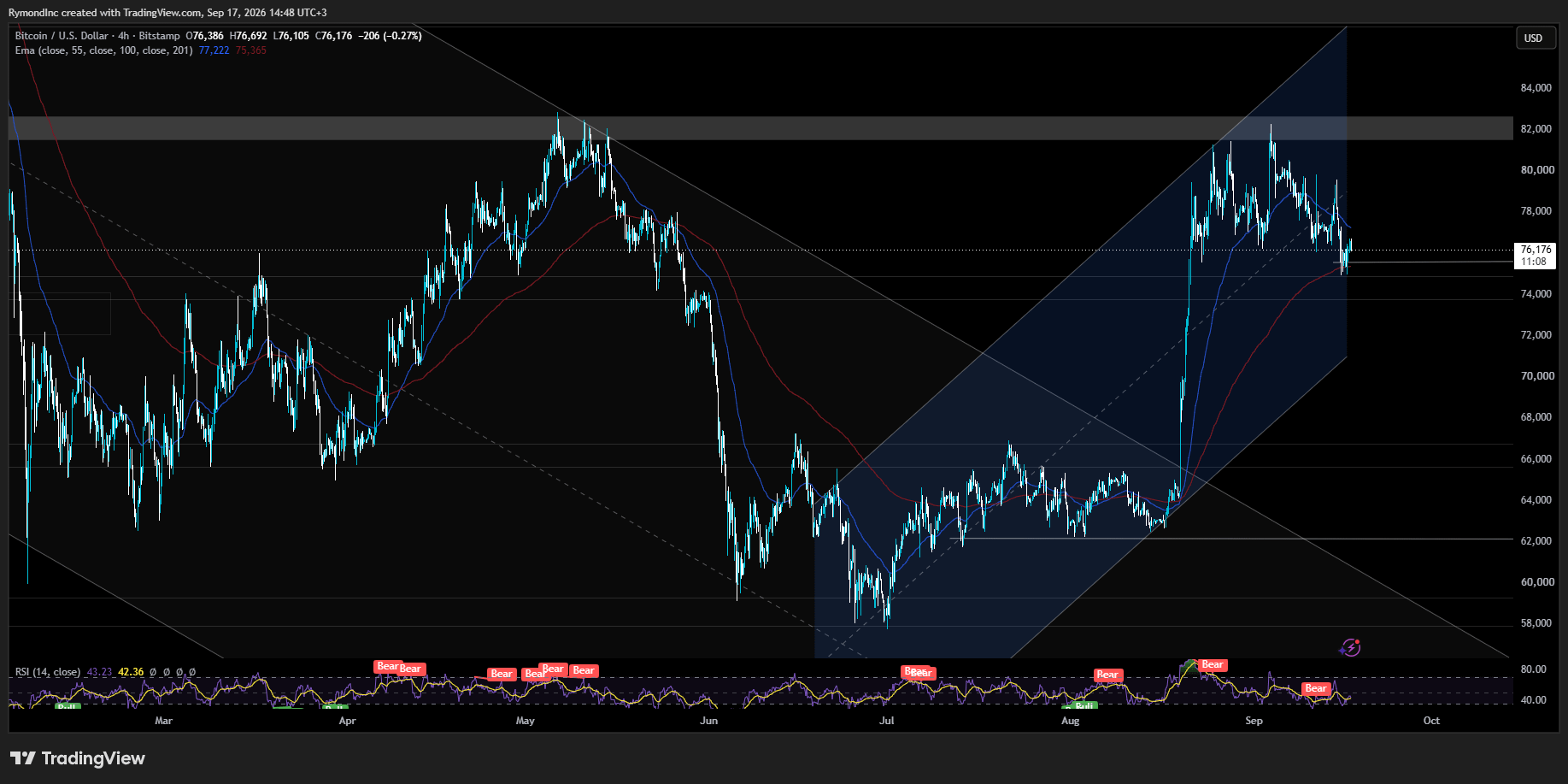
Here is where the simple bearish story gets complicated. Bitcoin did not sell off around the Fed's announcement. It traded near $76,150 in the session that followed, up about 0.76%, jumping from roughly $75,350 to above $76,100 and briefly touching $76,464.80 within minutes of the release.
The broader crypto market cap held at $2.7 trillion, up 1% on the day, on $93.6 billion in trading volume. Bitcoin's dominance sits at 56.8%, with ether at 11%, an unusual split for a hiking cycle that normally weighs on both at once.
Underneath that calm, positioning told a more cautious story. U.S. spot bitcoin ETFs shed roughly $746 million in combined net outflows across September 15 and 16: $450.33 million on the day of the failed Senate vote, then another $295.98 million the day the Fed hiked. The price barely moved. The money still left.
The dollar tells a related story. The Dollar Index held above 100 on Wednesday after a sharp gain in the prior session, near a seven-week high, rising 0.64% to 100.25. That marks a 1.52% advance over four sessions, up from 99.12 on September 11, as markets priced in and then absorbed the Fed's move.
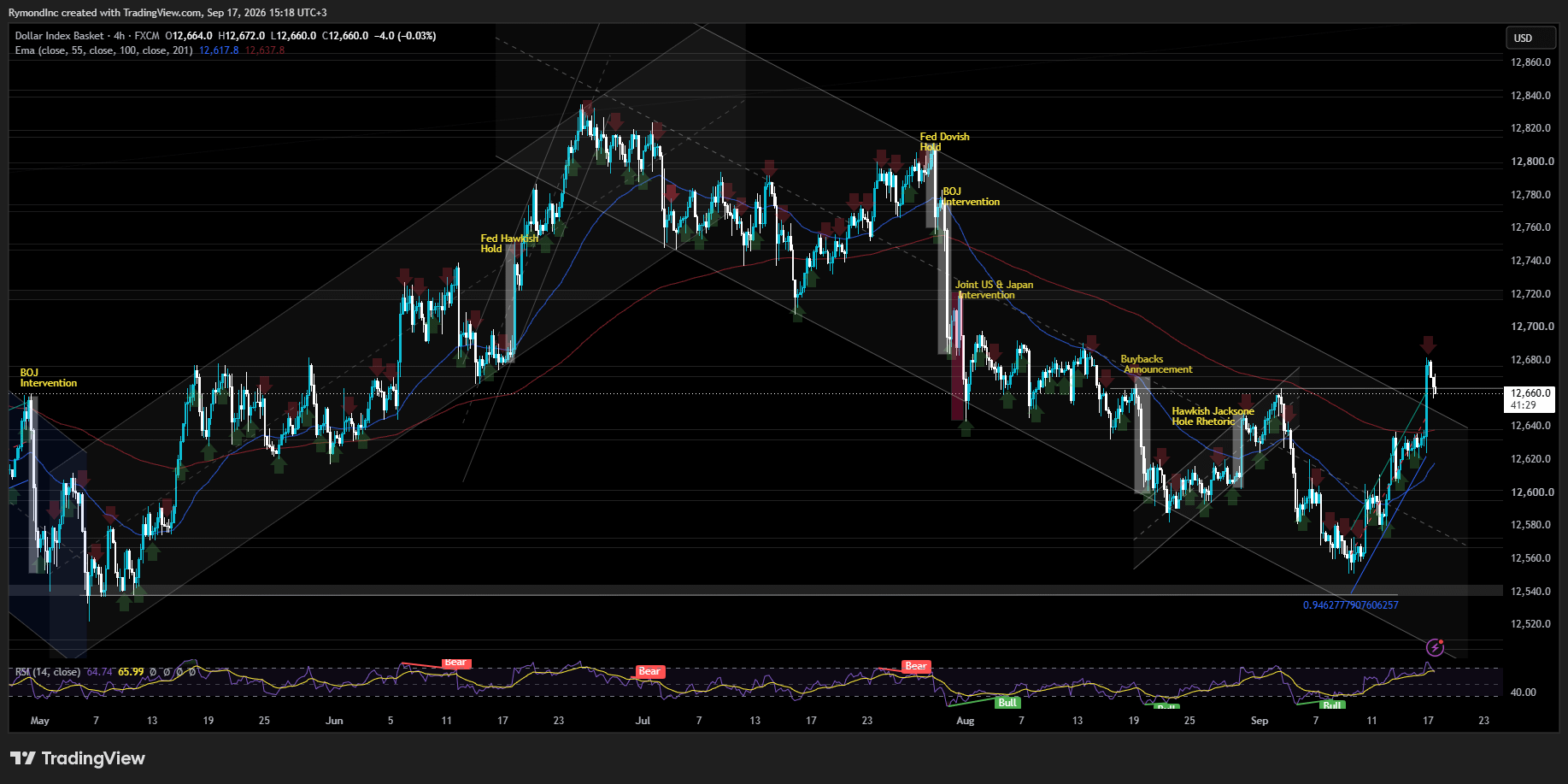
None of this favors bitcoin on two fronts at once. Higher rates squeeze the liquidity that risk assets rely on. A stronger dollar, meanwhile, gives capital a more defensive place to sit than a speculative asset competing for the same flows.
A Good Spell That Never Fully Paid Off
Crypto had been enjoying a rare stretch of good news before all this. Renewed enthusiasm for the debasement trade, sparked by Treasury Secretary Scott Bessent's buyback announcement, drove roughly a 30% rebound in a matter of days. Before that announcement, bitcoin had spent months in the doldrums, losing support from institutional buyers along the way.
That rally raised hopes of a sustained run into year-end. It never fully closed out 2026's losses, and Tuesday's failed vote knocked the wind back out of it.
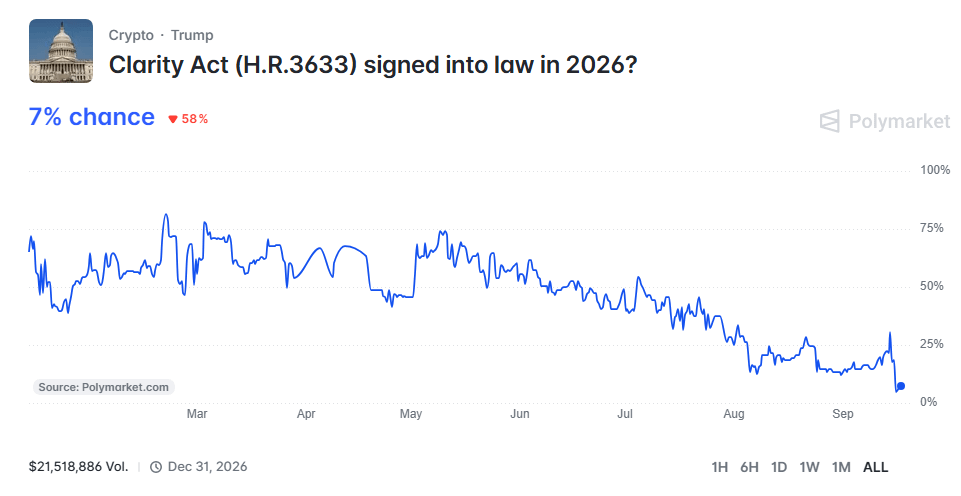
Whether the Clarity Act ever clears the Senate is now genuinely uncertain. Prediction markets give it low odds of passing this year, with Polymarket assigning a 7% chance the Clarity Act (H.R.3633) is signed into law in 2026. Even so, President Trump's own financial ties to the industry, and his administration's continued embrace of digital assets more broadly, suggest more policy support out of Washington remains likely, regardless of this particular bill's fate.
The fallout spread well beyond bitcoin itself. Crypto-adjacent stocks, including Coinbase Global and Circle Internet Group, fell alongside it after Tuesday's vote, at a moment when retail interest in the space has already been fading, and higher rates and tighter liquidity are weighing on sentiment more broadly.
The Flows Behind the Price
Before the vote, the flow picture looked considerably brighter. U.S. spot bitcoin ETFs pulled in a 2026-high $3.52 billion in August as bitcoin rallied. A three-week run of inflows worth more than $3 billion since mid-August carried into early September.
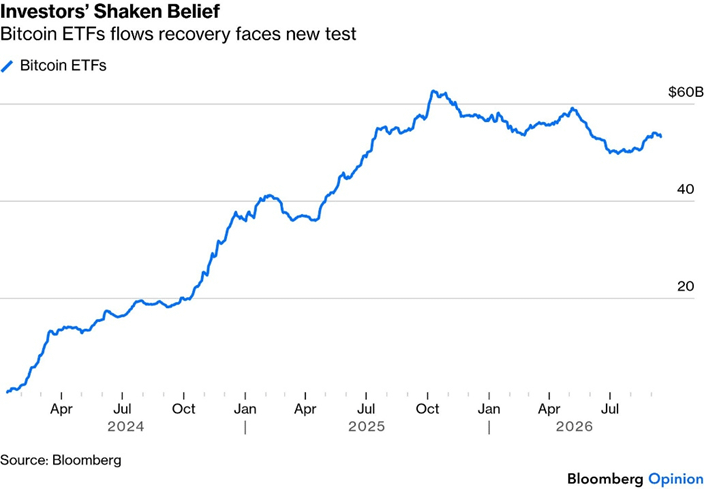
That momentum reversed fast. Outflows totaling $462.7 million hit across four sessions from September 8 to 11, followed by a partial $159.9 million rebound on September 14. Tuesday's vote then erased the entire month's remaining gain in a single session.
Bloomberg Intelligence puts cumulative inflows into U.S. spot bitcoin funds, since their January 2024 launch, at $55 billion, down from a peak of $63 billion.
That 3% drop on vote day is a reminder of just how much the market had been leaning on this one catalyst. To be fair, bitcoin has weathered worse. Between 2017 and 2020, the coin went more than 1,100 days without setting a new all-time high. The current drought, dating to the October 2025 peak, stands at 346 days and counting.
Where the Chart Goes From Here
The next real test sits at $81,600, an area defined by the month's recent highs and the primary obstacle standing between here and anything more constructive. A clean break above it would go some distance toward restoring a genuinely bullish bias and could open the door to a steadier uptrend into the fourth quarter. Support currently holds around $76,098.
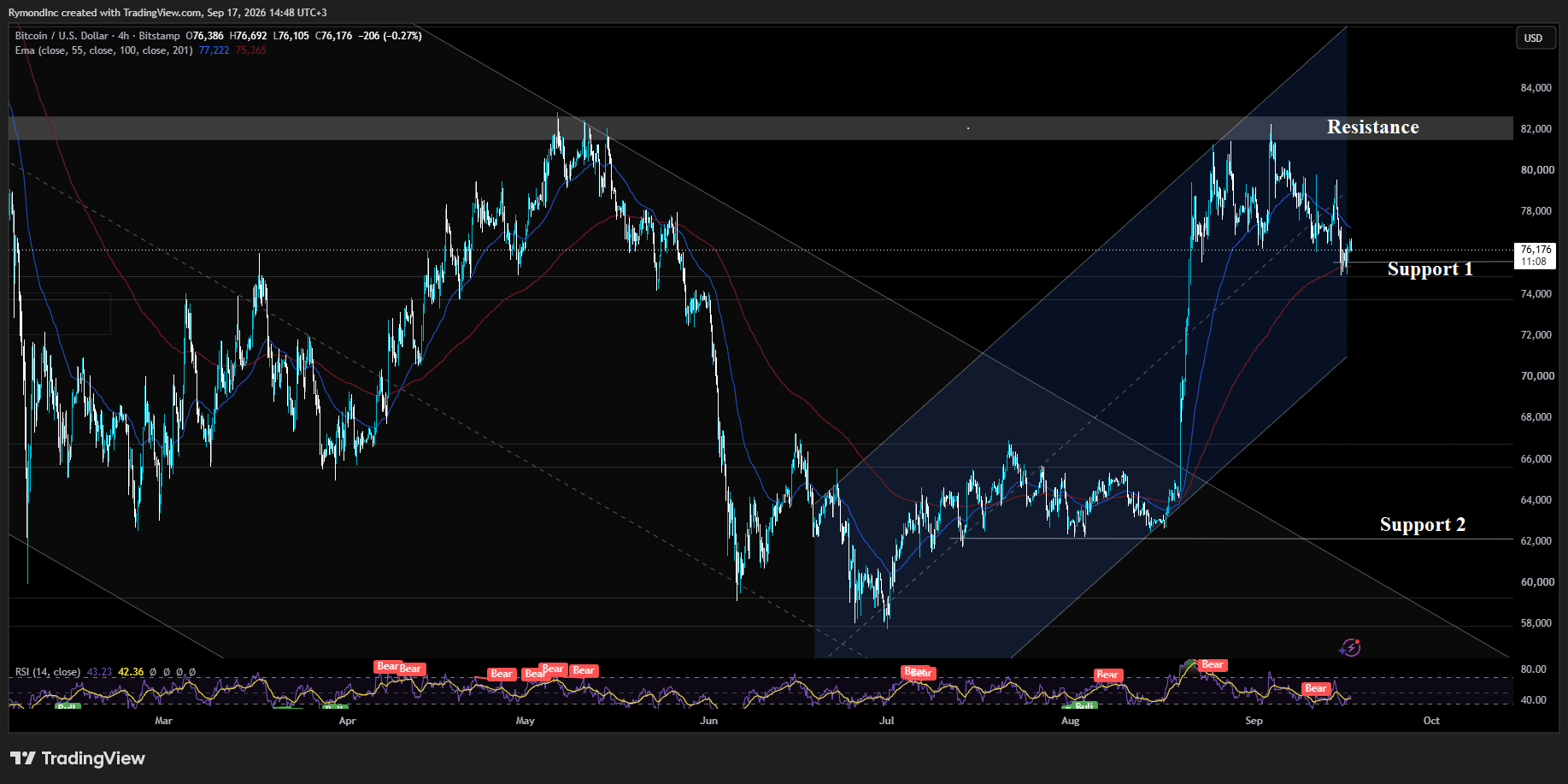
The moving averages are not offering much comfort in the meantime. Nine of Bitcoin's signals point to sell against just three buys as of Wednesday. The five- and ten-day averages both lean bearish, and more tellingly, so do the 100-day and 200-day lines, evidence that the longer-term trend itself has turned down. Only the 20-day average currently signals a buy, with the 50-day stuck in between.
The wider basket of technical indicators reads much the same way: five sells, two neutral readings, and a single buy. The Relative Strength Index sits at a neutral 50.7. The Stochastic oscillator reads overbought at 94.7, while the Stochastic RSI reads oversold at 12.1, a contradiction that says more about short-term noise than about where the underlying trend is heading. The lone holdout leaning bullish is the MACD, still in buy territory at 1,182.4.
A Year-End Forecast With No Consensus Left
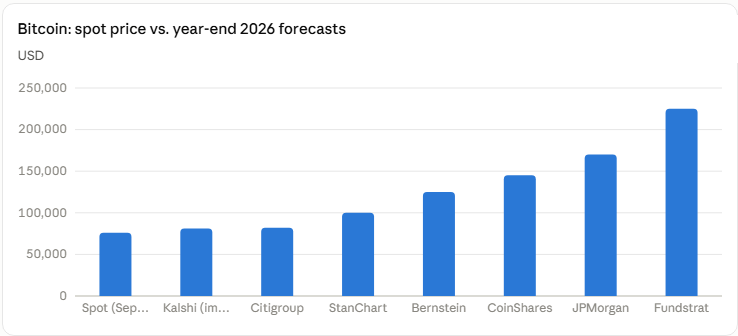
Wall Street's year-end targets for bitcoin have moved in exactly one direction in 2026, and it is not up. Every major bank that has revisited its forecast this year has cut it at least once. None has raised one. Most of these targets predate Wednesday's hike, since no major bank had published a revised note as of Thursday morning.
Forecaster Year-end 2026 target
Citigroup $82,000; cut twice from $143,000; Standard Chartered (Kendrick) $100,000; cut twice from $300,000, flagged a possible dip to $50,000 along the way. Bernstein $125,000; Cut once, from $150,000, which now applies to mid-2027 instead; Fundstrat (Tom Lee) $200,000 to $250,000, Unchanged since January.
Kendrick has since suggested, in comments this past August, that his own $100,000 call might prove too conservative if the current rebound extends, though Standard Chartered has not formally moved the number. Tom Lee remains the clear outlier, unmoved through the entire drawdown, which makes him either the contrarian who gets vindicated by a fourth-quarter melt-up, or the next call in line to get walked back.
What the market itself is pricing, rather than what any single bank is calling for, may be the more honest signal. Kalshi's own year-end contract, as of September 15, priced bitcoin's December 31 close near $81,000, a modest grind higher from here rather than a Wall Street moonshot. Polymarket gives bitcoin a 51% chance of touching $90,000 at some point before year-end, and just a 26% chance of reaching $100,000.
A survey of 11 AI models, published September 6, clustered mostly between $84,500 and $105,480 for a December 31 close, with a median call of $96,500. One of the 11 tied its forecast explicitly to concerns that tighter-than-expected Federal Reserve policy would keep bitcoin from reclaiming its October record.
Between a Senate that cannot pass its own crypto bill and a Fed chairman who won't say he is finished, bitcoin is left making its case the hard way, one contested basis point at a time.