

Layer 2s are supposed to make blockchain ecosystems faster, cheaper and more scalable.
But there is another question worth asking:
Who actually captures the value created by the L2?
That question is what makes Kinetiq’s Elysium particularly interesting.
Elysium is being designed as a purpose-built Layer 2 for the Hyperliquid ecosystem, focused on trading, liquidity, token launches and seamless composability with HyperCore.
Rather than creating another isolated execution environment, the goal is to make Elysium an extension of the existing Hyperliquid economy.
And the economics are where things get especially interesting.
Why Hyperliquid Needs Elysium
Hyperliquid has built powerful trading infrastructure around HyperCore, but bringing EVM applications into that environment comes with limitations.
HyperEVM’s dual-block architecture introduces complexity for applications that require fast and predictable execution. During periods of congestion, transaction costs can also become a serious problem, with swap fees potentially reaching levels that are difficult to justify for everyday users.
For #DeFi builders, traders and liquidity providers, infrastructure bottlenecks eventually become economic bottlenecks.
Elysium is designed to address this by providing a specialized execution environment built around Hyperliquid’s strengths.
Instead of asking every application to operate under the same constraints, Elysium is being optimized for high-performance trading and liquidity applications.
HYPE as Gas
One of Elysium’s simplest but most important choices is using $HYPE as its native gas token.
This eliminates the need to introduce another gas asset and helps maintain economic continuity with Hyperliquid.
Users already holding $HYPE can interact with the Elysium environment without needing to learn or acquire an additional gas token.
More importantly, Elysium remains connected to the economic activity of the Hyperliquid ecosystem rather than creating an entirely separate economy.
Supercharging Spot Trading and PropAMMs
Elysium isn’t simply targeting cheaper transactions.
It is being designed around financial applications.
One major component is support for PropAMMs, combined with access to Hyperliquid market information through the L1Read precompile.
This gives applications a way to build directly around HyperCore’s market infrastructure.
The result could be an environment where developers can create more sophisticated liquidity and trading applications while remaining connected to Hyperliquid’s underlying markets.
That distinction is important.
Elysium isn’t trying to replace HyperCore.
It is designed to help more applications connect to it.
A New Token Generation Lifecycle
Another interesting part of the design is the proposed progression for new assets:
AMM → PropAMM → HyperCore Spot → HIP-3 Perps
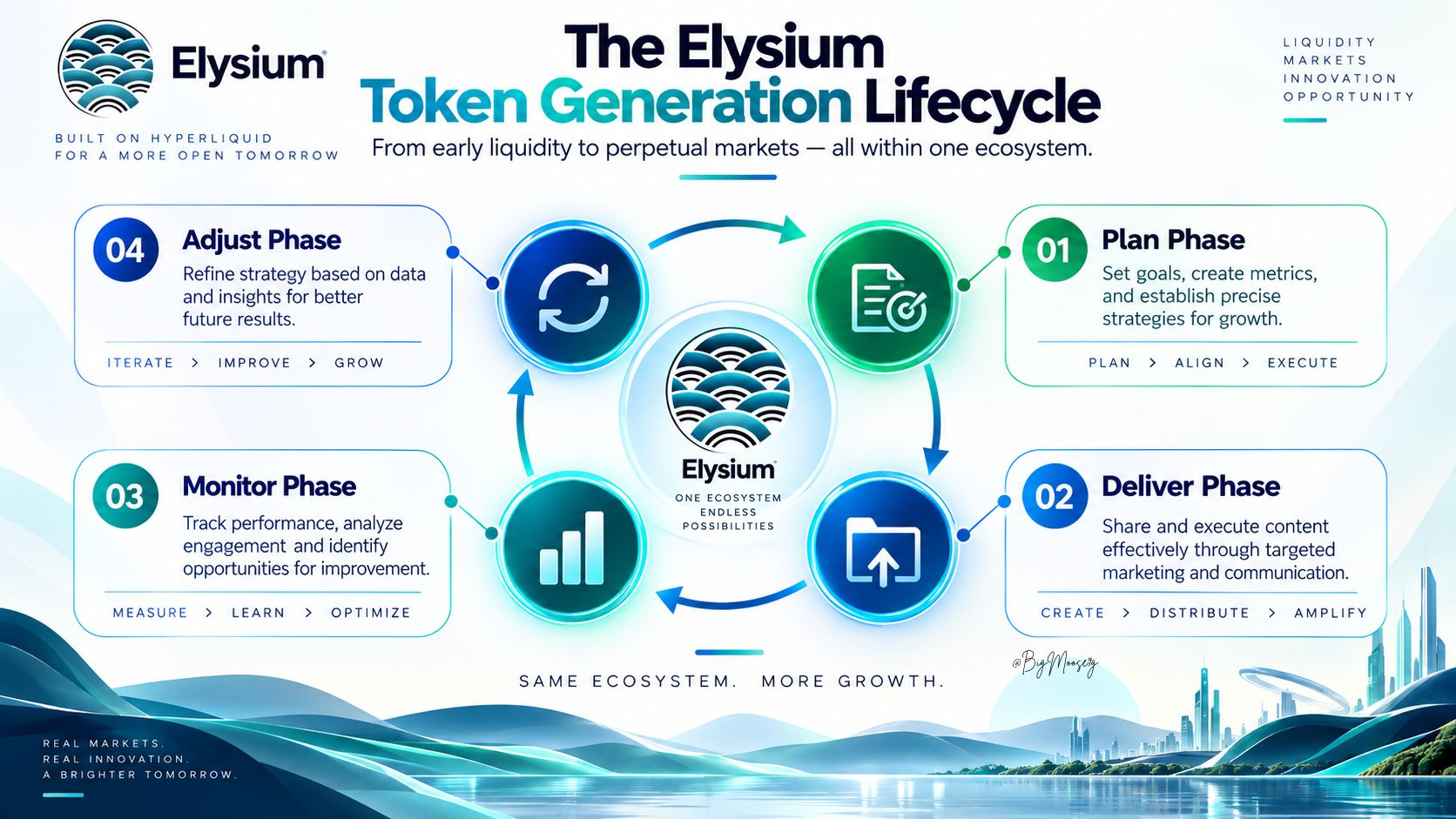
Instead of forcing every new token to immediately compete for mature market infrastructure, Elysium can provide a path for assets to develop their liquidity progressively.
A token could begin with an AMM, move into a more sophisticated PropAMM environment, graduate toward HyperCore spot markets and potentially reach perpetual markets through HIP-3.
This creates a potential lifecycle for assets rather than treating token launches as isolated events.
For builders, that can mean more infrastructure to work with.
For traders, it can create a clearer path from early liquidity to deeper markets.
For Hyperliquid, it could increase the number of assets and applications ultimately interacting with its core trading infrastructure.
The Most Important Part: Sequencer Fees
This is where Elysium’s design becomes particularly different from many traditional L2 models.
The announced sequencer fee allocation is:
50% — KNTQ buy & burn
25% — Builders
25% — Treasury
The 50% allocation is the centerpiece.
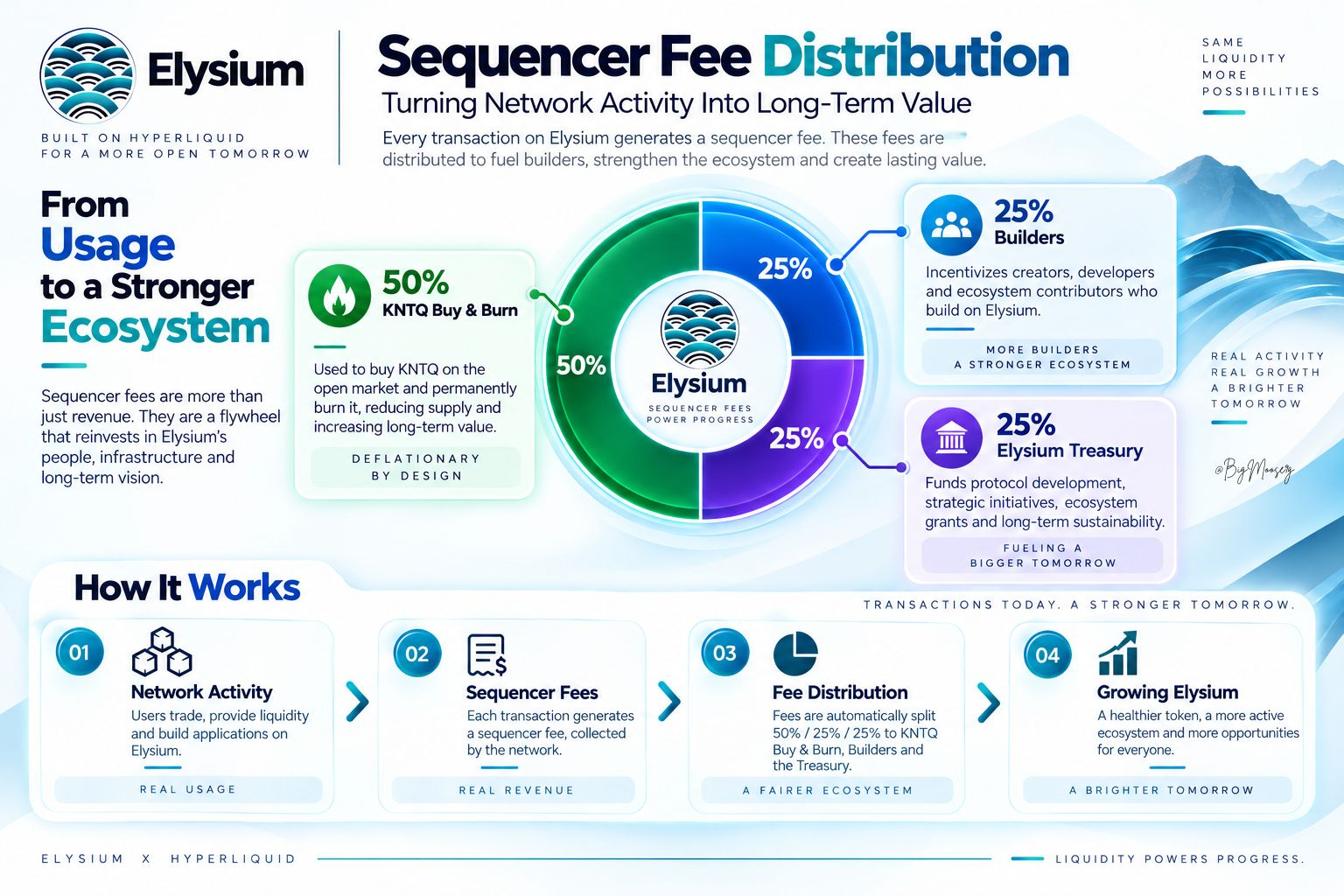
Elysium sequencer fees are intended to fund programmatic open-market purchases of KNTQ.
Those purchased tokens are then sent to the Hyperliquid Assistance Fund for permanent burning.
In simple terms:
Elysium activity → Sequencer fees → KNTQ purchases → Permanent burn
That creates a direct relationship between network usage and the #Kinetiq token KNTQ supply reduction.
The other 50% is also important.
Builders receive 25% of sequencer fees, giving applications an economic incentive to generate activity on Elysium.
Another 25% goes to the treasury, supporting continued ecosystem development and infrastructure.
This creates three connected beneficiaries:
Builders receive a share of economic activity.
The Treasury receives resources to support the ecosystem.
KNTQ receives a mechanism for supply reduction.
Why This Could Be Different From Traditional L2 Value Extraction
A common criticism of L2 economics is that the L2 can capture significant economic value while the underlying ecosystem receives comparatively limited direct value.
Elysium is attempting a different model.
The L2 is designed around Hyperliquid rather than independently from it.
It uses $HYPE as gas.
It is designed to access HyperCore market data.
It provides pathways toward HyperCore spot markets and HIP-3 perps.
And critically, 50% of its sequencer fees are directed toward KNTQ buybacks and permanent burns.
That creates an economic loop where greater Elysium activity can potentially create greater KNTQ supply reduction.
But Let’s Keep It Real
The mechanism is interesting, but it shouldn’t be turned into a guaranteed price narrative.
A 50% buy-and-burn allocation does not automatically mean KNTQ will appreciate.
The actual impact depends on Elysium’s adoption, transaction volume, sequencer revenue and successful execution of the mechanism.
If usage is small, the absolute amount of KNTQ purchased and burned will also be small.
So the important metric to watch isn’t simply the announced percentage.
It is actual network activity.
If builders come.
If traders come.
If liquidity grows.
If applications generate meaningful transaction volume.
Then the economic flywheel becomes increasingly relevant.
My Take
What makes Elysium interesting isn’t one isolated feature.
It is the combination of its architecture and economics.
$HYPE as gas.
HyperCore composability.
Native access to Hyperliquid market data.
PropAMMs.
A progressive token lifecycle.
And a sequencer model where half of generated fees are directed toward KNTQ buybacks and permanent burns.
That creates something different from the typical “launch an L2 and capture fees” model.
The real thesis is much simpler:
Build useful infrastructure → attract activity → generate sequencer revenue → reward builders and the treasury → permanently reduce KNTQ supply.
Whether that becomes a powerful flywheel will ultimately be determined by adoption and execution, not marketing.
But if Elysium delivers on its technical goals, it could become an important new execution layer for the Hyperliquid ecosystem.
And that makes it worth watching closely.