
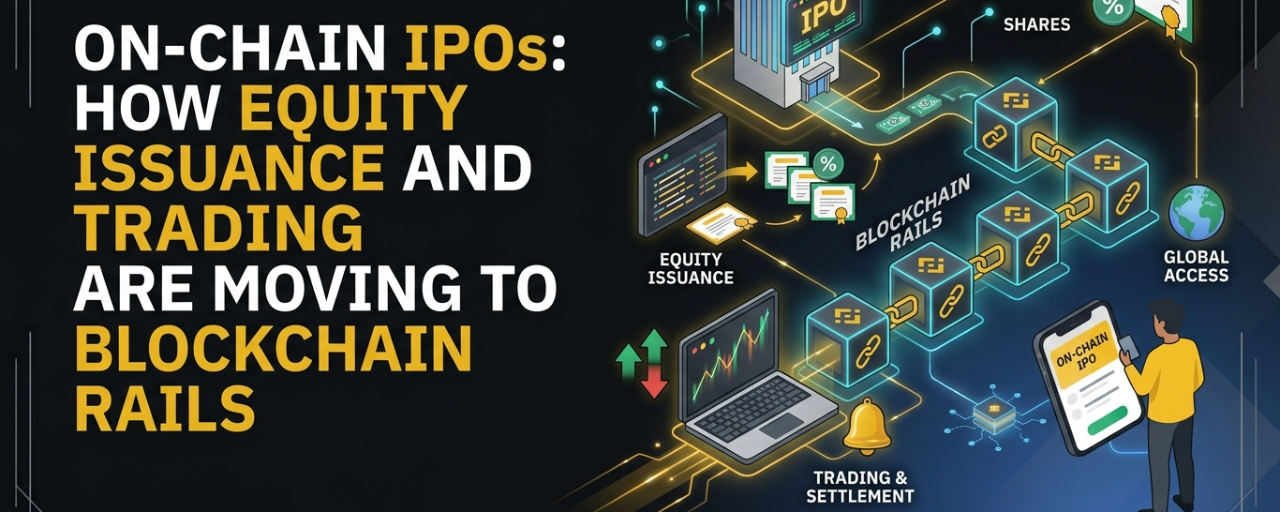
What if an IPO didn't have to rely entirely on the traditional financial rails we've used for decades?
The idea of bringing equity markets on-chain is moving from a theoretical concept toward something increasingly tangible.
@CZ , Binance's co-founder, has argued that IPOs will eventually move on-chain. The reasoning is straightforward: blockchain can potentially make ownership, trading, settlement and financial-market infrastructure more programmable, transparent and globally accessible. But this transition probably won't happen all at once.
Instead, it can be viewed as a progression through several stages, from simply bringing equity prices and access on-chain, to moving trading and settlement onto blockchain rails, and eventually creating new forms of exposure to companies before they become publicly traded.
Here's how that evolution could look.
Stage 1: Bringing Equity Exposure On-Chain
The first step is already familiar: tokenization.
Tokenized securities allow traditional financial assets to be represented using blockchain-based tokens. The underlying asset can remain within a regulated custody structure while the token provides a blockchain-based representation of the economic exposure.
This creates a bridge between traditional financial markets and digital-asset infrastructure.
Instead of completely replacing existing securities markets, tokenization can initially operate alongside them. This is already happening with products such as tokenized stocks and other real-world assets. The significance isn't simply that a stock gets a token.
It's that once an asset is represented digitally on-chain, it can potentially interact with blockchain-based financial infrastructure in ways that traditional securities cannot.
That opens the door to new forms of accessibility, transferability and composability.
Stage 2: Trading and Settlement Move On-Chain
Tokenization is only the beginning. The bigger transformation happens when trading, settlement and collateral increasingly operate on blockchain rails.
Traditional securities markets often separate different parts of a transaction.
You have the trading venue.
Then clearing.
Then settlement.
Then custody.
Then collateral management.
Blockchain technology creates the possibility of bringing some of these functions closer together.
A transaction can potentially involve the digital asset, payment and ownership record within a more integrated environment.
This doesn't mean blockchain automatically eliminates intermediaries or makes settlement instant in every situation.
Regulation, custody, compliance and infrastructure still matter.
But the architecture is fundamentally different.
Instead of simply putting a traditional asset onto a blockchain, the market itself can increasingly be designed around programmable digital assets.
Stage 3: Pre-IPO Exposure Enters the Picture
The most interesting development may happen before the IPO.
Today, there is a significant distinction between private companies and publicly traded companies. Once a company goes public, its shares can generally be traded through established public markets.
Before that happens, access to private-market exposure can be considerably more restricted. This creates a potential opportunity for blockchain-based financial products.
If private-company exposure can be represented digitally and appropriate market structures are created around it, investors could potentially gain access to forms of pre-IPO exposure before a company reaches a public exchange.
This doesn't mean pre-IPO exposure is equivalent to owning shares in a public company.
Private-market assets can have very different liquidity, valuation, disclosure and regulatory characteristics. But blockchain could provide new infrastructure for representing and transferring these forms of exposure.
Pre-IPO Perpetuals Could Create Another Market
There's another possibility that sits somewhere between traditional equity ownership and derivatives:
pre-IPO perpetual contracts.
Perpetual contracts allow traders to speculate on the price of an underlying reference without necessarily owning the underlying asset.
Applying this concept to private or pre-IPO companies could create markets around expected valuations before an official public listing.
That could provide a form of price discovery before an IPO.
However, it also introduces significant risks.
A private company's valuation can be difficult to establish because there may be limited public information and limited trading activity.
A derivative market built around that valuation could therefore experience substantial volatility and liquidity challenges.
So pre-IPO perpetuals should not be interpreted as equivalent to buying shares in the company. They represent a fundamentally different financial instrument.
Binance and the Pre-IPO Market
This is where Binance's development of pre-IPO products becomes particularly interesting.
Binance has been exploring ways to provide users with access to pre-IPO markets, including preparations around Pre-IPO Spot products.
The broader idea is to give users exposure to companies before their traditional public-market debut, creating another bridge between private markets and digital-asset infrastructure.
If these products develop successfully, the traditional sequence:
Private company → IPO → Public trading
could increasingly become:
Private company → Pre-IPO market → IPO → Public trading
with digital infrastructure connecting multiple stages.
That doesn't mean the traditional IPO disappears.
Rather, the boundary between the private and public markets could become less rigid.
Why Blockchain Rails Matter
The attraction of blockchain for capital markets isn't simply speed.
There are several characteristics that make the technology interesting for financial infrastructure.
Programmability
Assets can be designed with rules embedded into their digital infrastructure.
Transparency
Blockchain networks can provide verifiable transaction records, depending on the implementation.
Composability
Tokenized assets can potentially interact with other blockchain-based applications and financial systems.
Global accessibility
Blockchain networks operate across borders, although actual access to financial products remains subject to local laws and regulations.
24/7 infrastructure
Unlike traditional exchanges that operate according to specific market hours, blockchain networks can operate continuously.
These characteristics don't automatically solve every problem in capital markets.
But they provide a different technological foundation for building financial products.
The Bigger Picture
The most important part of the on-chain IPO discussion isn't necessarily whether the next IPO happens entirely on a blockchain.
The bigger question is:
How much of the capital-markets lifecycle can eventually move onto blockchain rails?
Issuance.
Ownership.
Trading.
Settlement.
Collateral.
Liquidity.
Price discovery.
And eventually, access to private-market exposure.
If each of these components becomes increasingly digitized, the distinction between traditional financial markets and digital-asset markets could become much less pronounced.
Tokenized equities may be the first step.
On-chain settlement could be the next.
Pre-IPO markets could follow.
And eventually, an IPO itself could become just one stage in a company's broader digital financial lifecycle.
From IPOs to On-Chain Capital Markets
We're still early in this transition.
Regulation remains a major factor.
Custody structures need to evolve.
Liquidity needs to develop.
Investors need appropriate disclosures and protections.
And new products need to be clearly distinguished from the underlying assets they reference. But the direction is worth watching.
The financial system has already moved from paper certificates to electronic securities.
The next transition could be from electronic securities to programmable, blockchain-based financial assets. And if that happens, the IPO may no longer represent the moment when a company's equity first becomes digitally accessible.
It could simply become another milestone in an increasingly on-chain capital market.
The future of equity markets may not be about replacing traditional finance overnight. It may be about gradually rebuilding its infrastructure on blockchain rails.
DYOR. Stay SAFU.
#Binance #IPOWave #PreIPO #Tokenization #blockchain
Disclaimer: This article is for educational and informational purposes only and does not constitute financial, investment, legal, or tax advice. Pre-IPO products, tokenized securities and derivatives involve risks and may not be available to all users or in all jurisdictions. Always conduct your own research before making financial decisions.