

Hook:
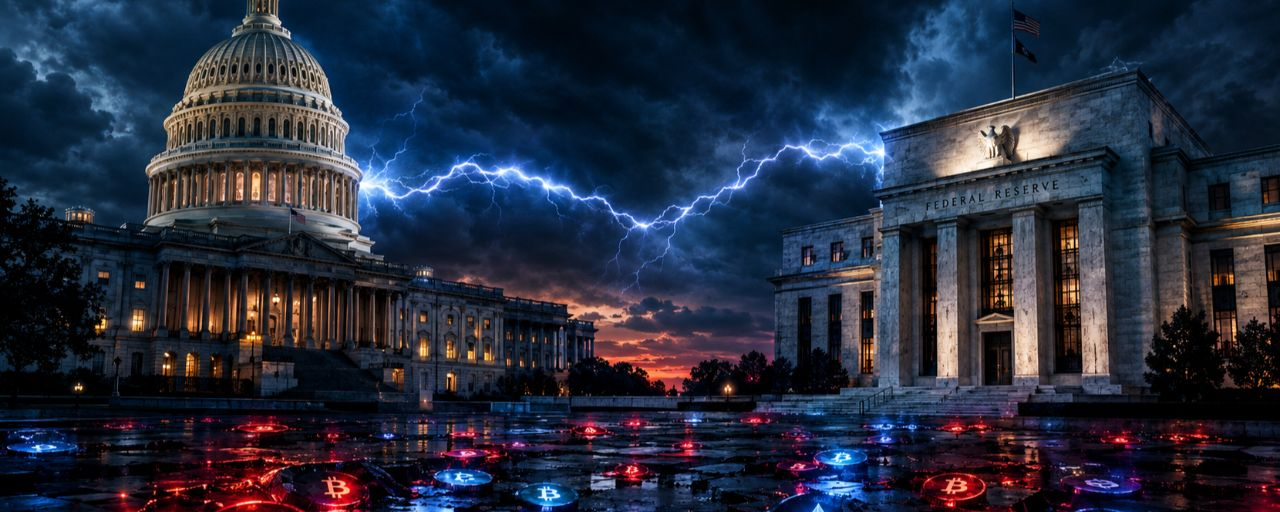
Yesterday, the U.S. Senate killed the CLARITY Act. Today, the Federal Reserve is expected to raise interest rates for the first time in three years. Two of the three biggest catalysts crypto has faced all year landed back-to-back, and the market's reaction has been brutal: Bitcoin down to $76,700, XRP down 7.3%, Coinbase stock down 9%, Circle down over 10%. This is the story of crypto's roughest 48 hours of 2026 — and why some of the industry's biggest names are calling the chaos a strange kind of good news.
Macro Factors: A Rate Hike Nobody Wanted But Everybody Expected
The Federal Reserve's two-day policy meeting concludes today with a decision due at 2:00 p.m. ET, and virtually every major bank on Wall Street — Goldman Sachs, JPMorgan, Morgan Stanley, Bank of America, Citigroup, Wells Fargo, UBS, HSBC, and Barclays — expects a 25-basis-point hike, which would lift the federal funds target range from 3.50–3.75% to 3.75–4.00%. The shift traces back to August's inflation CPI came in at 3.4% year-over-year with a hotter-than-expected 0.4% monthly increase, while the Producer Price Index hit 5.4%, driven heavily by a 3.9% jump in petrol prices. CME FedWatch now prices a 93% probability of the hike, and futures markets flipped dramatically in the days following the September 11 CPI release. Bitcoin has been whipsawing through this uncertainty all week, touching $79,579 on Monday before sliding to a low of $75,560 — its weakest level since August 21 — as traders priced in both the rate decision and the Senate's crypto legislation fight simultaneously.
Institutional Moves: Buying the Panic, Again
Despite the two-front pressure, institutional buyers haven't abandoned ship. U.S. spot Bitcoin ETFs recorded $159.9 million in net inflows on September 14 alone, led by BlackRock's IBIT with $134.3 million, followed by Fidelity's FBTC at $53.3 million and Morgan Stanley's MSBT at $9.7 million — a clear signal that some large allocators are treating this week's volatility as a buying opportunity rather than a reason to retreat. That said, not everyone is playing the same game: crypto-adjacent equities took a beating yesterday as the CLARITY Act vote failed, with Coinbase sliding nearly 9% to $174.80 and Circle collapsing more than 10% to $87.51, reflecting how directly exposed publicly traded crypto infrastructure companies are to U.S. regulatory outcomes compared to the underlying tokens themselves. Michael Saylor's Strategy, meanwhile, used the moment to reinforce its long-standing thesis, arguing that Bitcoin has had adequate regulatory clarity through the CFTC for years regardless of what happens with broader market-structure legislation.
On-Chain and Whale Behavior: Liquidations Everywhere, Except in One Corner
The past 48 hours have been a liquidation bloodbath across leveraged crypto positions. Over 79,000 traders were liquidated in a single 24-hour window heading into today's Fed decision, with total losses reaching $337.75 million, while a separate burst of short-covering earlier in the week saw over $100 million in short positions wiped out in just 30 minutes as Bitcoin briefly spiked above $79,000. Options markets are reflecting the fear directly: Bitcoin's put options are now pricier than calls across both 7-day and 30-day tenors, with the 7-day 25-delta skew swinging by over 3 volatility points week-over-week — traders are actively paying up for downside protection through this week's back-to-back macro and regulatory events. Yet amid all this stress, one corner of the market has stayed almost eerily calm: Zcash and Monero remain the only large-cap cryptocurrencies trending higher, a divergence analysts say would confirm a genuine structural rotation into privacy assets if it survives both today's Fed decision and tomorrow's Bank of Japan meeting.
Regulation: The Bill That Needed 60 and Got 50
The CLARITY Act's failure yesterday closes out a saga that began back in May 2025, when the bill was first introduced to establish a regulatory framework splitting digital asset oversight between the SEC and CFTC. It advanced through the Senate Banking Committee in May 2026 by a 15-9 vote, cleared procedural calendar hurdles in June, and even earned a late push from Treasury Secretary Scott Bessent, who explicitly linked the bill to strengthening enforcement authority over a proposed U.S. Bitcoin reserve. But it ultimately fell short on cloture, with only 50 of the required 60 votes secured — meaning at least several Republicans joined Democrats in opposition, driven partly by unresolved concerns over ethics provisions tied to government officials' crypto holdings and banking industry pushback on a stablecoin "circuit breaker" provision. Senator Elizabeth Warren was among the loudest opponents, warning the bill risked unwinding post-Great Depression financial guardrails. The practical result: comprehensive federal crypto market-structure rules likely won't return to serious Senate consideration until 2027 at the earliest, though Brian Armstrong of Coinbase has argued that SEC and CFTC rulemaking could still deliver meaningful clarity even without new legislation.
Outlook: Two Paths, Same Question
Crypto now faces a genuinely bifurcated setup heading into the back half of September. If today's Fed hike lands as a "one-and-done" move with dovish forward guidance from Chair Kevin Warsh, markets could stabilize quickly, treating the CLARITY Act failure as a one-time political disappointment rather than a lasting structural setback — echoing Saylor's view that Bitcoin never really needed the bill in the first place. If instead the Fed signals further tightening ahead of tomorrow's Bank of Japan decision, the combination of higher-for-longer U.S. rates and unresolved crypto regulation could extend this week's selloff meaningfully, particularly for high-beta altcoins like Solana and regulation-sensitive assets like XRP. Either way, the fact that Zcash has held its ground through the worst of both storms this week suggests that not every corner of crypto moves on the same macro and political triggers — a genuinely new dynamic for a market long characterized by everything trading in lockstep.
Closing Thought:
Crypto just survived a legislative failure and is about to face a rate hike in the same 24-hour window — and it's still standing. That resilience, more than any single price level, might be the real story of September 16.
Disclaimer: This article is for informational purposes only and does not constitute financial, investment, or legal advice. Cryptocurrency markets are highly volatile and carry significant risk of loss, including losses driven by leverage and liquidations. Always conduct your own research and consult a licensed financial advisor before making investment decisions.
#FedRateWatch #EthereumFallsBelow$2400 #BitcoinSlidesTo$76000 #ClarityActOddsHalveOnPolymarket #US30YTreasuryYieldTops5.40%

The clock is ticking, the market is falling, and there may be no time left to hesitate.