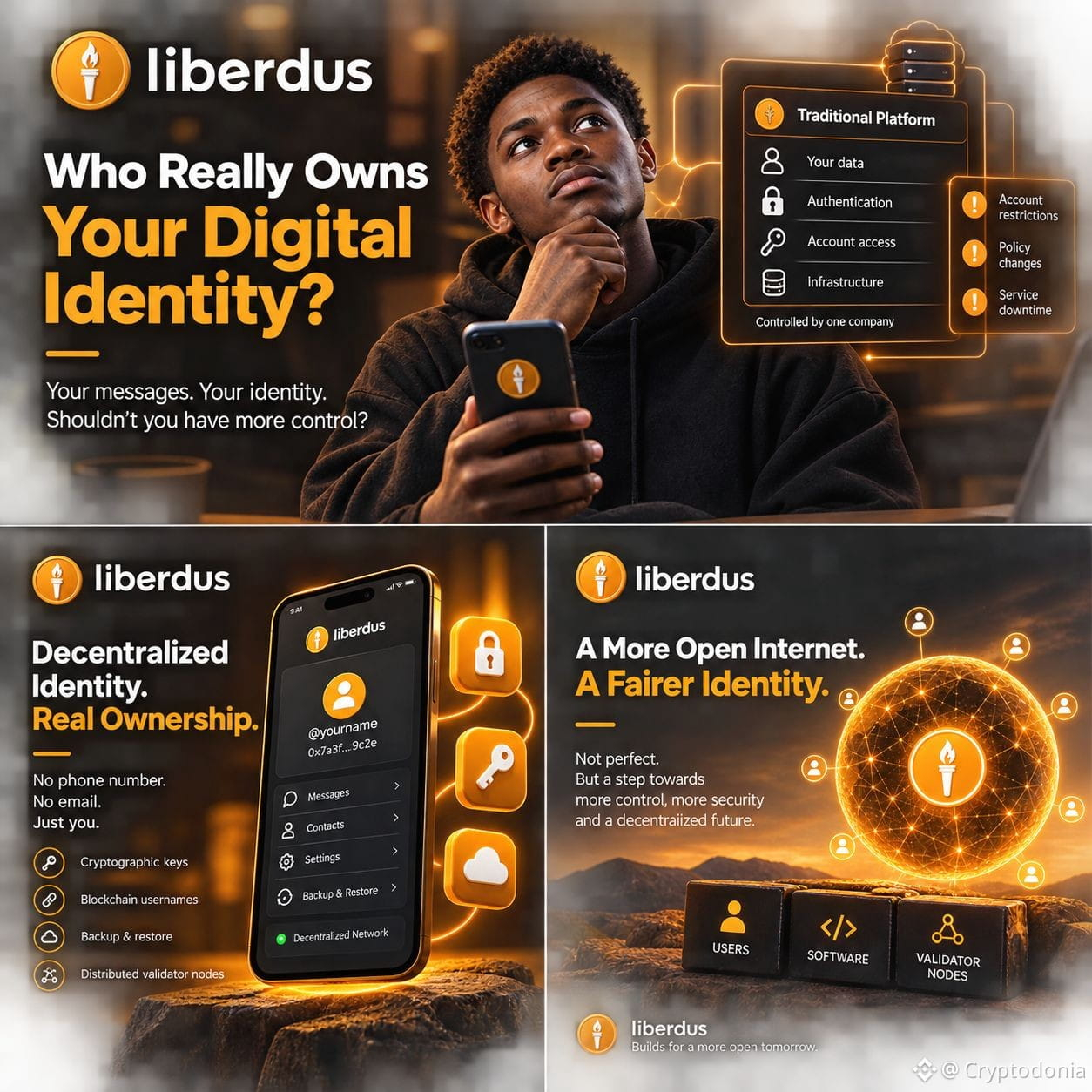
Who really owns the digital identity you use to communicate? We create messaging accounts in seconds, but rarely think about who controls the identity behind them. On centralized platforms, the company manages authentication, account access and the infrastructure connecting you to others. Convenient, yes, but it also means your communication depends on one platform. Decentralized systems are exploring a different model: giving users more direct control while distributing the infrastructure. #Liberdus is one project exploring this approach. Its accounts use cryptographic keys, can be created without a phone number or email, and can be backed up and restored across devices. Its network also uses distributed validator nodes rather than relying on a single central server. Liberdus documentation Decentralization doesn't remove every risk. Users still have responsibility, and technical challenges remain. But it changes an important question: Instead of asking which platform owns your digital identity, what if you had more control over it yourself? As digital identity becomes increasingly connected to our relationships, communities and finances, I think this is a conversation worth paying attention to. #Privacy $XLM #Security $LINK

Posting