
Monday, 31 August 2026 - 14:35 - Kuala Lumpur, Malaysia
@PositiveMindsGlobalResults @Binance Square Official @Binance Earn Official
The cryptocurrency market is entering a fascinating phase: prices are relatively quiet, but capital is still moving beneath the surface.
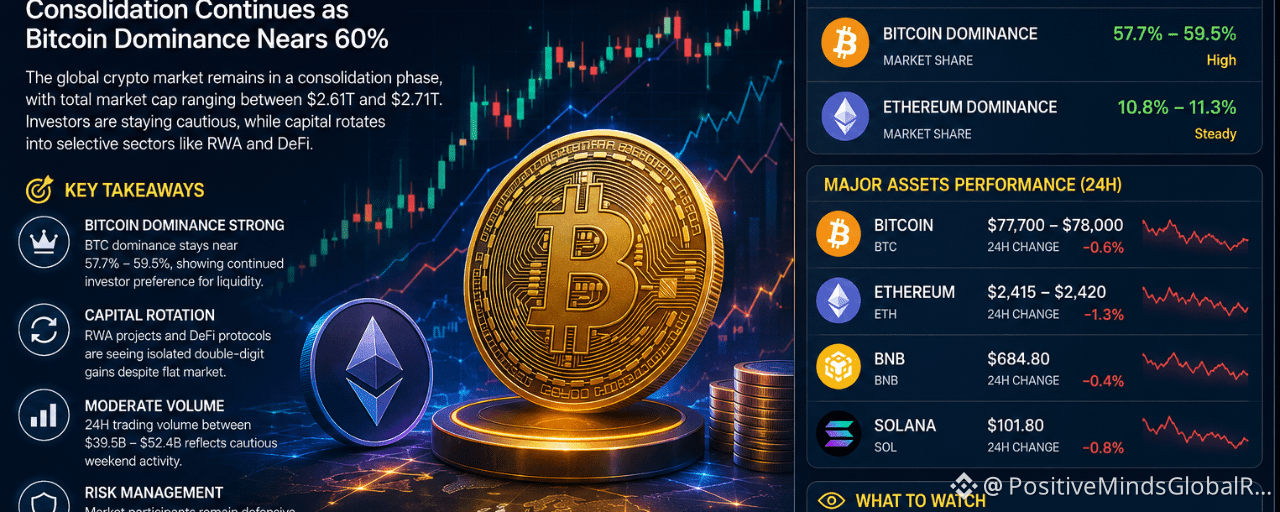
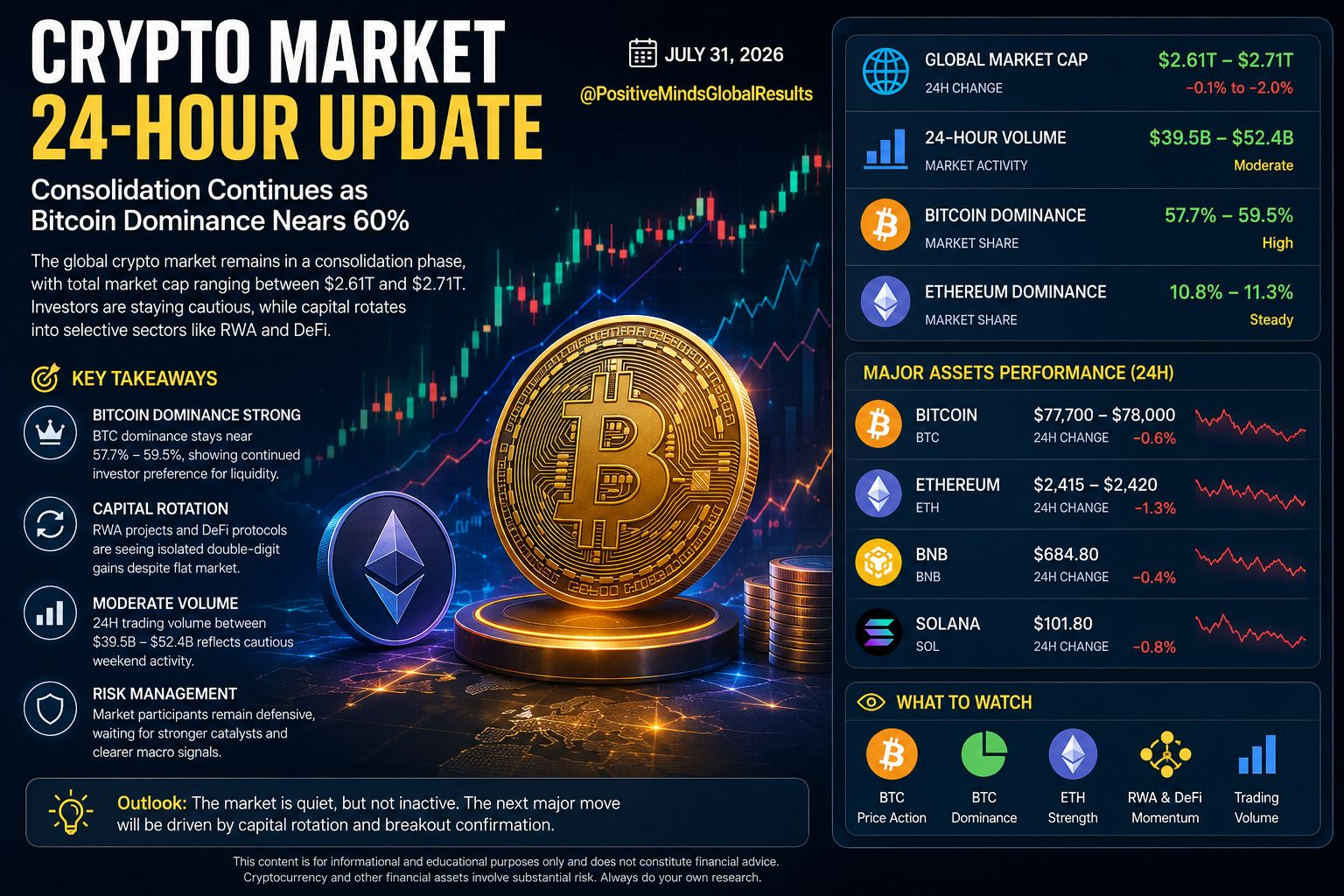
Over the past 24 hours, the global crypto market has largely traded sideways, with total market capitalization fluctuating between approximately $2.61 trillion and $2.71 trillion. The relatively modest movement suggests that investors are taking a cautious approach, digesting recent macroeconomic developments while waiting for the next major catalyst.
Trading volume has remained around $39.5 billion–$52.4 billion, reflecting moderate liquidity and a market that appears more focused on consolidation than aggressive expansion.
But the calm may not last.
Bitcoin Near $78,000: Consolidation or Preparation for the Next Move?
Bitcoin (BTC) remains the dominant force in the cryptocurrency market, trading around $77,700–$78,000.
After its recent pullback, Bitcoin has entered a period of consolidation as traders reassess market valuations, investment flows and the broader economic environment.
The key question now is simple:
Is Bitcoin building a base for another move higher—or is the market waiting for another correction?
At the moment, there is no clear confirmation of either scenario.
Bitcoin's dominance remains exceptionally strong at approximately 57.7%–59.5%, demonstrating that investors continue to favor the market's largest and most liquid digital asset.
High BTC dominance often reflects a more defensive environment. Rather than aggressively chasing smaller altcoins, investors appear to be concentrating liquidity in Bitcoin while waiting for greater confidence.
Ethereum Struggles to Generate Strong Momentum
Ethereum (ETH) is trading around $2,415–$2,420, with a relatively modest 24-hour decline of approximately 1%–1.7%.
Ethereum's dominance remains near 10.8%–11.3%.
While ETH continues to maintain its position as the second-largest cryptocurrency, its current price action suggests that the market has not yet entered a strong broad-based altcoin rotation.
For Ethereum to become a stronger market leader, investors will likely be watching for improving relative strength, increasing volume and sustained capital inflows.
BNB and Solana Remain in the Waiting Zone
BNB is holding near $684.80, while Solana (SOL) is trading around $101.80.
Both remain important indicators of broader risk appetite.
If major altcoins begin outperforming Bitcoin while BTC dominance declines, it could signal that investors are becoming increasingly willing to move further along the risk curve.
However, continued sideways trading would suggest that the market remains in a defensive consolidation phase.
Moderate Volume: Why It Matters
The estimated $39.5 billion–$52.4 billion in 24-hour trading volume indicates that liquidity remains active but not exceptionally aggressive.
This matters because low-to-moderate liquidity can make short-term price movements less reliable. A sudden move in either direction without significant volume may represent temporary positioning rather than a confirmed trend reversal.
For that reason, traders may be watching volume confirmation as closely as price itself.
A breakout accompanied by substantially higher volume would generally provide a stronger signal than a breakout occurring in thin market conditions.
The Hidden Story: Capital Rotation
Perhaps the most interesting development is not happening in Bitcoin.
While BTC and ETH remain relatively range-bound, certain areas of the cryptocurrency market—including Real-World Assets (RWA) and selected DeFi protocols—are attracting concentrated attention.
Some projects in these sectors have recorded isolated double-digit gains despite the broader market remaining relatively flat.
That divergence is worth watching.
It suggests that investors may not be abandoning the cryptocurrency market. Instead, they could be becoming more selective about where capital is deployed.
Rather than buying the entire market, investors may increasingly favor projects with identifiable utility, strong narratives, institutional relevance and real-world applications.
Why RWA Could Become an Important Narrative
The Real-World Asset (RWA) sector represents one of the most significant connections between traditional finance and blockchain technology.
The underlying concept is straightforward: bring traditional financial assets and other forms of real-world value onto blockchain infrastructure.
This could potentially improve transparency, programmability, settlement efficiency and accessibility.
As financial institutions explore tokenization, RWA-related blockchain infrastructure could become an increasingly important area of the digital-asset ecosystem.
At the same time, DeFi continues to develop decentralized financial applications involving trading, lending, liquidity and other financial services.
The combination of RWA and DeFi could create an increasingly sophisticated digital financial ecosystem.
Five Signals Crypto Investors Should Watch
1. Bitcoin's $78K Zone
Bitcoin's ability to establish a sustained move above or below its current trading range could provide the market with its next major directional signal.
2. Bitcoin Dominance
BTC dominance near 60% remains a major indicator.
If dominance continues rising, capital may remain concentrated in Bitcoin.
If dominance begins falling while BTC remains stable or rises, it could be an early signal of increasing appetite for Ethereum and altcoins.
3. Ethereum's Relative Strength
ETH's performance against Bitcoin will be important.
A sustained improvement in ETH relative strength could indicate that investors are beginning to expand beyond the largest cryptocurrency.
4. RWA and DeFi Momentum
If RWA and DeFi projects continue attracting capital while the broader market remains flat, it could reveal where investors believe the next major growth opportunities are developing.
5. Trading Volume
Price movements become more significant when supported by strong liquidity and rising trading activity.
A high-volume breakout could therefore be considerably more meaningful than a low-volume price spike.
The Bigger Picture: Quiet Markets Can Hide Major Shifts
The current crypto market does not necessarily look like a market preparing for an immediate collapse.
Instead, it looks like a market waiting for confirmation.
Investors are balancing several competing forces: liquidity, macroeconomic conditions, Bitcoin's market dominance, institutional participation, risk appetite and emerging blockchain narratives.
With total market capitalization around $2.6–$2.7 trillion, Bitcoin near $78,000, and major altcoins largely range-bound, the market remains at an important decision point.
But beneath the surface, the movement of capital may be more important than the movement of prices.
The Real Question Is Not "Will Crypto Move?"
The more important question is:
Where will the money go when investors decide the waiting period is over?
If Bitcoin breaks higher while dominance eventually declines, the market could enter a broader phase of capital rotation toward Ethereum, altcoins, RWA and DeFi.
If Bitcoin loses important support while liquidity remains weak, investors could instead become even more defensive and concentrate capital in the most liquid assets.
For now, crypto is quiet—but it is far from inactive.
The next major opportunity may not come from simply predicting Bitcoin's next candle. It may come from identifying where capital is quietly moving before the broader market notices.
@PositiveMindsGlobalResults
This article is for informational and educational purposes only and does not constitute financial advice. Cryptocurrency and other financial assets involve substantial risk. Investors should conduct their own research and consider their individual risk tolerance before making investment decisions.
$BNB
$BTC