
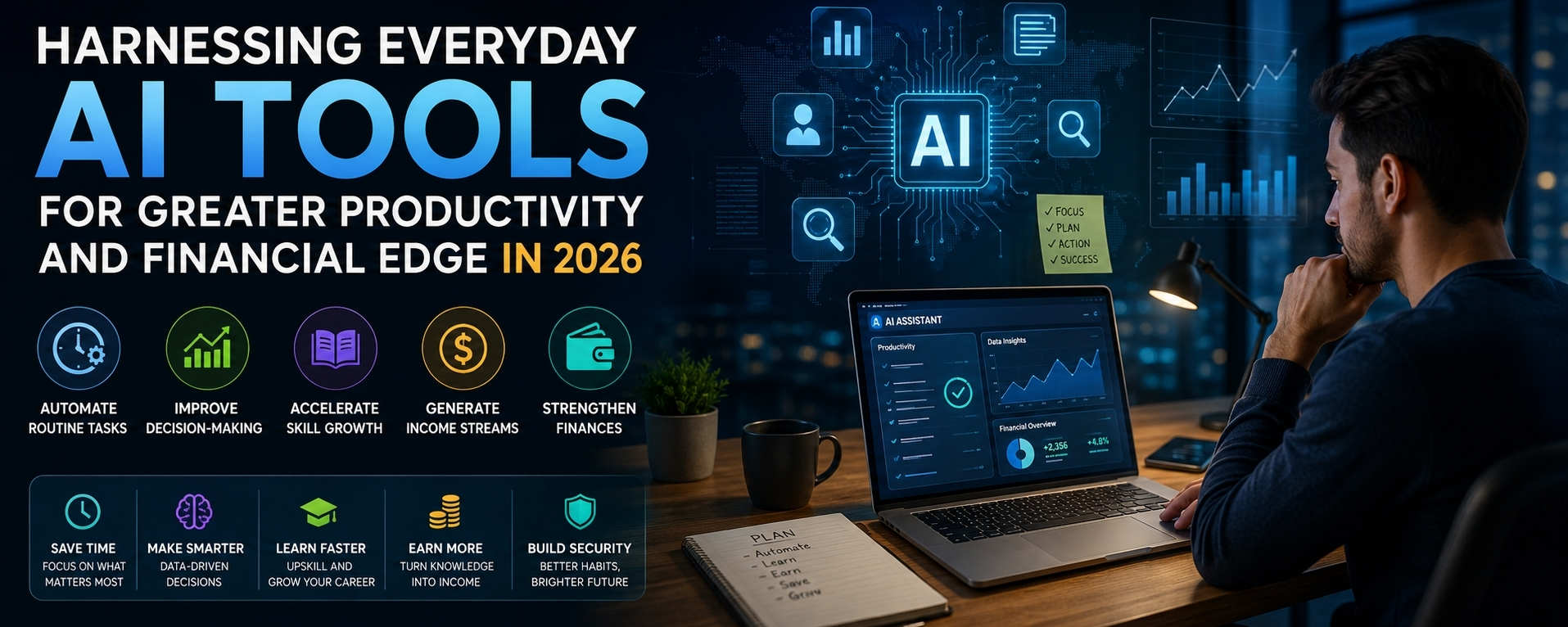

Harnessing Everyday AI Tools for Greater Productivity and Financial Edge in 2026
In an era where artificial intelligence continues to advance rapidly—powering everything from advanced language models to specialized productivity platforms—ordinary individuals now have unprecedented access to tools that can save time, reduce costs, and open new income streams. As of late August 2026, with tech companies reporting sustained growth and hundreds of millions of users integrating AI into daily workflows, the opportunity to turn these capabilities into tangible personal benefits has never been clearer. This article outlines practical, professional strategies for leveraging accessible AI to improve efficiency, enhance decision-making, and create measurable value in work and personal finances.
1. Automate Routine Tasks to Reclaim Time
Many professionals spend hours on repetitive work such as email drafting, data organization, scheduling, or basic research. Modern AI assistants can handle these efficiently. For example, tools that summarize long documents, generate polished first drafts of reports or emails, or manage calendars based on priorities free up significant hours each week.
Actionable step: Identify 2–3 time-consuming tasks in your routine. Use free or low-cost AI platforms to create templates or automated workflows. Track the hours saved over two weeks and redirect that time toward high-value activities such as skill development or side projects. Consistent application often yields 5–10 extra productive hours weekly.
2. Improve Decision-Making with Data-Driven Insights
AI excels at analyzing information quickly. Whether evaluating investment options, comparing career opportunities, or planning household budgets, AI can process market data, historical trends, and personalized inputs far faster than manual methods. In periods of economic uncertainty—such as fluctuations in energy prices or interest rate signals—this capability helps individuals make more informed choices.
Actionable step: Feed relevant data (budget figures, job descriptions, or market summaries) into reputable AI tools and request structured comparisons, risk assessments, or scenario projections. Always cross-verify key outputs with primary sources. This approach reduces costly mistakes and supports better long-term planning.
3. Accelerate Skill Acquisition and Career Advancement
Learning new skills has become more efficient. AI tutors, personalized learning paths, and practice generators allow users to master professional competencies—coding, digital marketing, data analysis, language proficiency, or financial literacy—at their own pace. In competitive job markets, rapid upskilling translates directly into better opportunities and higher earning potential.
Actionable step: Select one high-demand skill relevant to your field. Use AI to create a 30-day learning plan with daily exercises, feedback on practice work, and progress tracking. Pair this with free or affordable online resources. Many users report measurable progress within weeks that strengthens resumes or enables freelance work.
4. Generate Supplementary Income Streams
AI lowers barriers to creating digital products, content, or services. Individuals can develop simple tools, write specialized guides, design marketing materials, or offer consulting supported by AI research. Platforms that reward high-quality digital content or freelance marketplaces make monetization realistic for beginners who focus on genuine value.
Actionable step: Identify a niche where you have knowledge or experience. Use AI to outline, draft, refine, and package a useful resource (e.g., a checklist, short course outline, or template pack). Test it with a small audience before scaling. Start modestly—focus on solving a real problem for others rather than chasing trends.
5. Strengthen Personal Financial Habits
AI budgeting and planning tools can analyze spending patterns, suggest optimizations, and model future scenarios (such as the impact of rising fuel or utility costs). Combined with disciplined tracking, these tools help build emergency funds, reduce unnecessary expenses, and allocate resources more effectively toward savings or investments.
Actionable step: Input your monthly income and expenses into a privacy-conscious AI financial assistant. Request categorized insights and a realistic savings plan. Review and adjust monthly. Small, consistent improvements compound significantly over time.
Best Practices for Responsible Use
Prioritize privacy: Prefer tools with strong data protection and avoid sharing sensitive personal or financial details.
Maintain critical thinking: Treat AI outputs as starting points, not final answers. Verify important facts.
Focus on consistency: Occasional use yields limited results; integrating AI into daily or weekly routines delivers compounding benefits.
Stay ethical: Create original value rather than relying solely on generated content for professional or commercial purposes.
The defining advantage in 2026 is accessibility. High-capability AI tools are available to individuals without specialized technical backgrounds or large budgets. Those who treat them as practical partners—automating the mundane, accelerating learning, informing decisions, and supporting income efforts—position themselves for greater control over their time and resources.
Start with one focused application this week. Measure the results. Iterate. Over months, the cumulative gains in productivity, knowledge, and financial resilience can meaningfully improve quality of life. In a rapidly evolving technological landscape, deliberate adoption of these tools remains one of the most straightforward paths to personal advantage.