
Iran's top diplomat says the door to renewed talks with Washington remains open, even as oil markets shrug off the diplomatic thaw and press on with a fifth straight day of losses.
Foreign Minister Abbas Araghchi said on X on Friday that putting diplomacy back on track isn't impossible. He described creative discussions with Qatar's prime minister and foreign minister, Sheikh Mohammed bin Abdulrahman bin Jassim Al Thani, who visited Tehran this week for the first time since the war began in late February.
"It hinges on U.S. understanding of one simple fact: pressure doesn't work," Araghchi wrote, calling on Washington to build trust, speak respectfully and honour its commitments. He offered no further detail.
It's a notably softer tone from a foreign minister who has spent much of the past six months trading barbs with the White House. And it comes despite Washington launching a fresh economic campaign this week designed to squeeze what's left of Iran's finances.
Pakistan, the principal mediator in the conflict, sent a delegation to Tehran on Monday; officials from Oman and Qatar followed later in the week. Iraq, for its part, is now offering crude buyers the option of collecting supplies from outside the Gulf altogether, a sign, if nothing else, that exporters aren't waiting around for the Strait to fully reopen.
Oil shared the optimism. Brent crude closed down 0.5% on Friday, capping a week in which the benchmark shed 4.93%. WTI slipped a more modest 0.11% on the day but still finished the week down 4.6%.
Behind the price action sits a genuinely messier supply picture. Goldman Sachs says total exports of crude and refined products out of the Gulf region have climbed to between 15 million and 16 million barrels a day, roughly two-thirds of pre-war levels, according to analysts Daan Struyven and Yulia Zhestkova Grigsby.
That's still 7 million to 8 million barrels short of where things stood before the conflict, though well above the 5 million-to-6 million-barrel trough hit in March. Worth separating out: Goldman's own numbers suggest the volume moving specifically through the Strait of Hormuz is closer to the 8 million-to-10 million-barrel range cited by US officials, a narrower figure than the Gulf-wide total and one easy to conflate with it.
Dark crossings by specialised shippers and a jump in ship-to-ship transfers are doing much of the heavy lifting. Producers are adapting, in other words, whether or not the Strait has formally reopened.
Is it working? CENTCOM certainly thinks its part is. Commander Adm. Brad Cooper announced Thursday that US forces have swept the Strait's internationally recognised shipping lanes clear of Iranian sea mines, calling it a major milestone achieved by Navy divers, SEALs and air power over several months of quiet, careful work.
CENTCOM says US forces have escorted almost 1,500 commercial vessels through the waterway during that stretch, moving close to 750 million barrels of crude towards global markets, though those numbers come from the military itself and haven't been independently verified vessel by vessel.
But even with the mines gone, actual traffic remains a fraction of what it once was. Lloyd's List Intelligence logged 114 transits in the week to August 23, up more than 30% on the week before, yet tracking estimates still put current volumes at somewhere between 5% and 15% of pre-crisis levels, nowhere close to the roughly 100-plus vessels a day the Strait handled before the war.
Part of the difficulty is that a good chunk of the traffic simply isn't visible. Tankers routinely switch off their satellite transponders, going dark, in industry parlance, to slip through undetected, which makes true flow through Hormuz hard to pin down with any precision.
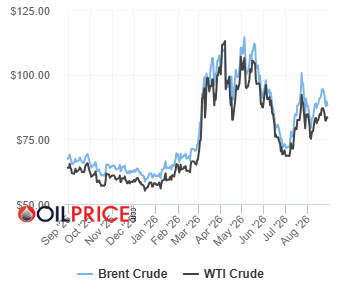
Traders told Bloomberg this week that somewhere between 6 million and 8 million barrels a day are transiting the Strait right now. Whatever the exact figure, it's enough to have helped drag prices down from more than $120 a barrel in April to around $89 today.
Crude is one thing. Gas and refined fuels are another story entirely. Flows of liquefied natural gas and refined products out of the Gulf remain well below crude's recovery. Qatar has extended a force majeure on LNG supplies to European and Asian buyers by another month, and Goldman flagged greater price upside risk on that side of the ledger than on crude, should disruptions persist.
Trump, for his part, insists the Strait is open, pointing to 24 boats that moved through the waterway overnight as evidence conditions are turning a corner. He cast Iran as the party now angling for a deal, saying Tehran was begging for negotiations, though he added he has no interest in sitting down with Iranian officials himself.
CENTCOM says the naval blockade has been total: not a single barrel of Iranian oil has left the country's shores since it took hold in mid-July, cutting off a revenue stream Tehran can ill afford to lose the longer the standoff runs.
Iran's Revolutionary Guard Navy wasn't buying Washington's version of events either, calling the claim that the Strait is open "an obvious lie" and insisting it retains full control of the waterway. Iranian lawmaker Amir Hayatmoghadam wasn't having it. Iran controls the Strait, he said on Thursday, and vessels from the United States, France, Britain or other hostile countries won't be entering the region.
President Masoud Pezeshkian struck a more conciliatory note towards Iran's neighbours, saying Tehran is ready for cooperation and understanding with Saudi Arabia and the UAE, and that Iran has agreed internally on a route through the Strait a position he said an Omani official shares, based on the framework set out in the Islamabad agreement.
A fuller reopening, Pezeshkian added, depends on Washington meeting Iran's conditions, among them relief from fuel and petrochemical sanctions, the release of frozen funds, and a resumption of foreign investment.
Negotiations shouldn't be viewed in black-and-white terms, he said, while warning that the war has deepened Iran's fuel shortage and that sanctions combined with the blockade have cut the country's exports and imports by as much as 35%.
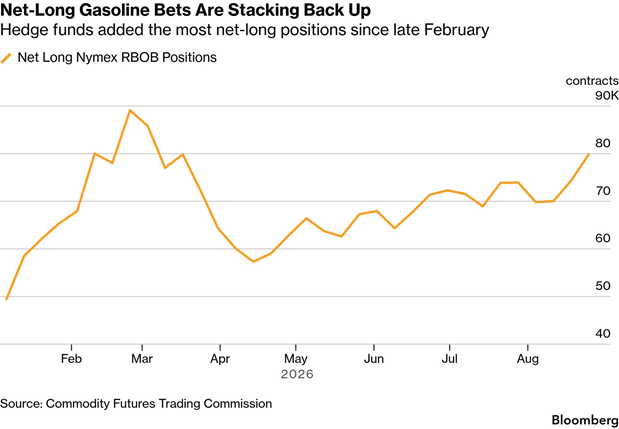
Fuel markets are feeling all of this. Hedge funds boosted their bullish bets on US gasoline by the most since the conflict began six months ago, according to CFTC positioning data. Diesel remains the more acute problem, squeezed by both the drop in Hormuz voyages and a fresh wave of Ukrainian strikes on Russian refineries, but gasoline has tightened sharply too. US stockpiles have fallen to their lowest seasonal level since 2012, according to EIA figures, leaving the market with little cushion heading into whatever comes next.