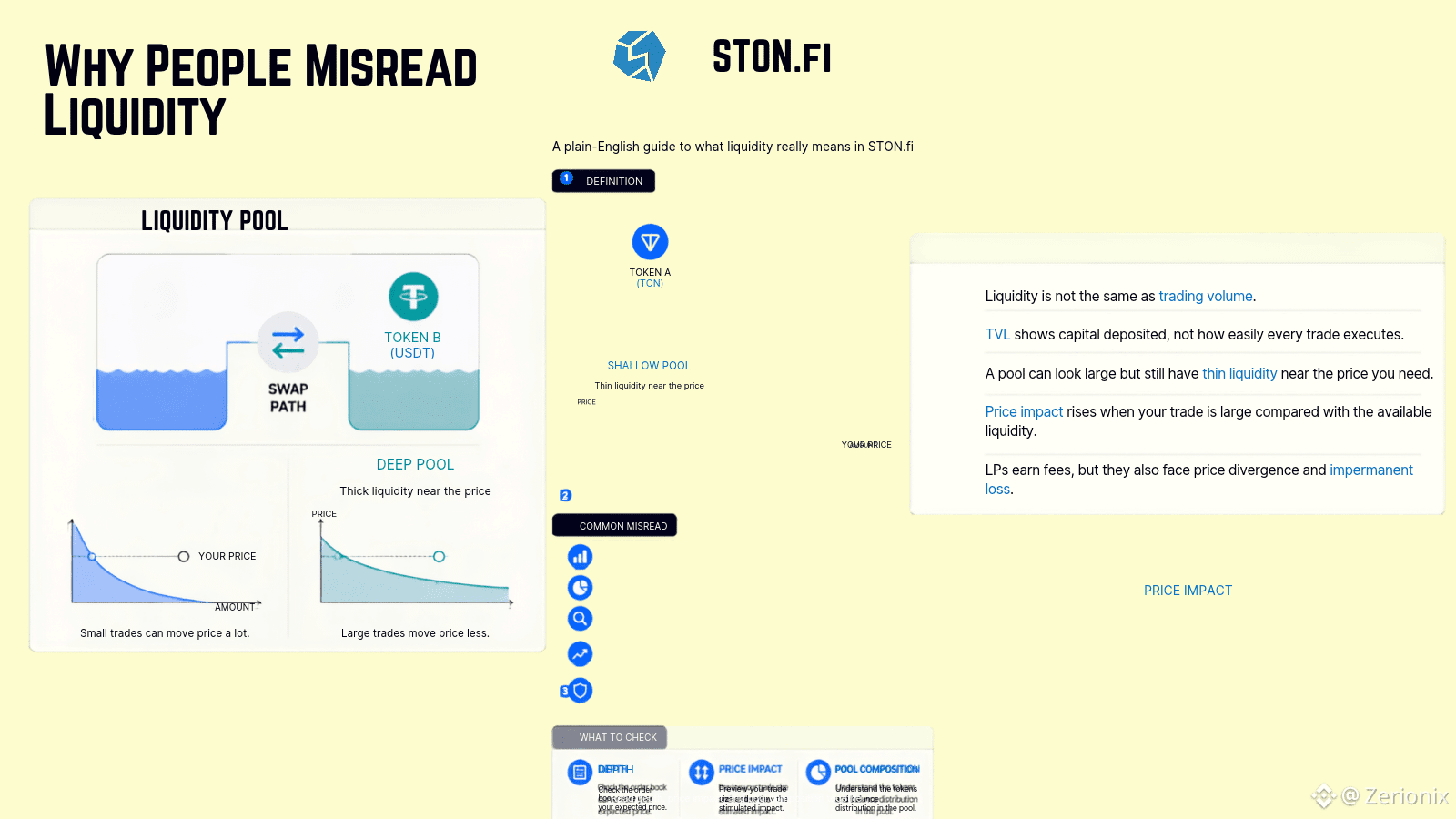
Liquidity is one of the most misunderstood concepts in DeFi. People see a high TVL number and assume the pool can handle size. In reality, TVL is often a lagging and incomplete signal. What matters more is active liquidity — how much is actually available near the current price, how concentrated it is, and how quickly it moves when volatility hits. A pool can show impressive total value while still delivering painful slippage on anything beyond a small trade. Thin order books disguised as deep TVL are common. This misreading shows up constantly. Traders enter size based on the headline number, then watch execution deteriorate. Liquidity providers stay in pools that look large but generate little real fee income because most of the capital sits idle outside the active range. Better questions exist. How much volume does the pool actually process relative to its size? How does price impact behave at different trade sizes? Is the liquidity concentrated or passive? On platforms like STON.fi , where volume is heavily concentrated, these questions become easier to answer because the activity is visible and consistent rather than fragmented across thin venues. Liquidity is not a static number. It is a behavior. Treating it as a simple TVL figure is one of the faster ways to overpay for both entries and exits. 👉 Explore pools and volume on @ston_fi → https://ston.fi 👉 Read more → https://blog.ston.fi/ $BTC $XAUt #Altcoin Season# #Meme Alpha#

Posting

--