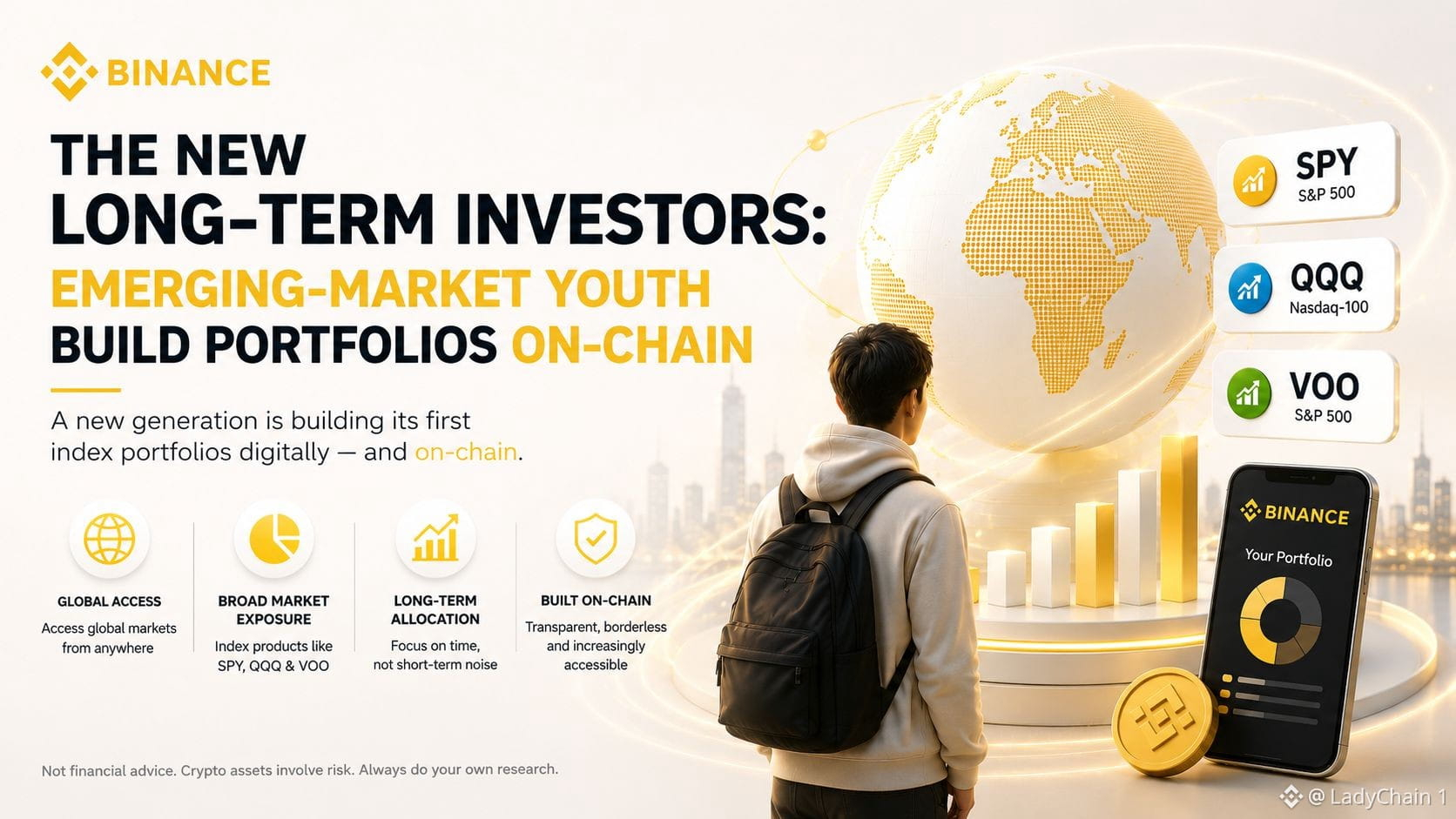
The New Long-Term Investors: Emerging-Market Youth Build Portfolios On-Chain Long-term wealth allocation is no longer only the preserve of the developed-market middle class. For decades, building a portfolio of broad-based index products required access to international brokerages, mature financial infrastructure, and markets where global equities were easily available. For many young people in emerging markets, those barriers made long-term investing more difficult. That is beginning to change. A new generation is gaining access to long-term portfolio exposure through digital and on-chain infrastructure. For some, products linked to broad market indexes, including SPY, QQQ, and VOO, represent a starting point for thinking beyond short-term trading. The principle is simple: diversification. Instead of trying to identify a single winning company or constantly chasing the next market narrative, broad-based index products can provide exposure to a larger segment of the market. The idea is not new. What is new is who can increasingly access it. Young people who grew up with smartphones, crypto, digital wallets, and global platforms may build their first long-term portfolios through infrastructure very different from the traditional brokerage system. This does not eliminate risk. Markets can decline, product structures vary, and availability depends on local regulations and platform access. But the structural shift matters. For the first time, a generation from markets that were historically less connected to global capital markets is gaining new pathways toward diversified, long-term portfolio construction. The bigger story is not only about SPY, QQQ, or VOO. It is about access. A globally diversified portfolio is becoming less dependent on being born in a market with mature financial infrastructure. For the new long-term investor, the journey may not begin at a traditional brokerage. It may begin digitally — and increasingly, on-chain. NFA.

Posting