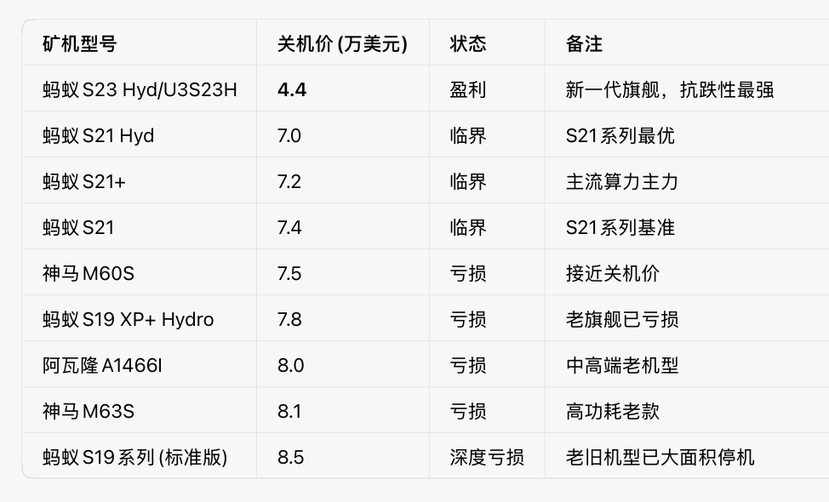
Kesimpulan inti: Harga mati mesin BTC mainstream (0,08 dolar/derajat) pada tahun 2026 terikat di 69.000-74.000 dolar AS.
Dengan institusionalisasi industri + iterasi daya, deviasi harga mati di dasar pasar beruang semakin menyempit menjadi 5%-10%, kisaran dasar kali ini diperkirakan antara 55.000-70.000 dolar AS, dan dukungan dasar menjadi lebih 'kuat'.
Verifikasi pola sejarah, dasar pasar beruang pasti akan sementara menembus garis biaya mesin utama, setelah pembersihan daya + penyesuaian kesulitan, harga akan kembali ke harga mati, dan harga absolut dasar akan terus meningkat seiring dengan kematangan industri.
Satu, harga mati mesin BTC saat ini (Februari 2026)
Dengan tarif listrik 0,08 dolar/derajat dan tarif kolam 5% sebagai basis perhitungan inti (harga mati = (konsumsi listrik harian mesin × tarif listrik) ÷ (produksi BTC harian × 95%)), seluruh mesin di jaringan membentuk jajaran biaya yang jelas berdasarkan efisiensi, daya utama terkonsentrasi di zona harga mati kritis:
1. High-end new models (Antminer S23 Hyd/U3S23H): shutdown price $44,000, currently profitable, and has the best resilience in the network;
2. Mainstream computing power backbone (Antminer S21 series): shutdown price $69,000 - $74,000, accounts for a large portion of overall network computing power, at the critical shutdown node;
3. Mid-to-high-end old models (神马M60S/Antminer S19 XP+ Hydro, etc.): shutdown price $75,000 - $80,000, has small losses, and is close to shutting down;
4. Old models (Antminer S19 standard version): shutdown price $85,000, deeply in loss, has largely stopped operating to clear.
Core feature: Shutdown price is not a fixed value, it dynamically adjusts with the overall network computing power difficulty, electricity costs, and BTC block rewards, and after halving, block rewards are halved, which will significantly push the shutdown price upwards.
Two, three cycles: historical evolution laws of the bear market bottom and shutdown price
The two bear markets of 2018 and 2022 verified the core logic that 'shutdown price is the core cost anchor, bottom breaches the cost line, and deviation narrows with industry maturity'. Specific characteristics and differences are as follows:
2018 Bear Market (Bottom $3,200)
Mainstream mining machines (S9) shutdown price is about $4,000, the bottom is 20% lower than the shutdown price, lasting 2-3 months; at that time, the industry was mainly retail, with high-cost miners concentrated on clearing, and the overall network computing power plummeted. Only after a significant reduction in difficulty did prices stabilize and bottom out, making the bottoming cycle longer.
2022 Bear Market (Bottom $15,500)
Mainstream mining machines (S19 series) shutdown price is about $18,000, the bottom is 14% lower than the shutdown price; the deviation is narrower by 6 percentage points than in 2018; institutional miners are increasing their share, computing power de-escalation is milder, and after difficulty is lowered, prices quickly return to shutdown prices, significantly improving bottom rebound efficiency.
2026 Cycle (projecting bottom $55,000 - $70,000)
Mainstream mining machines (S21 series) shutdown price $69,000 - $74,000, the bottom is expected to be 5%-10% lower than the shutdown price, and the deviation is further narrowing; the degree of industry institutionalization deepens, computing power iteration accelerates, combined with institutional funds supporting the bottom, computing power de-escalation will be smoother, bottom support will be stronger, and the bottoming cycle may further shorten.
Commonality and core trends
1. Commonality: The bear market bottom will inevitably briefly breach the current mainstream mining machine shutdown price. After breaching, it triggers a closed loop of 'high-cost mining machines clearing → computing power falling → difficulty lowering → shutdown price moving down → new support forming';
2. Trend: As computing power iterates, mining becomes institutionalized, and electricity prices vary by region, the deviation of the bottom from the shutdown price continues to narrow (20% → 14% → 5%-10%), and the absolute price of the bear market bottom shows a stepped upward trend ($3,200 → $15,500 → $55,000 - $70,000).
Three, the core logic of shutdown price and bear market bottom
1. The shutdown price is the core support line for computing power, not an absolute iron bottom: short-term market sentiment and liquidity shocks may lead to a significant breach of the shutdown price, but this state does not have sustainability, and continued breaches will trigger passive contraction of the entire network's computing power, forming an upward repair force for prices;
2. Three steps in forming the bear market bottom: price breaches mainstream mining machine shutdown price → high-cost, low-efficiency mining machines shut down in batches, computing power clears → overall network computing power difficulty is lowered + miners hold back sales + institutional bottom-fishing funds enter → price rebounds, completing the bottoming process;
3. The hierarchy of mining machines determines the price support gradient: the shutdown price of high-end new models forms the ultimate support for the bear market, mainstream computing power models have shutdown prices as core support, and outdated models have shutdown prices as weak early support. The rhythm of computing power clearing matches well with the hierarchy of mining machines.
Four, key memory points
1. Cost line rule: the shutdown price is the core cost anchor of BTC bear market, the bottom must breach it, the deviation must narrow, and the price must rise;
2. Differences in three cycles: 2018 'deep drop slow grind', 2022 'shallow drop fast bounce', 2026 'slight drop steady support';
3. 2026 Core Judgment: $69,000 - $74,000 is the current core support for computing power, $55,000 - $70,000 is the core range for the bear market bottom. Once breached, the clearing of computing power + institutional support will drive prices back to the cost line quickly.
The overall network weighted average shutdown price is $72,000, and according to this, it also conforms to the above estimates. The more panic there is, the smarter one needs to be; perhaps it is not as bad as everyone imagines!
Bitcoin may form a price bottom near the high point of the previous cycle, around the $60,000 range, with the timing likely falling in the first half of 2026, and then gradually establish a more solid price support range.
Currently, the market's weakness is more likely to be a correction approaching the end rather than the start of a new long crypto winter.
Although volatility in the short term is still hard to avoid, if a reversal occurs as expected in 2026, it may open what Bitcoin calls 'the most critical round of the cycle', with impacts that may even surpass traditional four-year market cycles.