
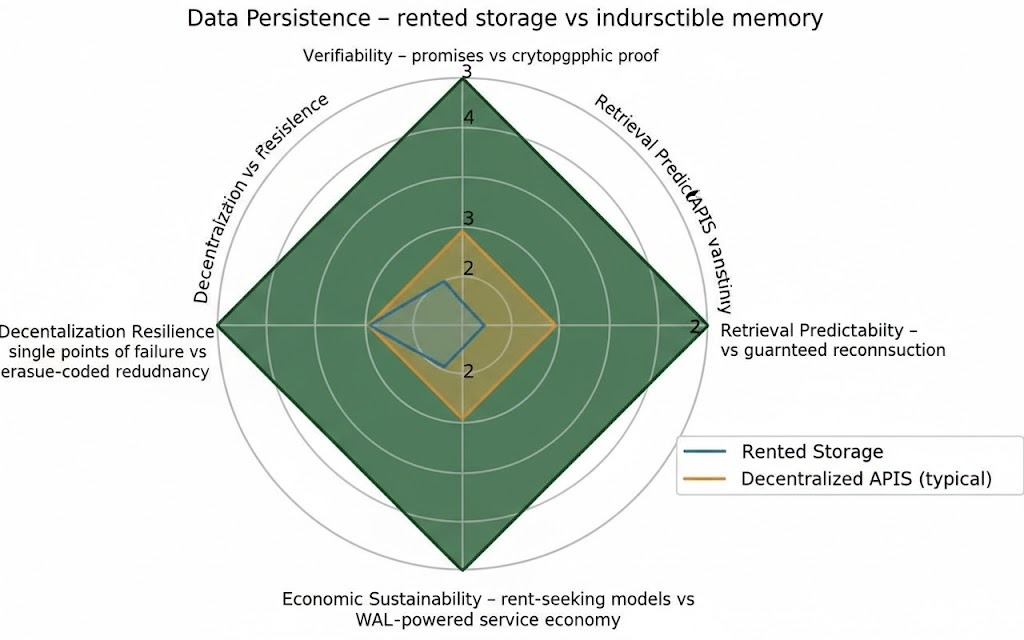
The biggest flaw of the internet is not speed, but fragility. We live in a digital world built on rented storage, where data integrity is a promise, not a guarantee. Connections break, platforms ignore APIs, and vast amounts of cultural memory disappear as cloud service providers go bankrupt. This is not a technological flaw, but a design flaw of centralized networks. The @Walrus 🦭/acc emerged to remedy this flaw, not by creating another dedicated storage layer, but by constructing a completely new, verifiable foundation for data persistence. This is true infrastructure thinking.
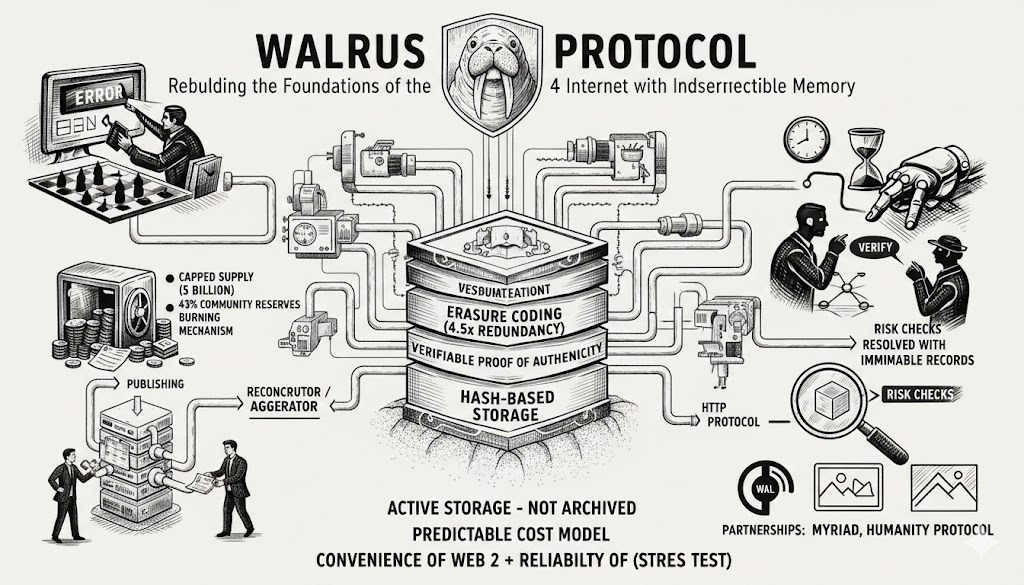
The Walrus Protocol breaks the old paradigm of "decentralized storage," no longer allowing users to directly manage the deletion and restoration of nodes. Instead, it provides an open service economy that simulates the true efficiency of the internet. Publishers are responsible for high-throughput data ingestion, aggregators reconstruct and deliver data via the standard HTTP protocol, and caches optimize read operations to reduce latency. This is not centralization, but specialization with cryptographic security measures. All service roles are open to everyone, and every byte delivered comes with a verifiable proof of authenticity. You'll have both the convenience of Web 2 and the reliability of Web 3.
This architectural transformation is measured in its performance. #Walrus is designed for active storage—data should be kept fresh, not just archived. It employs erasure coding (with a redundancy factor of approximately 4.5x) and hash-based storage, creating a predictable cost model that ensures long-term data availability—a stark contrast to networks that charge for persistence but offer unpredictable retrieval. The recent protocol migration of 250 TB of historical data from Team Liquid was not only an achievement but also a stress test, demonstrating its ability to handle large datasets of active data.
The WAL cryptocurrency is the economic engine of this service layer, designed for practical use, not speculation. Walrus has a capped supply of 5 billion tokens, and its allocation is carefully strategyd to ensure the network's long-term sustainability: 43% is allocated to community reserves, a significant portion for user distribution and operator support, and a burning mechanism to combat deflation. This token is used to pay publisher fees, reward trusted nodes, and ensure network security, thus establishing a closed economic system where value accumulates for users who provide verifiable uptime.
Partnerships like Myriad embody the core of Walrus: it is a record of reality. By linking market evidence (images, videos, and articles) to Walrus, Myriad ensures that disputes are resolved based on immutable records, not on alterable claims. This transforms Walrus from a mere repository into a collective memory infrastructure. Similarly, the migration of millions of credentials from Humanity Protocol to Walrus demonstrates Walrus's role as a pillar of verifiable identity.
The Walrus project represents a mature evolution: it recognizes that building a new Web3 requires addressing the biggest flaws of the old network first. It is building a robust, economically sustainable, and permanently verifiable foundation layer upon which everything else can be built. Its success depends not on the cycle of media hype, but on the enduring reliability of the data we cherish for decades to come.

