#BPIUrgesFinCENExpandStablecoinIDRulesToSecondaryMarketsWriting
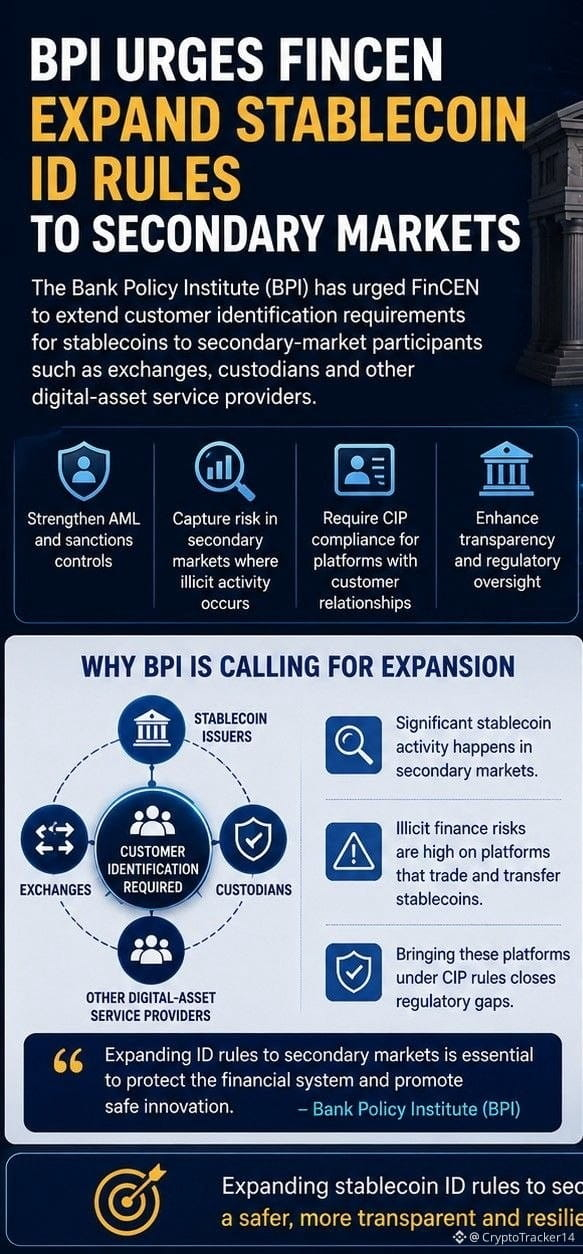
The Bank Policy Institute (BPI) is urging the U.S. Financial Crimes Enforcement Network (FinCEN) to expand customer identification requirements for stablecoins beyond issuers to include secondary-market participants such as crypto exchanges, custodians and other digital-asset service providers.
BPI and The Clearing House argue that these platforms handle a significant share of stablecoin trading and that much illicit activity occurs in secondary markets. They want platforms establishing customer relationships for stablecoin transactions to follow Customer Identification Program (CIP) requirements under the Bank Secrecy Act.
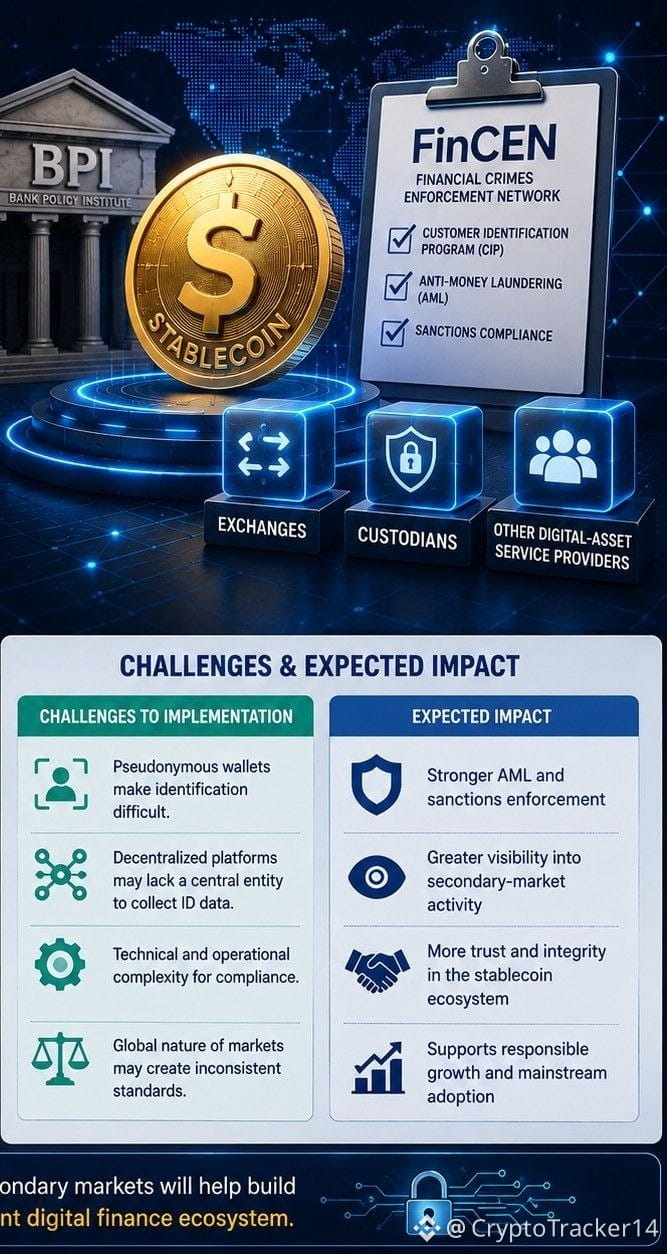
The proposal could strengthen anti-money-laundering and sanctions controls, but implementation may be difficult. Blockchain transactions can involve pseudonymous wallets, while decentralized exchanges may lack a central entity capable of collecting customer information. FinCEN has acknowledged these practical challenges.
If adopted, the approach could significantly increase compliance obligations across the stablecoin ecosystem while giving regulators greater visibility into secondary-market activity. It also reflects growing pressure for consistent KYC and AML standards as stablecoins become more integrated into U.S. payments and financial markets.
The Bank Policy Institute (BPI) is urging the U.S. Financial Crimes Enforcement Network (FinCEN) to expand customer identification requirements for stablecoins beyond issuers to include secondary-market participants such as crypto exchanges, custodians and other digital-asset service providers.
BPI and The Clearing House argue that these platforms handle a significant share of stablecoin trading and that much illicit activity occurs in secondary markets. They want platforms establishing customer relationships for stablecoin transactions to follow Customer Identification Program (CIP) requirements under the Bank Secrecy Act.
The proposal could strengthen anti-money-laundering and sanctions controls, but implementation may be difficult. Blockchain transactions can involve pseudonymous wallets, while decentralized exchanges may lack a central entity capable of collecting customer information. FinCEN has acknowledged these practical challenges.
If adopted, the approach could significantly increase compliance obligations across the stablecoin ecosystem while giving regulators greater visibility into secondary-market activity. It also reflects growing pressure for consistent KYC and AML standards as stablecoins become more integrated into U.S. payments and financial markets.