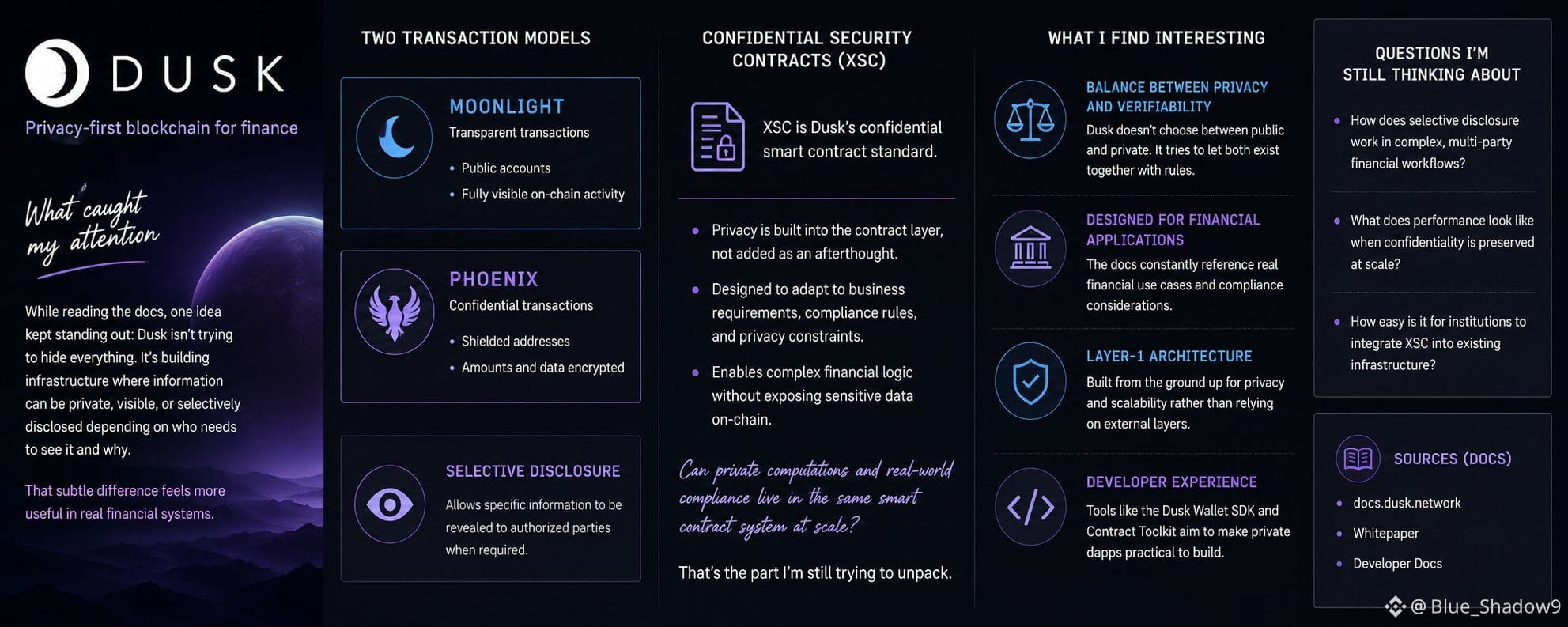

One thing about Dusk kept bothering me in a good way while I was going through the docs: they don’t seem to treat privacy as simply “hide the blockchain.”
@Dusk
The more I looked, the more nuanced it became.
Dusk separates transparent activity through Moonlight from confidential transfers through Phoenix, while also talking about selective disclosure. That last part is what caught my attention. In financial systems, complete secrecy isn’t always useful. Sometimes a transaction has to remain private from the wider network while still being provable to the right party.
That idea also makes the XSC standard more interesting to me. Dusk is trying to give smart contracts a way to operate with confidentiality built into the design, rather than treating privacy like something added afterward.
I’m not sure yet how well all of this translates into real-world financial infrastructure. That’s the part I find more interesting than the usual “privacy blockchain” description.
The architecture raises a bigger question for me: can a blockchain give institutions enough privacy to actually use it, without losing the verifiability that makes blockchains useful in the first place?
That balance is what I’ll be watching.
$DUSK
#dusk
@Dusk
The more I looked, the more nuanced it became.
Dusk separates transparent activity through Moonlight from confidential transfers through Phoenix, while also talking about selective disclosure. That last part is what caught my attention. In financial systems, complete secrecy isn’t always useful. Sometimes a transaction has to remain private from the wider network while still being provable to the right party.
That idea also makes the XSC standard more interesting to me. Dusk is trying to give smart contracts a way to operate with confidentiality built into the design, rather than treating privacy like something added afterward.
I’m not sure yet how well all of this translates into real-world financial infrastructure. That’s the part I find more interesting than the usual “privacy blockchain” description.
The architecture raises a bigger question for me: can a blockchain give institutions enough privacy to actually use it, without losing the verifiability that makes blockchains useful in the first place?
That balance is what I’ll be watching.
$DUSK
#dusk